
For the farmers, tilapia with genetic resistance will lead to a more sustainable and profitable production. After more than five years of R&D and systematical breeding work, GenoMar introduces new disease resistant products addressing one of the most economically important diseases in Nile tilapia. Repeated laboratory tests and a field trial have demonstrated an increased survival of ~ 30% for the tilapia selected for streptococcosis resistance.
Selection based on DNA-information
GenoMar Genetics who manages the breeding and distribution of tilapia genetics under the brands GenoMar, Aquabel and AquaAmerica initiated research back in 2015 with the aim of exploring genetic variation to this deadly disease. Since 2016 resistance to streptococcosis has been routinely included in the selection index of the breeding programs for Nile tilapia. Similar research to increase the survival in other major diseases like columnaris and francisellosis is ongoing.
“Our geneticists can now accurately determine the genetic component in the DNA of tilapia that codes for increased survival towards streptococcosis, and we used this knowledge to optimize the selection decisions leading to animals with higher streptococcosis resistance without negatively affecting other important traits,” says Rajesh Joshi, Senior Researcher in GenoMar Genetics.
Works from day one
The advantage of genetic resistance is that it protects the fish throughout the whole tilapia farming cycle from birth to harvest and does not have application cost.
“This is a particularly important innovation for the control of streptococcosis in the tilapia aquaculture industry which struggles with adoption of vaccination and use of antibiotics. We have managed to prove that genetic resistance is an efficacious and cost-effective new tool against streptococcosis,” says Alejandro Tola Alvarez, CEO in GenoMar Genetics.
30% more survivability for streptococcosis resistant fish
To validate the effectiveness of the genetic selection, laboratory tests and field trials were performed to compare the survival between the selected and non-selected tilapia fish. The relative survival after using two different routes of infection (IP and Cohab) with the bacterium Streptococcus agalactiae were 42% and 25% respectively, for the selected fish. Further, another experiment was performed in Malaysia under field conditions to see whether improved survival in laboratory challenges also applies in commercial farms or not. Results showed increased survival by around 30% for the selected fish (see Figure 1). 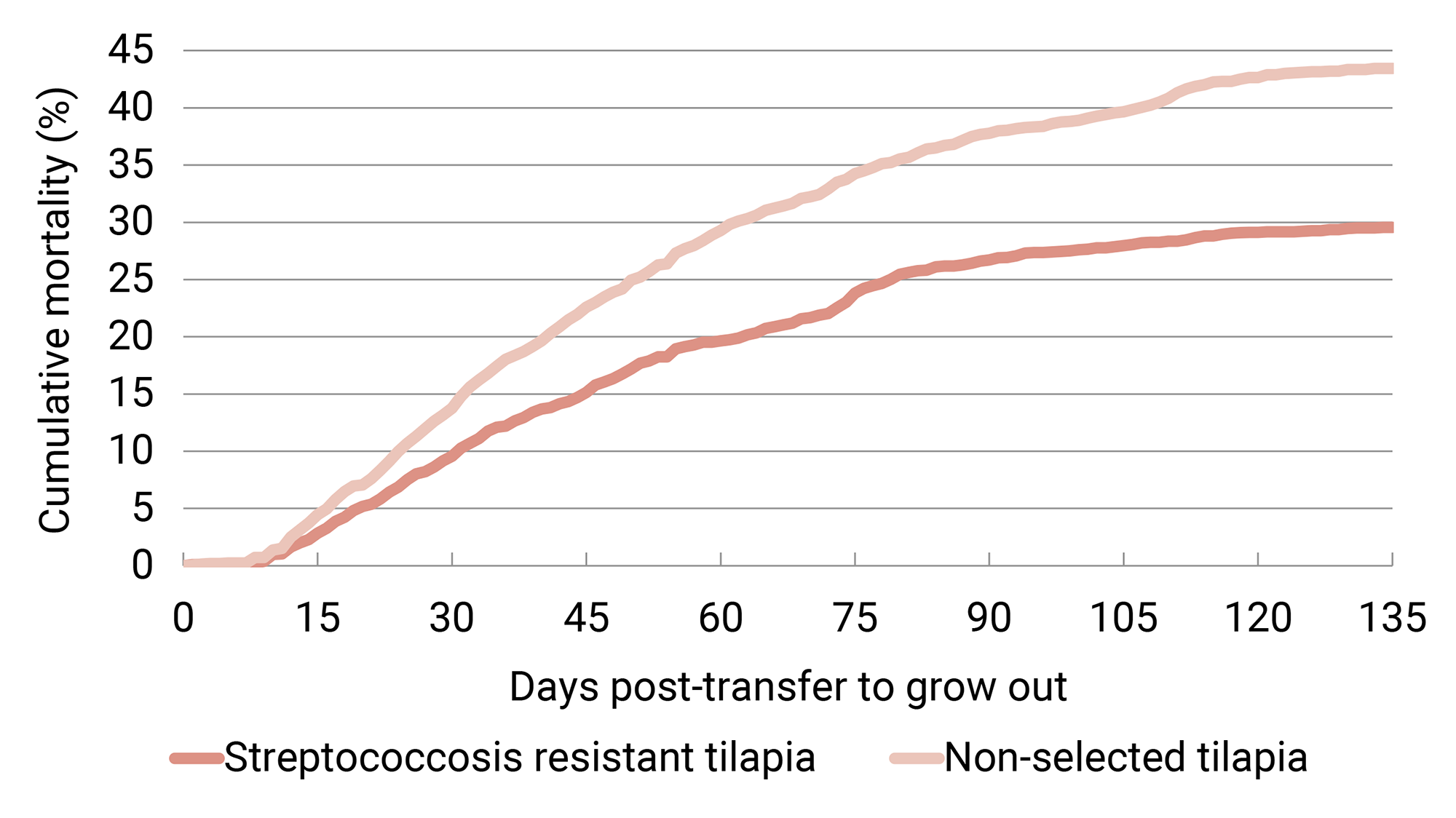
Figure 1. Daily, cumulative mortality in a field trial with tilapia selected for streptococcosis resistance and non-selected tilapia, 135 days post-transfer to grow out. Both groups consisting of around 2000 fish each, were mixed, individually tagged, and raised together in cages at a commercial farm in Malaysia.
First tilapia fingerlings with streptococcosis resistance to farmers in 2021
The first tilapia fingerlings selected for streptococcosis resistance are available to Asian customers under the brand GenoMar from January 2021.
GenoMar Genetics is an international aquaculture breeding and distribution company focusing on
the global tilapia markets. From breeding centers in Norway, Asia, and Latin America, it has innovation and technology programs for some of the most recognised independent brands in the industry such as GenoMar, Aquabel and AquaAmerica. The expanding production infrastructure enables to quickly disseminate genetic progress and supply year-round, high quality stocks to clients contributing to a sustainable and profitable tilapia industry.


