
Indonesian-based startup JALA Tech PTE (JALA) has raised USD6 million in new funding from Mirova, Meloy Fund and Real Tech Fund in November. The start-up uses proprietary hardware and data platforms to transform the shrimp aquaculture business into a more sustainable industry. The new investments came from the Meloy Fund, a US-based fund focused on benefiting coastal ecosystems and managed by Deliberate Capital and Real Tech Fund, Japan’s leading deep-tech focused venture capital fund, and Mirova, Natixis Investment Managers’ affiliate dedicated to sustainable investing, through the Althelia Sustainable Ocean Fund. The company’s current investors include HATCH, based in Norway, Singapore and Hawaii and 500 Global operating in the US and Asia.
JALA develops and provides hardware and software that accurately measure the water quality of shrimp ponds and a platform to visualise and manage the acquired technical and financial data, allowing aquaculture producers to monitor pond conditions and make optimal farm management decisions. The platform is equipped with functions such as shrimp growth information, harvest prediction, financial management and disease alerts. The recommendations provided are generated through an artificial
intelligence model developed by JALA.
JALA also operates a marketplace that directly connects shrimp farmers and processing companies which allow the farmers to become more competitive in the supply chain. Another advantage of the marketplace is that it allows for product traceability, which is becoming increasingly important for today’s consumers – from individuals to large retail and wholesale groups.
JALA supports the optimisation of aquaculture pond operations throughout the whole of Southeast Asia. As of 2021, the platform is being used by more than 6,700 farms, achieving improvements in productivity and feed conversion ratios, and facilitating the monthly trade of 200 tonnes of shrimp. Indonesia is one of the top 5 shrimp producers in the world with China, Ecuador, India and Vietnam.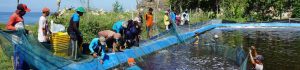
As of today, many issues related to shrimp aquaculture remain unresolved such as pollution caused by the release of farm effluents in rivers and the ocean, disease outbreaks and mortality, inefficient value chains, low value addition for the farmers and limited product traceability. transparency. JALA aims at contributing to solving some of these issues to make the shrimp value chain a more sustainable, transparent, efficient and fair.
In the future, JALA plans to develop or collaborate on auto-feeders, oxygenators, and environmentally friendly recirculating aquaculture systems. The Company will also explore how their ecosystem can contribute to the dissemination of sustainable certification standards for shrimp aquaculture.
The Althelia Sustainable Ocean Fund (“Fundâ€) is a Luxembourg SICAV-SIF authorised by the Commission de Surveillance du Secteur Financier (“CSSFâ€), closed to new subscription. Alter Domus Management Company S.A. is the Alternative Investment
Fund Manager (AIFM) of the Fund and is duly authorised by the CSSF as an alternative investment fund manager pursuant to Chapter 2 of the AIFM Law and the AIFM Directive. Mirova Natural Capital Limited is an investment advisor to Alter Domus
Management Company S.A. The fund is exposed to loss of capital risk, deal flow risk, operational risk, liquidity risk, country risk, market risk, legal and regulatory risk, currency risk, counterparty risk, project risk, valuation risk.
Liris Maduningtyas, Co-founder and CEO JALA said: “We are delighted to receive this new funding, which will be instrumental in helping us achieve our goals of developing new ways to improve the industry and its impact on our society.â€
The funding was made by the Althelia Sustainable Ocean Fund, advised by Mirova Natural Capital, an affiliate of Mirova. Commenting on the new investment, Lisa Hubert, Investment Manager, Althelia Sustainable Ocean Fund: “We are pleased to announce this important investment to contribute to make more sustainable an industry which plays such a significant role in South East Asia. Poor practices have been
common in this area and with this investment in JALA we are backing a business which can make a quantifiable difference to the farmers, the value chain players and the end consumer.â€


