
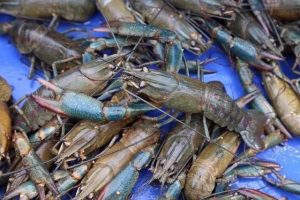
Cambodia’s Ministry of Commerce has flagged “Takeo crayfish†as a potential Geographical Indication (GI), in a bid to build a more substantial reputation around the freshwater crustacean found primarily in the eastern reaches of the southern province of Takeo. This latest contender for the coveted GI tag is a variety of Australian red-claw crayfish Cherax quadricarinatus.
Suon Vichea, director of the ministry’s Department of Intellectual Property Rights, told Phnom Penh Post that the ministry, in collaboration with national and international experts, has organised virtual conferences with the Takeo provincial Department of Commerce and trader representatives on the promotion of the geographical brand and plans for GI registration.
He said the associated team has gathered input from traders and set up an interim committee to compile a booklet that presents a detailed profile on the breeding and rearing of the crustacean, the managing association, internal regulations, the design and layout of the GI logo, and other pertinent information.
“In order to implement this project effectively, the Ministry of Commerce plans to invite traders, stakeholders and local authorities to a workshop later this month to participate in the compilation of the booklet,†he added.
Vichea expects the ministry to complete the preliminary procedures by end-April, leading to the registration of the GI and official recognition. Rim Zip, a Takeo crayfish seller for more than 30 years based in provincial town Donkeo, said that although the lobster-like crustacean has garnered some, it could stand to benefit from GI certification.
He said the crayfish are exclusively found in the wild in eastern Takeo’s Angkor Borei and Borei Cholsar districts, where they are most abundant between August and January, which coincides with much of the rainy season. He added that the crustaceans – farmed or wild has a distinct size and flavour that is very recognisable by national and international tourists.
“Once the Takeo crayfish is designated as a GI, it’ll be one of our vendors’ best-selling products, and its taste will be recognised nationwide,†he said. Zip said that he can sell an average of 80-100kg per day on weekdays and 200-300kg on weekends and holidays of wild caught, natural and imported from Vietnam Australian red-claw crayfish.
According to Ear Ouk, a crayfish seller in the province, sales have been affected by the pandemic. Sales improved slightly as domestic tourism picked up, but not to previous levels. “With Takeo crayfish registered as a GI, customers would be more confident in its quality, and sales would improve,†According to the two traders, Australian red-claw crayfish costs nearly USD50 per kg for first-grade product, more than USD30 for second-grade, over USD20 for third-grade, and USD20-25 for farmed produce imported from Vietnam.
In May 2020, with a large export potential, the ministry encouraged the Cambodia Amazing Aquaculture Technological Co Ltd (CAAT) to expand crayfish farming from 25ha to 100ha. CAAT ‘s farm is in Thnal Keng village, Trapaing Prasat commune, Trapaing Prasat district, Oddar Meanchey province. Crayfish is currently raised on family farms in Cambodia, while large-scale breeding operations are not yet available. CAAT started in 2016 and has gradually developed ponds, hatcheries and other infrastructure. Currently, it is experimenting with hatching and breeding to produce one tonne of crayfish meat per day. Production capacity is about 50 tonnes/6 months. The target for its hatchery is 5-10 million seedstock. Aquaculture production in Cambodia was 307,408 tonnes in 2019, up 21% from 254,048 tonnes in 2018. Source: The Phnom Penh Post.


