
In the July 2022 update on seafood, lead author Gorjan Nikolik, Senior Analyst – Seafood, Rabobank says that weaker seafood demand is expected in 2H 2022 compared to both 2H 2021 and 1H 2022.
The report Global Aquaculture Update 2H 2022: On the Brink of Recession, says that with softening demand, price corrections, and persistently high production costs, salmon and shrimp farmer profits are likely to decline from recent highs, In contrast, fish meal prices are likely to be supported by the high prices of alternatives.
Focussing on the salmon, shrimp and fish meal, the main highlights of the report are:
- Seafood demand is expected to weaken 2H 2022.
- Production costs are persistently high, driven by feed, freight, and energy, with no reduction expected in 2H.
- Both salmon and shrimp prices will correct from record levels, while fish meal prices are likely to be supported.
Demand drivers
Recessionary dynamics have already started in both the EU and the US in the midst of their Covid recoveries. Foodservice demand for seafood will cool in both regions, which means another switch back to retail. China is the most unpredictable factor in 2H 2022. Potentially, there is considerable upside for both shrimp and salmon, especially in Q4 2022, as long as Covid-related lockdowns and import restrictions are not reintroduced.
Supply drivers
Salmon supply will improve in 2H, compensating for the supply contraction in 1H, though this year’s growth is still the lowest since 2016. Shrimp supply is expected to grow in 2H 2022, though at a decreasing pace as farmer profitability approaches breakeven. Despite a high first season quota, Peru’s fish meal production will not surpass 2021. Good production in other parts of the world is unlikely to offset the loss.
Shrimp
Shrimp prices have been on a downward trend since March 2022 and the report expects a challenging 2H of high costs and lower prices if supply growth continues. Indonesia, Vietnam and especially Ecuador are on the growth path. It expects Ecuador’s shrimp volume to be 1.3 million tonnes for the full year. High costs of feed, freight and energy are expected to continue in 2H 2022.
A challenging period in the short term is expected if shrimp supply continues to expand and if demand declines further due to recessionary consumer behaviour.
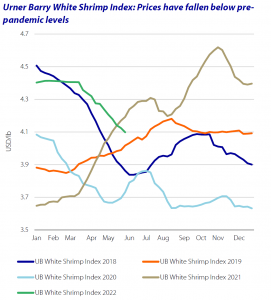
Source: Rabobank
Fishmeal
Fish meal supply will be roughly the same in 2H 2022. IFFO expects a slight contraction in fish meal supply and for fish oil, a flat supply due to the growing relevance of rendered products from the aquaculture sector (such as pangasius and salmon oil).
In China (by far the largest importer), high fish and piglet prices in China could be a driver of fish meal demand (as farmers are less concerned about cost and focused on the quality of feed). Demand is also related to the availability of vegetable proteins and oils (substitutes for both fish meal and fish oil). Rabobank says that a stable supply combined with a still favourable fish meal/soymeal price ratio means there is limited downside to prices.


