Since 2004, the World Nutrition Forum (WNF), an invitation-only summit, has been the go-to event for the global animal science, livestock and aquaculture production and feed manufacturing sectors. It is an opportunity for knowledge sharing and networking with top executives, experts, scientists and opinion leaders to explore a broad set of key issues in the food and feed industry. The Forum was held biennially up to 2018; the last WNF was held in Cape Town, South Africa. The 2023 program covered the realm of animal science and recent innovations, to update livestock producers and processors as well as feed manufacturers.
In 2023, DSM, took over this summit and held it in exotic Cancún, Mexico from May 8-10. On 9 May 2023, DSM merged with Firmenich and took the new name, dsm- firmenich. “Against a backdrop of volatility and uncertainty, we cannot restrain the progress of scientific innovation or our industry’s calling to feed the world sustainably,†said Ivo Lansbergen Executive Vice President, Animal Nutrition and Health as he welcomed around 700 participants and described the new company (see pages 4 AAP May/June 2023 and https://aquaasiapac.com/2023/05/10/dsm-firmenich-launched-as-innovators-in-nutrition-health-and-beauty).

“The new company aims to lead the sustainabilty race to the top, and in doing so, create a brighter future for all. There has never been a more exciting or challenging time in the agri-food sector. It takes all of us, together, doing our part. That is why I look forward to bringing together partners in the value chain so we can map our common journey.â€
The theme was “Genius sparks ideas†and it encompassed powerful intellectual capacity and boundless creativity. Eva Maria Binder, Head of Translational Science added that this summit embraced science governance and translational science for customers’ use.
Six goals of DSM formed the background for the summit:
• Making efficient use of natural resources,
• Improving lifetime performance of farm animals,
• Improving the quality of meat, milk, fish and eggs while reducing food losses and waste,
• Reducing emissions in livestock and aquaculture,
• Helping tackle antimicrobial resistance,
• Reducing our reliance on marine resources.

Journey to sustainability
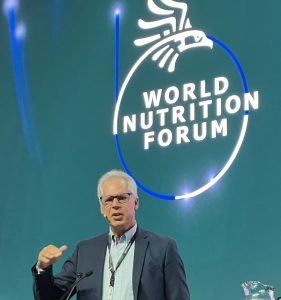
The ‘s’ in Genius is sustainability and the summit started with Bob Langert, Former VP of sustainability at McDonald’s describing the evolution of corporate sustainability. He said that initially it was difficult to get the sustainability message across internally and externally. While the past 30 years have largely been filled with playing defence and staying out of trouble, now the leading companies are playing offence. They need people within their organisations and supply chains to ensure that strategies are in place and the lofty goals established, to actually make things happened and to get things done. His message was: if we wait too long for an issue to trigger, amidst media and politics, the company can make rash decisions. The future requires transparency, commitment and doubling of expectations.
On the grand challenge of livestock production on the environment, Frank Mitloehner, University of California, Davis, USA, said that the impact of livestock includes 56% carbon dioxide and 18% methane and this amplifies the potential of global warming with regards to greenhouse gas (GHG) emissions. As the global community is actively working to keep temperatures from rising beyond 1.5°C, predicting GHGs and how they warm the planet and not their CO2 equivalent will provide information critical to developing short- and long-term climate solutions.
He considered two climate metrics. GWP* is a new metric formulated by the University of Oxford that assesses how an emission of a short-lived GHG gas affects temperature and accounts for methane’s short lifespan and its atmospheric removal. GWP100 overestimates methane’s warming impact by a factor of four and overlooks its ability to reduce warming when its emissions are reduced. He showed that both should be used in combination to provide strategic suggestions on fighting short-lived climate pollutants (SLCPs) that induce climate change. Mitloehner offered ways that feed additives can reduce sector wide methane emissions.
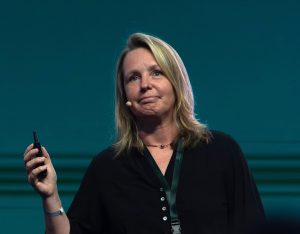
Rabobank’s Brebda de Swart, Global Head Sustainable Business Development Wholesale & Rural, said that bankers’ opinions matter as she looked at the economics of sustainability. “Sustainability is a need indispensable for long term commercial considerations. Animal protein sectors have the highest emissions and Rabobank has the target of net zero by 2050. It is not to stop financing but include sustainability into the financial commitment.†Her message is that the challenging environment aligns the interest of food companies and she urges both groups to work together in new ways. Steps include high quality on-farm precision measurement of climate and performance of the animal protein sector to implementing trustworthy traceability at competitive costs levels in the supply chain.
“The financial sector has a serious challenge in changing its business strategy to be a player that integrates data, agriculture expertise and supply chain traceability solutions,†said de Swart.
Mycotoxins and their mitigation
Scientific presentations on mycotoxin mitigation related mainly to livestock production but remain relevant for aquafeeds. A poster by Rosen et al. on ‘Beyond binding – a deeper look into mycotoxins mitigation strategies for aquatic species†discussed enzymatic detoxification of fumonisins and zearalenone by biotransformation in rainbow trout. Due to the complexity and variability of their molecular structure, these mycotoxins cannot be efficiently adsorbed and required a different mitigation strategy. On the impact of mycotoxins on health and nutrition, Todd Applegate, University of Georgia, USA, said that nutrient dense diets lessen the severity of mycotoxins in swine and mycotoxins have a role in protein synthesis. Veronika Nagl, DSM Austria revealed mycotoxins‘ dirty tricks. Based on selected examples from research, Nagl discussed how omics and other technologies have unravelled the molecular mechanisms of mycotoxins and their effects in the rumen.
In the latest challenges and trends in mycotoxin analysis, Rudi Krska, University of Natural Resources and Life Sciences (BOKU), Austria said that near infra red spectrum (NIRS), a 2-minute analysis is not yet fully validated. Combining NIRS (with a caveat of better cameras) and machine learning algorithms provide validation and calibration. High spectrum imaging (NIRS and HSI) can especially detect fungal infection in corn, wheat, rice and peanuts, deoxynivalenol in wheat and fumonisins and aflatoxin in corn. There is identification on infected kernel but insufficient accuracy. Immunoassay will make the invisible visible, but the equipment is very costly. “Data is important, but we need high quality ones,†said Krska.

Omics and gut microbiomes research
The microbiome strategy is to focus on beneficial functions encoded by key species and create best in class microbial references. A data platform will integrate multi-omics data, trials and performance data with experimental and screening data. Mick Watson, dsm-firmenich described how metagenomics enables precision characterisation of microbiomes. With bioinformatics methods and optimisation of the in-silico methods for the recovery of microbial genomes from metagenomes, there are metagenomics data from species of interest, creating highly accurate genome catalogues. Maia Segura-Wang, dsm-firmenich showed the steps in developing a gut microbiome precision service. This involves putting microbiome data from Verax (prediction service), from different sources, different and influencing components together and then sequencing. “By combining data from multiple sites, we have cross regional comparisons in terms of microbial and pathway abundance and prevalence. This collection is the first effort towards building commercial database of gut microbiome antibiotic resistant genes and functional pathways,†said Wang.