
Akaroa King Salmon has become the first King Salmon producer globally to adopt the innovative Blue Impact feed program developed by BioMar. This groundbreaking initiative supplements wild-caught fish in their formulations with cultivated algal oil, fish trimmings, and insect meal. The new approach significantly reduces the impact on wild fish stocks while utilising clean, sustainable sources of Ome ga-3 to produce the healthiest fish possible.
As an early adopter of this technology, Akaroa Salmon trialled the algal oil, achieving outstanding results with
their salmon that led to them winning the Seafood NZ “Future Adaptation” award in 2023. Building on this success, their partnership with BioMar now includes using novel ingredients like insect meal and fish trimmings sourced from pelagic fish in their feed. This initiative will see Akaroa King Salmon become a netpositive fish producer, committed to lowering its carbon footprint while incorporating regenerative and circular feed ingredients.
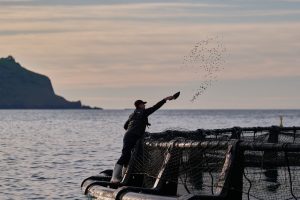 Akaroa King Salmon is a proudly 100% New Zealand owned partnership that includes NgÄti Porou, ÅŒnuku
Runanga – the mana moana (or guardians) of Akaroa Harbour – and the founding Bates Family. This partnership has a whakawhanaungatanga (relationship) based around intergenerational sustainability, aiming
to provide local employment and healthy seafood for today and future generations.
Duncan Bates, founder and managing partner of Akaroa King Salmon, reflected, “When I first started farming salmon in Akaroa Harbour, almost four decades ago, the feed ingredients essentially relied on wild caught fish as the raw material, and we fed up to 3kg of wild fish to grow 1kg of farmed salmon. Clearly, this wasn’t a
sustainable practice.â€
“With the introduction of Blue Impact, Akaroa King Salmon have started our journey to become a positive fish
protein producer, a far cry from those days long ago and a testament to our ongoing aspiration to become a
truly sustainable food producer. I am particularly excited to use novel ingredients like insect meal, utilising
waste streams previously going to landfill.â€
Nik Mavromatis, Marketing and Sales Manager of Akaroa Salmon explains, “Our customers have high
expectations – they want us to continue raising the finest tasting King Salmon while also being mindful of the
broader environmental impact, without compromising on the health benefits. I’m thrilled about the future of
aquaculture as we blend our farming expertise with the technical expertise of BioMar around innovative new
ingredients like oil from microalgae.â€
Blue Impact feeds are designed as an individualised journey that requires continuous improvements across all
three BioSustainâ„¢ impact parameters: Forage Fish Dependency Ratio (FFDR), percentage of circular and
restorative raw materials, and carbon footprint. This concept requires utilising innovative novel ingredients
such as insect meal, regenerative agricultural products, and trimmings from seafood processing in ascending
levels of inclusion in each successive version of the feed.
BioMar Group Press Release
Powered by Partnership. Driven by Innovation.
Mike Thomson, Commercial Director, BioMar Australia said he was not surprised that Akaroa has started their
Blue Impact journey, “Companies like Akaroa who are dedicated to sustainability and utilising more circular
and restorative ingredients are necessary for future-proofing the aquaculture industry. Using sustainable novel
ingredients is essential for decoupling feed and food supply chains and provides novel ingredient producers
the confidence to invest in R&D, upscaling, and commercialisation, increasing the availability of these
ingredients industry-wideâ€.
“We are excited to partner with Akaroa on their sustainability journey. Both companies are very ambitious in
this area, and I expect we will constantly be pushing one another to achieve important sustainability targets
and milestones. This kind of partnership leads to innovative solutions and meaningful sustainability
advancements for seafoodâ€, Mike continued


