
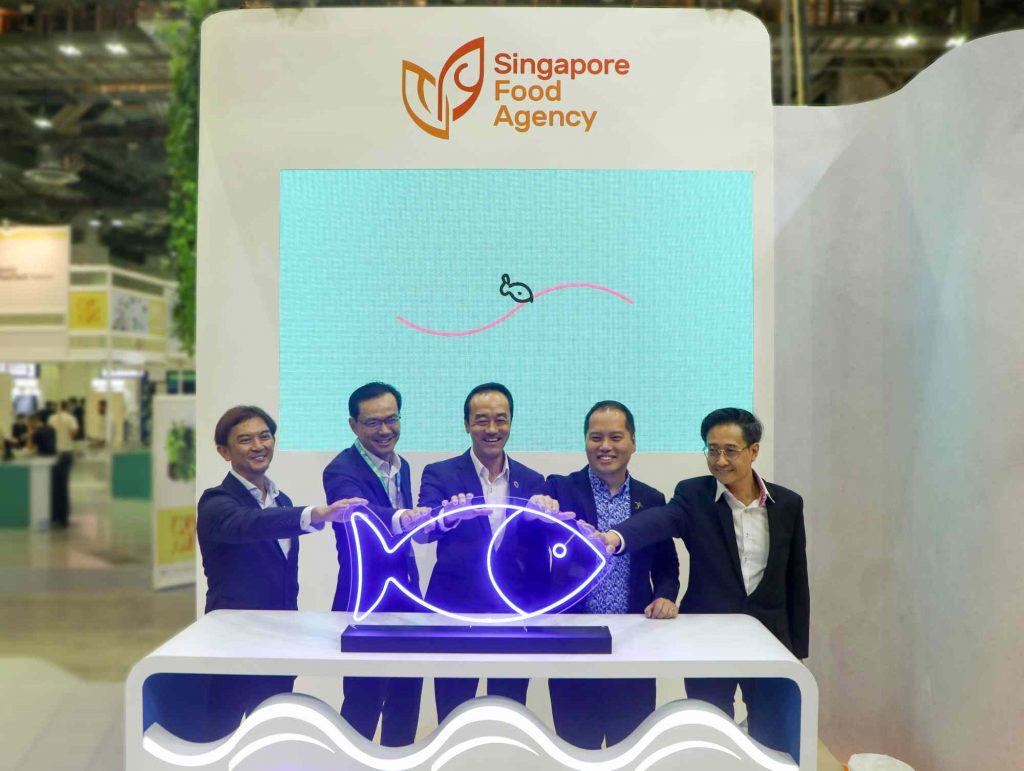
On November 19, Senior Minister of State for Sustainability and the Environment Dr Koh Poh Koon launched the Singapore Aquaculture Plan (SAP) to transform the aquaculture sector to be more productive and sustainable.
Food security is an existential issue for Singapore. It currently imports more than 90% its food, which makes the country vulnerable to food supply disruptions due to factors like climate change and disease outbreaks. To ensure its food resilience, the Singapore Food Agency (SFA) has committed to support the local agri-food sector to build its capability and capacity to produce food locally.
Singapore’s aquaculture industry is small, comprising 98 sea-based and 33 land-based seafood farms in 2023. Nevertheless, it contributes significantly to local production and fish has been identified as a nutritious source of protein that can be produced efficiently in land scarce Singapore.
It faces several challenges including limited sea space, suboptimal water quality, demands to mitigate its impact on theenvironment, and a limited domestic market
with strong import competition.
To address the above challenges, the industry is increasingly adopting innovative and sustainable methods, while keeping to a mix of production systems that are suited to Singapore’s unique constraints.
The SAP is a collaborative year-long effort by two sub-committees formed in November 2023. Consisting of the industry, nature groups, academia, off-takers, and various government agencies, the committees’ work embodies our collective vision for the sector and serves as a roadmap for future aquaculture development in Singapore.
The sub-committees have identified innovative approaches to balance sustainability with productivity and to uplift the aquaculture sector, anchored by five pillars.
- Space & Infrastructure Planning: To improve the robustness of site studies to ensure optimal site selection and develop key infrastructure, focusing on sustainable energy solutions and shared facilities.
- Enabling Regulations: Refining regulations to be more outcome-and science-based.
- Research, Innovation, Enterprise: Leveraging on the capabilities and solutions developed in the Marine Aquaculture Centre, the Singapore Food Story Research and Development Programme and AquaPolis to innovate and undertake collaborative research initiatives.
- Ecosystem Development: Continue to grow local champions, and foster partnerships, especially with technology firms, international aquaculture
leaders, and the talent pipeline from institutes of higher learning. - Demand Offtake and Promotion of Local Produce: Continue the efforts to engage public and key stakeholders, while refining marketing and promotional
strategies.
SMS Koh also announced the launch of the National Broodstock Centre and the Hatchery Development and Recognition Programme* to ensure a consistent supply of superior fingerlings for our farms. These initiatives fill a critical gap in the aquaculture sector, reduce our need on imported fingerlings, and offer tangible benefits such as a higher survival rate of fingerlings.
In addition, SFA has also operationalised the Aquaculture Sensing Network to support the aquaculture industry in water quality monitoring and better monitor nutrient discharges from farms. This comprises of a network of water quality sensors at aquaculture zones, complemented by water and sediment sampling. The data produced will provide operational insights on various water quality parameters, giving early warning against environmental threats such as harmful algal blooms.
Damian Chan, CEO of SFA, said:
“The launch of SAP today emphasises our commitment to uplift and transform the local aquaculture sector, which is important to Singapore’s food security. Our fish farms, as part of local production, cushion us from overseas supply disruptions and complement our efforts to diversify import sources of seafood. We recognise the recent challenges our aquaculture farmers face, such as rising costs and water quality. This is why we co-developed the SAP with our stakeholders. The initiatives under the SAP’s five pillars will help farmers to overcome these challenges, enable the sector to make the most out of its limited sea space, and encourage more consumers to buy locally farmed seafood.â€
Dr Toh Tai Chong (Member, sub-committee on sustainable aquaculture), Co-founder of Our Singapore Reefs, said:
“The SAP marks a turning point for the aquaculture sector in Singapore. Over the past year, stakeholders from different sectors have deliberated extensively to ensure that our aquaculture produce is safe, secure, and sustainable. But the journey is not over yet. I hope more people will step forward to help us refine the solutions and push the frontiers of innovation for the benefit of Singapore’s aquaculture sector.â€
Ken Cheong (Co-lead, sub-committee on productive aquaculture), CEO of Singapore Agro-Food Enterprises Federation Limited (SAFEF), said:
“SAFEF is proud and honoured to have contributed our ideas and suggestions to the SAP. This initiative has allowed many of us from diverse backgrounds to come together and leverage our combined expertise to build a sustainable and productive aquaculture sector. We look forward to the implementation of the roadmap and will continue to work with all stakeholders to drive meaningful change and set new standards for the local aquaculture industry.â€
The SAP paper can be viewed at: go.gov.sg/sappaper19nov24.
*More details on the National Broodstock Centre and Hatchery Development and Recognition Programme will be announced. Watch the SAP video of the launch


