
Luke and VTT have developed technology solutions to remove off-flavours and water mould in aquaculture. Off-flavors in fish and water mould cause significant economic losses to fish farming globally.
The Natural Resources Institute Finland (Luke) and VTT Technical Research Centre of Finland have developed capture solutions based on chemically treated fibre materials to address these challenges in fish farming.
Unpleasant off-flavours can accumulate in fish and reduce the market value and consumer interest in fish products. Managing off-flavours is key to the profitability of sustainable fish production.
Water mould is also a common problem in fish farms globally. In salmonid farming, water mould has been estimated to cause production losses of up to 10% per year through all stages of production. Water mould is also a threat to endangered fish stocks maintained in aquaculture farms.
Jani Lehto, Director of Luke’s Bioeconomy and Environment Unit said, “We have developed promising capture solutions to address the problems of off-flavours and water mould in aquaculture. Our solutions can have a significant impact on the profitability of the industry.
“These new cellulose-based capture materials will capture water mould spores and off-flavour compounds from the water, preventing them from accumulating in the fish,” said Hannes Orelma, Research Team Leader at VTT.
Encouraging results from trials
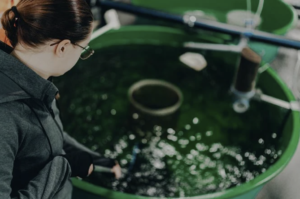
The capture of off-flavour compounds was studied at Luke’s experimental aquaculture facility in Laukaa. The concentrations of 14 off-flavour compounds were tested in a recirculating aquaculture environment, where part of the water was recirculated through a fibre material.
The chemically treated fibre material accumulated up to 1,000 times higher concentrations of off-flavour compounds compared to those in untreated water. After the treatment, the concentrations of off-flavours in the fish remained below the sensory thresholds.
Luke’s Research Manager and Senior Scientist Petra Lindholm-Lehto, who was responsible for the design and implementation of the experiments and measurements at Luke, said,
“This is a very interesting result, as no new solutions have been introduced in recent years to reduce off-flavours in recirculating aquaculture systems”
At Luke’s Enonkoski aquaculture facility, a fibre material developed specifically for the capture of water mould spores was tested. The use of the fibre material significantly reduced the amount of mould spores in the water compared to a culture tank without the material.
“Not enough is yet known about the behavior of the water mould and studying it in fish farming is challenging. Previously used treatments have proven to be unsafe or ineffective. The method we have developed is based on the use of harmless capture material and therefore the results of our experiments are interesting,” says Lindholm-Lehto.
Patents sought for capture solutions
Patent applications have been filed for both innovations developed by Luke and VTT.
“Our results are encouraging and show that these solutions have a lot of potential. Our next steps are to continue development of both technical solutions in commercial-scale farms and to move forward with commercialisation. We look forward to hearing from companies and operators who would like to develop these solutions further with us!” says Jani Lehto.


