
The world’s first natural waterbody exchange aquaculture vessel, Wan Qu Ling Ding, was successfully launched in May in Jiangmen, Guangdong province, marking a major step forward in China’s deep-sea aquaculture industry, according to China Daily
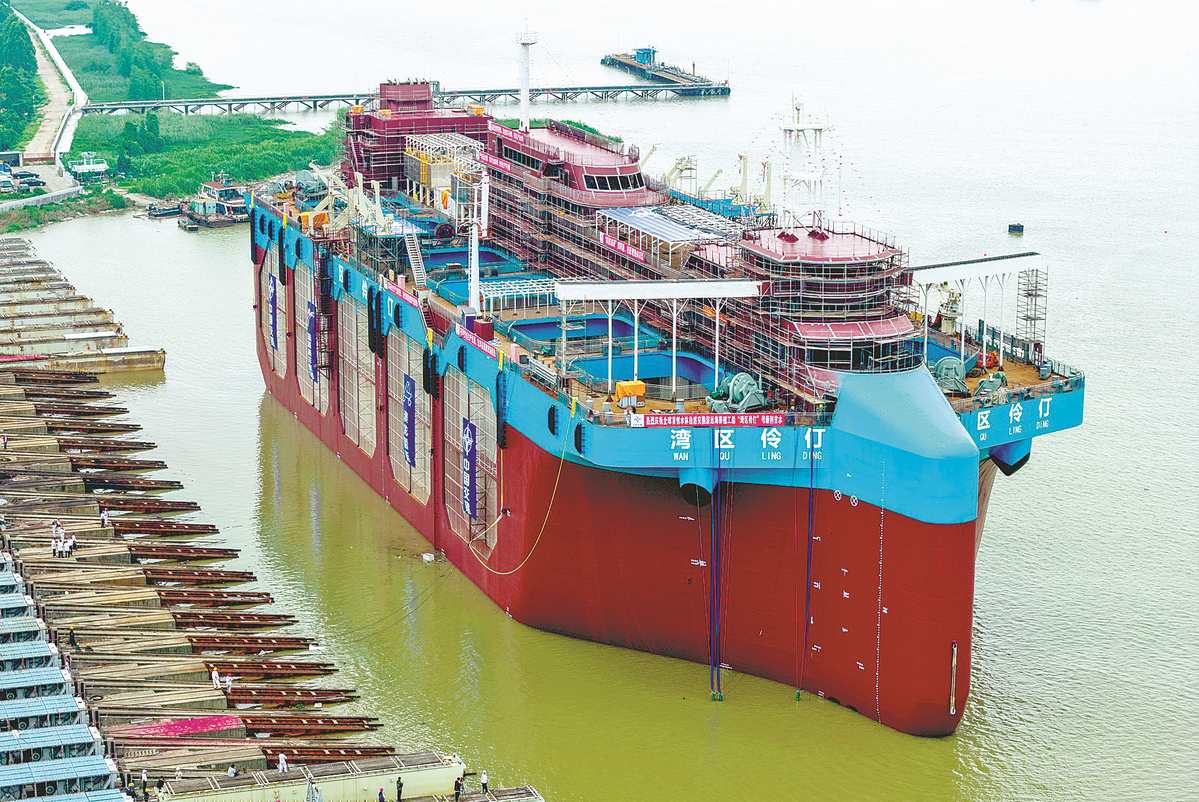
Dubbed a “breeding aircraft carrier” and a “deep-sea granary”, the vessel represents a new era of technology-driven marine aquaculture, and is expected to help Zhuhai, Guangdong, become a regional marine hub, according to a statement by the Zhuhai government.
The vessel, measuring 155.8 meters in length and 44 meters in width, features 12 independent breeding compartments and a breeding water capacity of about 80,000m3, equivalent to 32 standard swimming pools. Its annual fish production is estimated at 3,000 to 5,000 tonnes comparable to a land-based fishpond covering more than 3.33 million square meters.
Owned by Zhuhai Ocean Development Group Co, the vessel was approved for construction in November 2022 and is expected to be delivered in August. It will mainly operate in the waters around the Wanshan Islands in Zhuhai, near the mouth of the Pearl River.
The vessel will focus on breeding high-value species such as golden pomfret, yellowtail amberjack and grouper, supporting the integration of local fishing and tourism industries.
It employs a pioneering structure that integrates the bow and stern with a column-stabilized hull, along with natural water exchange technology that helps improve fish quality while cutting energy consumption.
Huang Hongyu, executive director and general manager of Jiangmen Hangtong Shipbuilding Co, which built the vessel, said,
“With a cruising range of up to 2,000 nautical miles, the vessel can navigate autonomously to avoid natural disasters such as typhoons and select optimal breeding waters. Its electric propulsion system enables so-called “maritime nomadism”, which shortens the breeding cycle and boosts economic returns.
“Our company will help accelerate the construction of modern marine ranches in Guangdong and contribute to building a ‘new Guangdong’ at sea.”
The vessel is also equipped with a 20-kilowatt wind power generation system that can meet static aquaculture electricity demands with 100 percent clean energy, significantly reducing carbon emissions.
Sensors and automatic feeding systems have been installed in various aquaculture compartments. If abnormal water temperatures or pollution are detected, the compartments can be raised to reduce resistance and the vessel can quickly relocate to safer waters, ensuring the health and quality of the fish.
The vessel is the world’s first mobile aquaculture platform designed by China in accordance with China Classification Society standards, and the country’s first large-scale platform integrating intelligent aquaculture, energy conservation and eco-friendly fishing and tourism.


