
A recent trend in Quang Tri is the application of high technology in aquaculture to achieve efficiency and sustainability, according to Deputy Director of the Department of Agriculture and Environment (DARD) Nguyen Huu Vinh in Vietnam.Vn,
High-tech aquaculture models are being widely applied in shrimp farming.
- 2-3 stage phases
- using biofloc technology;
- in greenhouses and net houses
In these models, the application of high technology has helped farmers easily monitor and analyse pond data, thereby making accurate decisions on stocking density, feed use, adjusting pond environmental factors, etc. Thereby helping to closely control the farming process, improve productivity and quality, minimize risks and bring efficiency.

In fact, in many facilities applying high technology have achieved outstanding efficiency in productivity and economy. A typical example is Vietnam High-Tech Seafood Company Limited, Branch 1 in Quang Tri, in Phuong Lang village, Vinh Dinh commune, with a white-leg shrimp farming model using CPF Combine house technology, with an annual harvest of more than 420 tonnes.
Nguyen Duc Tuan, Director of Vietnam High-Tech Aquaculture Company Limited, Branch 1 in Quang Tri, said that previously the company mainly grew shrimp using industrial methods in outdoor pond systems, which were not very effective and shrimp were easily lost due to disease.
After research, in 2019, the company decided to convert the model to greenhouse farming. Accordingly, on an area of 70ha, the company invested nearly 40 billion VND to build 20 nursery ponds with a volume of 300m3/pond and 24 commercial ponds with a volume of 900m3/pond, all of which are equipped with aerators, air blowers, automatic feeding machines, automatic shrimp sorting and harvesting machines. The remaining area is used for water treatment and water storage for shrimp farming.
According to Tuan, each pond is covered with a specialized tarpaulin, completely isolated from the outside environment, helping to minimize the risk of disease, while easily adjusting the temperature and light in the pond. In addition, the company also applies IQC software to update and analyse environmental factors, daily feed consumption of farmed shrimp, algae growth rate, etc, thereby facilitating timely adjustment and handling when there are fluctuations.
Applying a circulating water treatment process helps reuse 60% -80% of the pond’s wastewater. Using automatic shrimp sorting and harvesting machines to limit people entering the pond. “Compared to traditional farming methods, applying technology brings many times higher efficiency. Specifically, with 3 crops/year, the estimated yield can be up to 80 tonnes/ha, after deducting costs, it brings a profit of about 20%”, said Tuan.
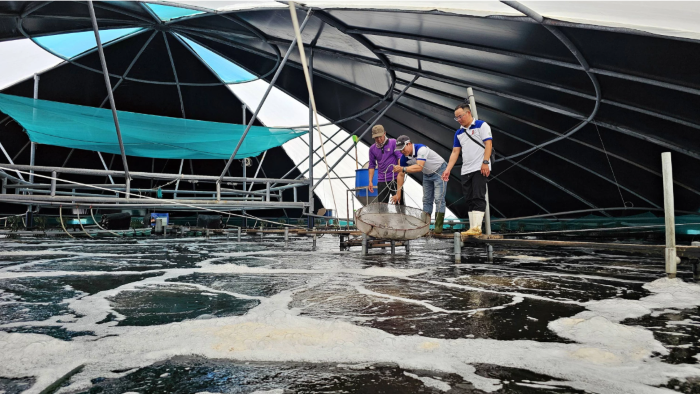
Similarly, the white-leg shrimp farming model according to the 3-phase process of Tran Van Dung in Phan Hien village, Vinh Thuy commune has brought an average profit of 1.8-2 billion VND/year. Dung said that after researching, in early 2022, he invested nearly 2 billion VND to convert the entire farming area of nearly 3ha to farming according to the 3-phase process. Of which, the commercial farming area is 0.5 ha including 6 ponds designed in a circular shape, lined with tarpaulin and equipped with a roof to ensure the most optimal water environment without depending on the weather, the rest is a circulating water treatment system. Dung said,
“The advantage of the high-tech shrimp farming model is that it limits the risk of disease, the shrimp are large in size, and the economic efficiency is much higher than that of traditional farming methods before”
The province currently has about 9,350ha of aquaculture area, with an annual output of about 22,150 tonnes. Of which, a number of intensive and semi-intensive shrimp farming areas have been formed along the Ben Hai River, Hieu River, Gianh River, Nhat Le River and sandy areas in coastal localities.
Deputy Director of the Department of Agriculture and Environment Nguyen Huu Vinh informed that the province aims to develop aquaculture in general, shrimp farming in particular, to become the province’s key agricultural product production industry in the direction of sustainable production, disease safety, adaptation to climate change and protection of the ecological environment; improve quality and production efficiency to bring benefits to people, businesses and the economy.
In recent times, the Department of Agriculture and Environment have focused on supporting the implementation and replication of many shrimp farming models in the direction of high technology and biotechnology and have brought about very positive initial results such as limiting disease risks, reducing input costs, increasing productivity, output and farming efficiency.
For example, with white-leg shrimp farming models following a 2-3 phase process, productivity can reach 25-30 tonnes/ha, 4-5 times higher than the average productivity of the whole province. Profit is estimated at about 1 billion VND/ha. Ving said,
“On this basis, the Ministry of Agriculture and Rural Development will continue to invest in upgrading, building and completing infrastructure to meet the requirements of aquaculture development in the province. Promote the application of new science and technology, digital transformation to increase productivity and output per unit area. At the same time, increase calling for and supporting businesses to invest in the field of high-tech aquaculture, seed production and seafood processing,”


