
Lisaqua raises €9 million to develop a first shrimp aquaculture farm with a low environmental impact.
Environmental and Solidarity Revolution Fund, funded by the Crédit Mutuel Alliance Fédérale Social Dividend and managed by Crédit Mutuel Impact, carried out this €9 million capital increase to support the industrialisation of Lisaqua, an innovative French company specialising in the production of shrimp with a low environmental impact and without antibiotics. The Belgian fund Noshaq and historical investors including the Agricultural Cooperative Le Gouessant and the Mer Invest fund also took part in this operation.
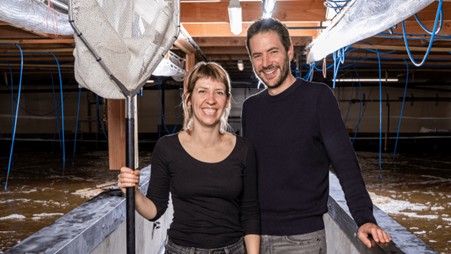
Founded in 2018 by Charlotte Schoelinck and Gabriel Boneu, Lisaqua is taking a new step in its development after the success of its pilot farm based in Saint-Herblain (44). This financing will enable Lisaqua to develop an industrial farm with a capacity of 100 tonnes of shrimp in Monthyon (77), and to continue its commercial development and R&D efforts. To do this, Lisaqua relies on a multidisciplinary team of 38 people (Biology, engineering, aquaculture, trade, etc.). This scale-up is also supported by the government’s “Première Usine” scheme as part of the France 2030 investment plan.
The farming process developed and patented by Lisaqua makes it possible to raise shrimp in controlled terrestrial tanks near the places of consumption. This breakthrough technology, which combines biofiltration systems with predictive models of livestock farming, makes it possible to meet the challenges of sustainable food by combining environmental preservation and food quality.
On the environmental side, the land-based farming method developed by Lisaqua contributes to the preservation of mangroves, as conventional shrimp farming is a source of destruction of these coastal ecosystems, which are essential for biodiversity and carbon capture. Lisaqua also uses several circularity techniques to limit its impact: recovery and recovery of heat lost by the department’s incinerator to heat its basins, bioconversion of effluents and reuse of farm water…
In terms of quality, shrimp are produced without antibiotics and sulphites, thus contributing to a healthier diet. They are distributed ultra fresh, their adoption by many great chefs also testifies to their taste qualities.
Lisaqua is already planning to expand its production capacity, with the extension of the Monthyon farm and the construction of new sites in France and Europe.
Charlotte Schoelinck and Gabriel Boneu, co-founders of Lisaqua, said:
“This financial operation is a key step for Lisaqua: after having developed our technology in the aquarium, in the laboratory and then on a pilot scale, this financing allows us to multiply our impact tenfold, to make our exceptional shrimps accessible to as many people as possible. The ESG anchoring shared with Crédit Mutuel Impact and Noshaq allows us to continue our development without compromising on environmental impact: producing more efficiently, with fewer resources, to develop healthier and more sustainable aquaculture.”
Sabine Schimel, Chief Executive Officer of Crédit Mutuel Impact, said:
“The technology developed by Lisaqua is a promising solution that contributes to more sustainable food. This transaction is fully in line with the investment strategy of our Environmental and Solidarity Revolution Fund, supplemented by the Crédit Mutuel Alliance Fédérale Societal Dividend. Agriculture and agri-food are major areas of investment for the Environmental and Solidarity Revolution fund. We support the ambition of Lisaqua’s founders and are proud to support the company over the long term to enable it to scale up and deploy its virtuous technology.”
Géraldine Hotterbeex, Investment Manager for Noshaq, adds:
“Lisaqua embodies our ambition to support innovative, sustainable and technologically differentiating agri-food models. By joining this adventure, we affirm our commitment to local and responsible production. The project to set up a farm in the Liège region, although still under study, represents a strategic opportunity for our territory. It could catalyze synergies around waste heat, foodtech and food sovereignty, in line with Noshaq’s priorities.”


