

On August 21, the two-day 14th Aquaculture Roundtable Series (TARS) successfully concluded in Chiang Mai, Thailand. It brought together 284 participants, 93 of them from Thailand. This was the largest edition to date, with participants coming from 22 countries.
This seventh TARS on shrimp aquaculture centred around precision farming for higher productivity and profitability. It provided a platform to examine Asia’s shrimp industry at a critical turning point, marked by low prices, rising costs, frequent disease outbreaks, and falling productivity.
“It is imperative for farms and businesses to adopt smarter and more precise farming methods to remain competitive. At the same time, we are seeing how data tools, AI and automation are transforming how we manage water quality, disease prevention and feed optimisation,”
said Dr. Thitiporn Laoprasert, Deputy Director General, Department of Fisheries (DOF) during her opening address.
“Such innovations not only improve productivity but also ensure sustainability and long-term profitability.”
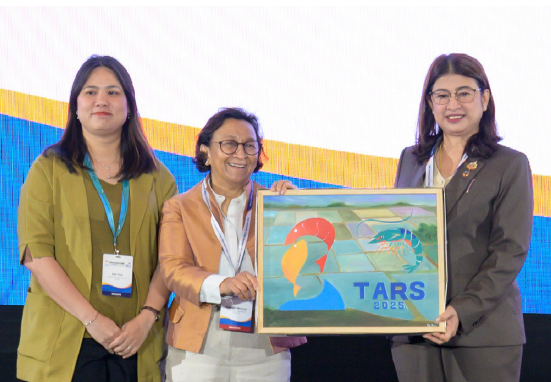
The program featured 10 sessions with 52 speakers, panellists and industry players navigating the multiple facets of Asia’s industry. TARS 2025 was organised by Aqua Culture Asia Pacific and Corporate Media Services, Singapore.
This year’s industry sponsors included dsm-firmenich, U.S. Grains Council, Jefo Nutrition, Auranta, Adisseo, ADM, SyAqua, Alltech, BioMar, Veramaris, Lucta, and Motiv.
TARS 2025 started with an assessment of the State of Global Shrimp Supply and Demand, and explored how Asia can better respond to shifting market needs (see pages 20-27). Participants learnt how Ecuador has a competitive shrimp industry by leveraging its professionalism, promoting investments and brand development. This showed that sustainable growth is possible through scale, innovation, and integration.

Ecuador’s success is not directly comparable since distinct geography, politics, and business environments shape its unique model. The lesson from Asian producers on intensification was that Ecuador should not push the limits of carrying capacity. The message was not to see Ecuador merely as a competitor, but to learn from its fundamentals in genetics, hatchery and nursery management and production planning.
Asia’s fragmented system, with 70% of production from small farms, limits cooperation. Meanwhile, Ecuador’s integrated model encourages collaboration between farmers and processors. At Hard Talk, business leaders along the value chain from genetics and hatcheries to farms and feeds in Asia and Latin America, and processing and marketing, discussed dysfunctions in Asian shrimp aquaculture. Members agreed that small farmers are resilient in the face of challenges and emphasised that greater collaboration, with added value tailored to target markets, is needed rather than full integration.
For the long-term sustainability of the industry, it is the second-generation farmers who are stepping up, forming strong peer networks to support one another and driving the transition from founder-led enterprises to modern, science-driven aquaculture businesses.
The “Pondside Chat” brought together second-generation shrimp industry leaders—Rizky Darmawan from Indonesia, Chodpipat Limlertwatee from Thailand, Hai Nguyen from Vietnam, and Mayank Sharma from India—for a dynamic dialogue on their farming practices.
The session on precision farming and production planning highlighted that disease-free broodstock and Vibrio control are non-negotiable. Genetics drives ~50% of performance, but hatchery management and the delivery of robust post larvae ultimately determine field success. Science-based SPF breeding programs remain the standard in Asia, despite Ecuador’s APE advances. Nursery systems enhance survival, inventory control, and profitability, but transfer logistics are critical. In Vietnam, Integrated systems are proving viable, with intensive, well-managed models demonstrating strong results.
In precision nutrition, the use of functional additives for gut health and immunity, as well as for health interventions, is effective. Awareness of the negative effects of mycotoxins and endotoxins in shrimp production is critical for feed efficiency. In terms of feed sustainability, fishmeal replacement with single-cell proteins and non-animal-based additives supports independence from marine ingredients in feeds.
Disease mitigation and control of transparent post larvae disease (TPD) in Vietnam require modular biosecurity to reduce spread and functional additives. Lessons on Vibrio control have also led to the use of functional additives to support gut health, microbiome, and immune modulation. While proven in salmon, adoption lags in Asia due to cost sensitivity. Early disease diagnostics, multi-pathogen management and lower stocking densities remain key to reducing disease risk.
The future-proofing session emphasised how retail downstream increasingly influences shrimp farming practices; focusing on provenance and health benefits. In securing post-harvest product quality, time and temperature control and an optimised supply chain, from producers to exporters, are critical.
For a sustainable feed strategy, priorities include lowering crude protein levels, shifting to byproducts/plant proteins, using novel inputs (insect and fermented meals) and pursuing certification.
There is an opportunity for growth with mathematical modelling to assess impacts of key factors, identify solutions, and formulate feeds to reduce marine ingredients and more sustainable protein/energy levels.
TARS 2025 also recognised the role of startups in advancing pond management, disease prevention, and climate adaptation—critical for farmers facing repeated crop failures.

Takeaways
The Interactive Roundtable Breakout session focused on “Future proofing: Precision shrimp aquaculture and the new deal”. Participants proposed key performance indicators (KPIs) and metrics for precision shrimp farming, reinforcing TARS’ hallmark of inclusive and solution-driven dialogue. Some takeaways are listed below.
Bespoke genetics and improved hatchery practices: A preferred combination of traits should be aligned with farming models (density, aeration level, salinity, etc). Emphasis is placed on traits for growth, robustness, and disease tolerance, with a KPI of over 70% survival after a challenge with various diseases. The metrics for female broodstock efficiency is 4 months and gravid ablation rates of 25-30%/day and gravid non-ablation rates of 15-20%/day.
Quality of post-larvae and juveniles: Recommended tests include those for antibiotics before stocking, PCR screening for pathogens at PL 5–7, size variation, and stricter stress tests leading to survival rates of 50–60%, rather than accepting an overall 90%.
Biosecurity and Vibrio control: These are vital for shrimp health. Broodstock must be healthy and pathogen-free, with regular audits and diagnostics. Bacteria load in water should be controlled at 103 CFU/mL. Probiotics and stringent testing protocols are recommended for Vibrio control. Fast-track disease monitoring and data collection on farming practices support future analysis and adaptation.
Stocking density and carrying capacity management:
Carrying capacity depends on infrastructure and pond aging. Maintaining biomass at 80% of capacity was suggested. Key metrics include maintaining dissolved oxygen levels above 5.5 ppm and proper aeration.
Waste control and management strategies: Critical for sustainable shrimp farming are probiotics and regular monitoring of water quality parameters. The target for feed conversion ratio (FCR) is less than 1.2, achievable through the adoption of advanced feed management practices such as acoustic feeding.
Monitoring growth metrics: Critical KPIs are average daily growth (ADG) at between 0.23-0.25g from PL12, an FCR of 1.2-1.5 and a survival rate (SR) of over 80% is expected at 100 days of culture.
Optimal size for profit margins: The best size is based on market conditions, management styles and profitability. In Thailand, optimal sizes include black tiger shrimp at size 8/kg and white leg shrimp at size 28/kg. Flexibility is advised based on circumstances.
Precision nutrition with digestible nutrients: It is not only nutrient digestibility and ratio of digestible protein: digestible energy but also to define digestibility according to age. Metrics are apparent digestibility coefficients, digestible protein, amino acids, energy, lipid and carbohydrates. Standardised digestibility metrics and measurement (in vitro assessment) are needed.
Shrimp feed formulation: With high-protein/high-cost versus low-protein/low-cost feeds, cost-effectiveness should be measured not only by cost of feeds but also by growth performance metrics such as FCR. Others are economic indicators (feed cost per kg gain) and environmental factors (nitrogen retention/excretion), survival rate and water quality.
Nutrient balance and feed quality: Digestible ingredients and alternative proteins support shrimp nutrition, while enzymes, acidifiers, and palatability enhancers improve digestion and absorption. Tailoring feed by life stage boosts growth, minimises environmental impact, and improves water quality.
Functional benefits: Functional feeds are formulated not only for growth but also to enhance immunity, stress resistance, gut health, and overall shrimp performance. Palatability remains essential. The non-specific immune system of shrimp can be improved.
Feed intake and palatability: The metrics include apparent feed intake, daily feed intake, and specific feeding rate rate. The best practice is to combine palatability, stability and digestibility.
Feed management: Real-time systems optimise feeding and monitor conditions. Acoustic monitors track shrimp response to reduce waste. Combining automated and manual feeding improves consistency and water quality.
Environmental sustainability: Balanced feed formulations improve feed utilisation and can reduce waste output. Overfeeding and excess nutrient discharge may require additional water treatments, which increase production costs and impact ecosystems.
Production planning for improved productivity: Farmers often produce and harvest simultaneously, creating volatility in supply and demand. Knowledge sharing is needed to improve sourcing of quality post larvae, feed, and best aquaculture practices. Greater transparency, traceability, value chain synchronisation, and regular (annual/quarterly) planning are essential.
Harvesting techniques & shrimp quality: Special pre-harvest feed improves shrimp quality, while rapid chilling methods such as ice killing reduces stress and maintains freshness. Strict control of post harvest time and temperature is essential for quality maintenance.
Measuring incoming shrimp quality: Quality control must address varied buyer standards and logistics. Using standard checklists, lab testing, feedback, and tracking key attributes—such as hepatopancreas, appearance, size, taste, and moisture—is vital. Efficient farm access and transport prevent delays that reduce shrimp quality.
Market-specific needs: This is to develop premium products with consistent taste and quality for the US; ensure an integrated supply chain for quality assurance and compliance for the EU; and offer convenient, Ready to Cook products for China.
Certification: Few feedmills are ASC-certified due to high costs and low farmer awareness. ASC should highlight certification benefits, connect certified farms and feedmills, and promote its tools for greenhouse gas measurement.
TARS.


