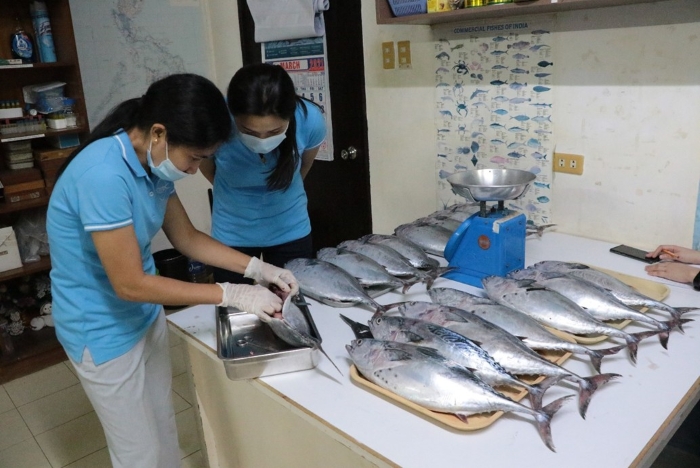
For the first time, a mackerel tuna—also known as kawakawa and long considered nearly impossible to breed—has reproduced naturally in captive conditions at a research center in the Philippines.
The tuna (Euthynnus affinis), known in the Philippines as “tulingan,” spawned at the Southeast Asian Fisheries Development Center Aquaculture Department (SEAFDEC/AQD) in Tigbauan, Iloilo, without the use of hormone injections.
The first spawning event under fully captive conditions was recorded in July 2025, with repeated spawning observed through September.
Overcoming a long-standing aquaculture barrier
“Tuna species pose exceptional challenges for aquaculture due to their highly migratory behavior, rapid swimming speeds, and acute sensitivity to confinement stress,”
shared Dr. Takahiro Sajiki, deputy chief of SEAFDEC/AQD and co-manager of the Japanese Trust Fund that supported the research project.
He added that these traits have limited breeding efforts, forcing most tuna farming operations to rely on wild-caught juveniles.
Kawakawa, a small neritic tuna widely consumed in Southeast Asia, has been particularly difficult to maintain and develop to maturity in enclosed systems, as well as induce to spawn under captive conditions.
Years of research behind the breakthrough
The milestone is the result of systematic, long-term research and broodstock management at SEAFDEC/AQD, despite early challenges with stress-related mortality and poor adaptation to domestication.
“Rather than relying on artificial spawning induction, we refined broodstock care, continuously monitored the fish, and used controlled environmental techniques to create conditions conducive to natural reproduction,”
said Irene Cabanilla-Legaspi, the SEAFDEC/AQD researcher who has led the kawakawa project since 2020.
“Years of careful observation and environmental control culminated in the release of eggs by captive kawakawa in an enclosed tank,”
she added.
From wild juveniles to captive spawners
The broodstock were sourced from juvenile kawakawa collected using an “otoshi-ami” fish trap in Antique Province. Before transport, the fish underwent several days of conditioning to prepare them for confinement stress and the long journey to tank facilities in the SEAFDEC/AQD Tigbauan Main Station.
“Transport protocols were strictly followed to maximize survival. Water temperature was lowered, each fish was handled individually, and temperature, salinity, and dissolved oxygen levels were monitored hourly. Water samples were also collected for bacterial analyses,”
according to Dr. Leobert de la Peña, head of SEAFDEC/AQD’s Research Division.
These measures resulted in high survival rates, even three days after transport, according to the research team.
Hatchery conditioning
At the hatchery, the juveniles were maintained in tanks with carefully regulated water quality and feeding regimes to minimize stress and promote fast growth and maturation.
Over time, the fish adapted to captive conditions and released viable eggs, confirming that kawakawa can complete the reproductive cycle in a fully enclosed system without hormonal intervention.
“This achievement brings us closer to establishing a full-cycle culture technology for kawakawa from egg to larva, juvenile, adult, and back to spawning,”
said Dan Baliao, Chief of SEAFDEC/AQD.
Implications for sustainable tuna production
Kawakawa is valued for its firm flesh with a similar flavor and texture to bluefin tuna. However, unlike large oceanic tuna species such as bluefin, it matures rapidly and thrives in coastal waters, making it a promising candidate for sustainable aquaculture. Notably, it also has high levels of the nutrient docosahexaenoic acid (DHA).
“Developing reliable breeding and culture techniques for kawakawa could reduce dependence on wild-caught stocks and help stabilize tuna production,”
Baliao said.
“However, we may need more years of dedication and persistence to replicate these results to ensure consistency, and scale them up to commercial production.”
The research was conducted under the Japanese Trust Fund–supported project, “Development of Full-Life Cycle Culture and Stable Production Technology of Kawakawa (Euthynnus affinis).”