Sarika Farm in Chachoengsao province is regarded as a model farm, and its owner, Khun Chalee Jitprasong, has diligently developed it to be the first ASC-certified farm in Thailand.
When we speak to shrimp industry stakeholders in Thailand, Khun Chalee’s name often comes up among the country’s most recently successful farmers. One of his farms, Sarika Farm in Bang Pakong district, Chachoengsao province, is regarded as a model farm that Chalee has diligently innovated, post-COVID, to achieve the Aquaculture Stewardship Council (ASC) certification. In 2024, his farm produced 150 tonnes in an area of 27 rai (4.32ha).
However, before the COVID pandemic (2020-2021), his success rate was low. The turning point came when he began to adopt a different culture model: small one-rai ponds for easier management, a closed system with no water exchange, the use of pond water probiotics, and direct stocking with vannamei post larvae (PL9) from fast-growth genetics at a density of 187PL/m2. Probiotics were also added to feeds through top dressing.

Successful farming model
Khun Chalee is humble in saying that if survival rate is a measure of success, then other farms, such as Khun Tawi’s farm in Surat Thani, produce 4,000 tonnes annually. There, the survival rate is stable at 90%, achieved by using pond probiotics and a low stocking density of 31PL/m2 in large 6-rai (0.96ha) ponds. The difference is that Khun Chalee’s model is intensive farming, harvesting smaller-sized shrimp of 80/kg. His productivity/ha is high and biomass control is managed via partial harvests.
The farm has 9 culture ponds, with stocking densities ranging from 200,000–300,000PL/rai (125-187PL/m2). Only the pond dykes are lined with HDPE, while the bottom is covered with gravel stones to prevent shrimp from stirring up sludge and to help control carbon and ammonia levels.
Recycled water
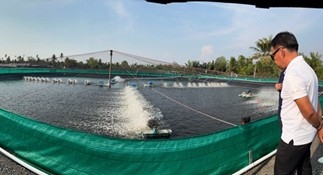
In the main reservoir pond, various freshwater fish, cichlids, clarias, tilapia, rohu and pangasius, act as biofilters. Water is disinfected using chlorine, and consequently, wastewater is recycled. Pond water depth is maintained at around 1.8m, with top-up water when necessary. No chemicals are used during the culture cycle. The spread of viral pathogens is rigorously controlled through strict biosecurity, while probiotics maintain pH balance and control algae bloom. Pond water salinity ranges from 8-12ppt.
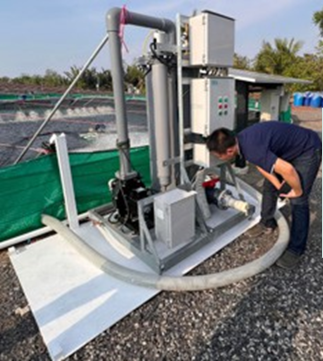
This is a smart farm, using startup HydroNeo’s technology to obtain accurate water quality measurements using high-quality sensors. High-efficiency motors reduce energy costs by 30%. The farm employs biofloc technology and maintains a pH range of 7.5-8, carefully keeping a 0.2 difference between day and night. The feed conversion ratio (FCR) is 1.1, and the average daily growth (ADG) is 0.2g, measured until the shrimp reach 30g. Khun Chalee continues to seek and remains open to innovations. He recently conducted a trial using pure oxygenation technology to evaluate its potential to improve overall farm performance and to assess the economic feasibility of adopting this technology.
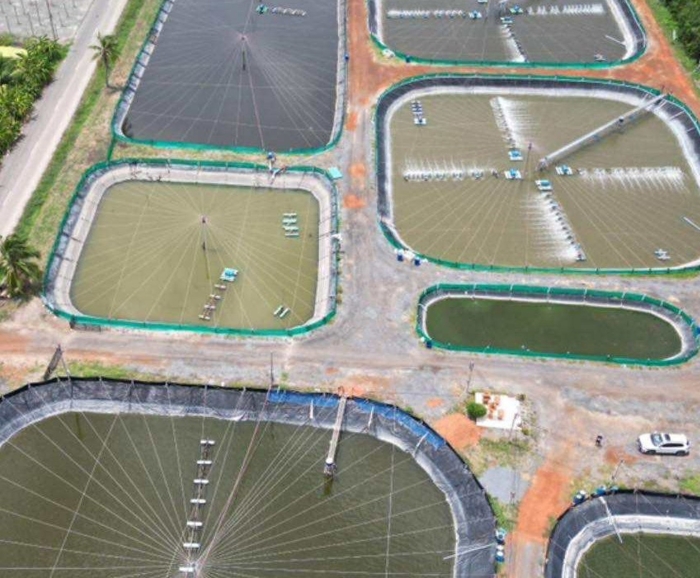
This is a smart farm, using startup HydroNeo’s technology to obtain accurate water quality measurements using high-quality sensors. High-efficiency motors reduce energy costs by 30%. The farm employs biofloc technology and maintains a pH range of 7.5-8, carefully keeping a 0.2 difference between day and night. The feed conversion ratio (FCR) is 1.1, and the average daily growth (ADG) is 0.2g, measured until the shrimp reach 30g. Khun Chalee continues to seek and remains open to innovations. He recently conducted a trial using pure oxygenation technology to evaluate its potential to improve overall farm performance and to assess the economic feasibility of adopting this technology.
How probiotics are helping to improve crop success
Due to an effective campaign in Thailand discouraging the use of antibiotics, shrimp farmers have increasingly turned to probiotics. Additionally, inconsistent crop cycles prior to the pandemic led many farmers to seek alternative approaches. Success rates—measured by the proportion of crops reaching profitable harvests in regions such as Chachoengsao—had generally remained low.
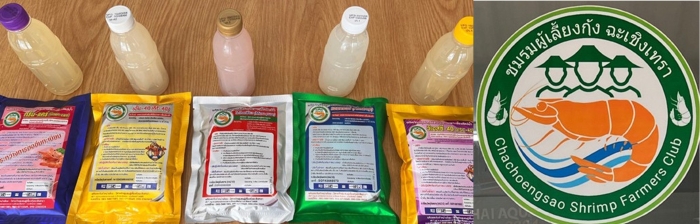
To address this, the Chachoengsao Shrimp Farmers Club began producing five probiotic strains in-house to help reduce organics, ammonia, nitrate, and harmful bacteria linked to early mortality syndrome (EMS) and white faeces syndrome. Most farmers use these probiotics primarily to control ammonia levels as a preventive measure.
Today, many farmers attribute their success to probiotic use. The club has invested in staff training for three months at the Department of Fisheries, focusing on product quality monitoring, reformulating products with new bacterial strains and quality control. Certification is granted by the Department of Fisheries. The probiotics produced at the Club’s centres are exclusively for members. “
If we do not come together, we will not survive in this industry,”
said Chalee.
Although primarily formulated for pond application, these probiotics can also be used as a top dressing for feed. However, due to their lack of heat tolerance, these products are not recommended for incorporation during feed milling. The probiotics are available in both liquid and powder forms.
Data from the centre indicate that nearly 90% of farms in Chachoengsao currently utilise probiotics. Farmers typically submit water samples, after which centre technicians provide guidance on selecting appropriate probiotic products. The probiotics market remains highly competitive, with numerous suppliers. However, the centre benefits from member-driven product testing.
All testing and registration activities are facilitated by Mahidol University, while BIOTEC, Thailand’s National Center for Genetic Engineering and Biotechnology, leads probiotic development work. BIOTEC collaborates with universities and companies to isolate and characterise Thai-native probiotic strains, such as Lactobacillus paracasei and Bifidobacterium animalis.
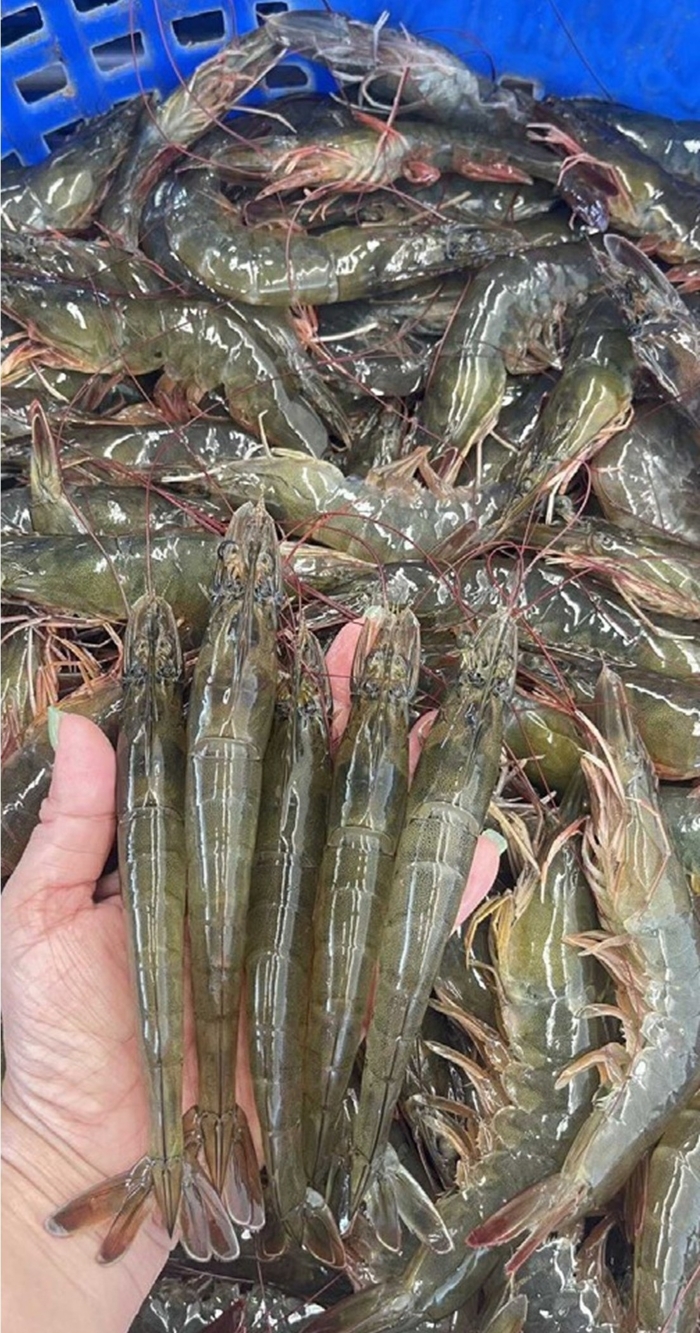 In Chachoengsao, shrimp ponds typically measure approximately one rai, with stocking densities ranging from 50 to 100PL/m2. The province plays a major role in Thailand’s overall shrimp production, which reached 300,000 tonnes in 2024. Chachoengsao is expected to produce about 108,000 tonnes, with daily sales to the local market averaging 300 tonnes. Harvested shrimp tend to be small-size at 80/kg. In March, farmgate prices were around THB 140/kg (USD4.3) for size 80/kg and THB 220/kg for size 50/kg (USD6.8) aligning favourably with prevailing production costs.
During discussions at the centre, Khun Chalee and Khun Somprasong reported a 7% increase in production following the implementation of shrimp health monitoring via PCR testing and regular water quality assessments. The Department of Fisheries (DOF) supports these water quality analyses. Previously, the success rate stood at approximately 3-5 out of every 10 ponds. With the introduction of probiotics, this figure has risen to 8 out of 10 ponds.