
Enterocytozoon hepatopenaei remains a silent yet pervasive threat to shrimp aquaculture worldwide. Now, a new breakthrough brings unprecedented speed and insights to manage its risk
Silent but pervasive threat to shrimp aquaculture
White faeces disease (WFD) has emerged as a significant threat to shrimp aquaculture, characterised by floating white faecal strings and pale midguts in affected animals. One of the causative agents of WFD is Enterocytozoon hepatopenaei (EHP), a microsporidian parasite responsible for hepatopancreatic microsporidiosis (HPM). First identified in Thailand in 2004, EHP has rapidly spread across major shrimp-producing regions in Southeast Asia and Latin America.
Although EHP infections rarely result in acute mortality, their chronic impact on shrimp health and farm productivity is profound. Infected shrimp exhibit poor growth performance and reduced feed conversion efficiency. This leads to uneven size distribution, extended production cycles, and diminished harvest value. The economic losses caused by EHP alone were estimated to be USD~560 million in India (2018-2019) and USD~230 million in Thailand (2018). As the pathogen continues to spread, its management has become a focal point for the industry to sustain the viability of shrimp farming operations.
“Symptoms are often absent or mild in early stages, infections frequently go unnoticed until performance losses become apparent.”
Persistent and tiny spores
The biological characteristics of EHP add to its threat. Its oval spores, measuring approximately 1.1–1.7μm X 0.7–1.0μm, can persist in pond water, sludge, and organic matter even under harsh environmental conditions. Once a shrimp is infected, (im)mature spores multiply in the hepatopancreas and are shed via faeces, rapidly seeding the pond environment and contributing to pond-wide transmission. Compounding the challenge is EHP’s subclinical progression; symptoms are often absent or mild in early stages, which means infections frequently go unnoticed until performance losses become apparent.
A new early-warning tool:
EHP indicator
Recent studies suggest that environmental EHP levels in pond water and sediment are linked to infection levels in shrimp. Active outbreaks showed spore loads ranging from as little as 101–103 DNA copies/mL of pond water. This underscores the potential of pond water monitoring as an early-warning system.
By tracking the mature spore concentrations released via the faeces, over time, farmers can detect rising infection pressure before clinical symptoms appear. However, this proactive approach depends on highly sensitive, rapid and cost-effective tools capable of detecting mature EHP spores in complex pond environments.
As ingestion of mature EHP spores forms the main risk factor for infection, measurements of this specific phenotype of EHP, are a crucial piece of information to enable its effective management. Here, we describe the development and application of a new EHP mature spore indicator for rearing environments of hatchery and farm environments in Vietnam and Thailand.
Capturing information on single EHP spore
At the core of the EHP Indicator is KYTOS’ proprietary single-cell analysis platform (Figure 1), which merges advanced microbiological profiling with machine learning to create predictive indicators. The process begins with the analysis of purified reference material from infected Penaeus vannamei, which is then analysed on the KYTOS platform to capture information on every single EHP spore particle.

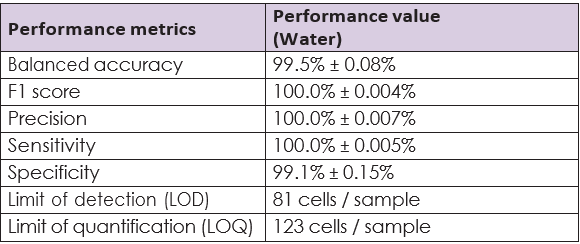
Proprietary machine-learning workflows are then used to fine-tune models capable of detecting these mature EHP spores in the presence of naturally occurring microbiota from shrimp ponds and hatcheries. In our case, this training data comprised more than 600 million single-cell data points from shrimp ponds (water, gut and hepatopancreas) and yielded highly robust model accuracy (99.5 %) and overall performance (Table 1).
Rapid insights for farmers
The beauty of this approach is that through a simplesoftware update, these predictions can be made available to all customer data analysed by the Kytos platform. The EHP Indicator quantifies mature spore loads and embeds them within a predictive framework, enabling farmers to detect infection pressure before visible symptoms arise. By providing early warning, it empowers shrimp producers to make informed management decisions, from strengthening biosecurity and adjusting feeding strategies to applying targeted pond interventions.
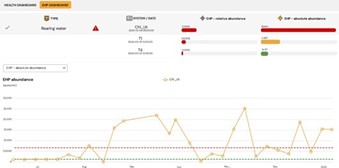
Delivered through the Kytos platform, the dedicated EHP dashboard transforms complex microbiome data into clear, actionable insights: spore density trends are visualised in real time, benchmarked against an extensive country-specific database and contextualised to distinguish background levels from critical infection thresholds (Figure 2). A continuous monitoring of pond water and shrimp tissue allows producers to detect deviations from baseline microbial conditions, anticipating outbreak risks with time to intervene.
This data-driven approach shifts disease management from reactive treatment to proactive prevention, resulting in improving crop outcomes, reducing economic losses, and enhancing sustainability. Integrated into a broader microbiome analysis service, the EHP Indicator is complemented by more than 25 additional indicators spanning bacterial, algal, and fungal groups, providing a comprehensive view of pond health.
Each sample can be analysed in under one minute, delivering all indicators – including EHP risk markers – with rapid turnaround, automated updates, and seamless digital access. Its strength lies in detecting mature spores rather than residual DNA, leveraging single-cell analysis and AI-powered models trained on over 100,000 aquaculture samples, and validated across thousands of real-world shrimp datasets. Robust to pond variation, geographic diversity, and farming practices, the EHP Indicator delivers accuracy, scalability, and real-time feedback, turning microbiome data into practical tools to achieve more profitable shrimp farming.
Cross-country differences in spore loads
Using this new model, EHP mature spore predictions were made on data of farms in our early-testing program to evaluate differences across geographical and market segments (Figure 3).
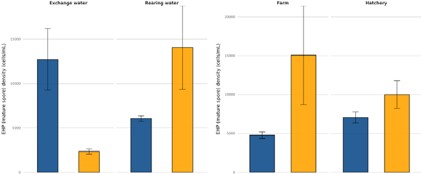
In Thailand, aggregated data indicated considerably higher EHP levels in exchange water than in rearing water, suggesting that incoming water may serve as an important contamination source. In contrast, Vietnamese farms exhibited much lower EHP densities in exchange water, likely reflecting the widespread application of stronger disinfection and water-treatment protocols. Nevertheless, EHP concentrations increased sharply in rearing water, pointing to internal amplification during culture despite clean water inputs.
At the production stage level, hatchery samples from Vietnam tended to show higher EHP spore densities than those from Thailand, potentially contributing to the elevated loads later observed in farm systems. These patterns underscore the critical link between hatchery biosecurity, post larvae (PL) quality, and the downstream risk of EHP outbreaks in grow-out ponds. Identifying the points at which contamination is most likely to occur provides a basis for targeted preventive measures that safeguard shrimp health and improve production performance.
EHP changes with seasons
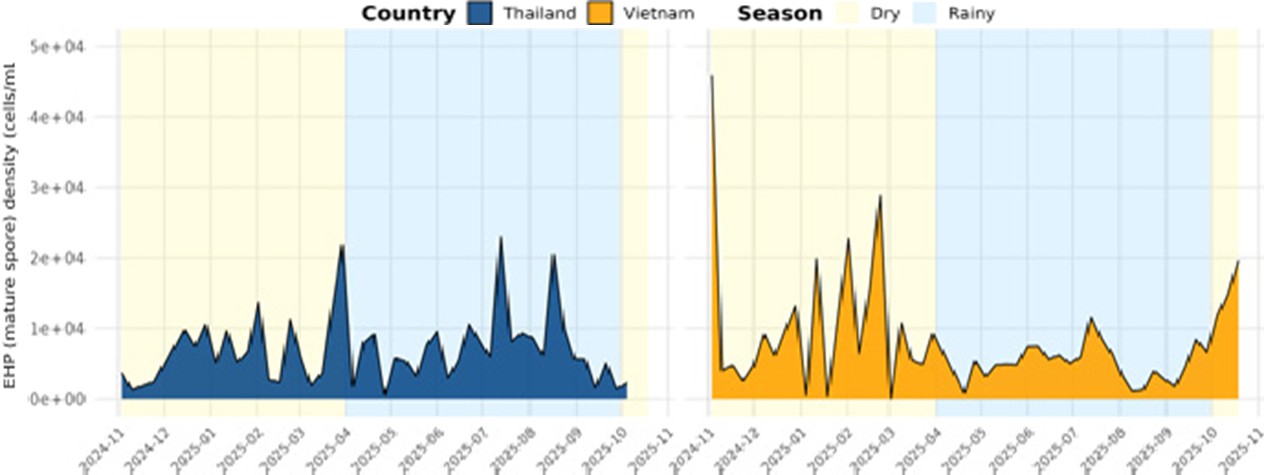
Seasonal patterns in EHP spore densities revealed clear geographical differences between Thailand and Vietnam (Figure 4). In both countries, EHP levels fluctuated across dry and rainy seasons, reflecting the influence of environmental conditions and management practices on microbial risks in shrimp ponds. Thailand displayed more stable yet persistent EHP signals throughout the year, whereas Vietnam showed greater volatility during the dry season. These trends highlight the interaction between seasonality and water management in shaping pathogen pressure.
To capture these dynamics more effectively, the Kytos team updates its microbial monitoring database continuously. This growing dataset enables the identification of emerging trends, local risk periods, and region-specific responses to management practices.
By collaborating closely with industry stakeholders, Kytos translates microbial insights into practical recommendations that support early detection and farm management. Continuous monitoring not only reveals how EHP behaves across seasons but also empowers producers to make informed, data-driven decisions that enhance shrimp health, improve production outcomes, and build long-term resilience.
Acknowledgments
The development of the EHP Indicator is the result of the collective efforts of KYTOS teams in Belgium, Thailand, and Vietnam, whose dedication and creativity were instrumental in bringing this innovation to fruition (Ruben Props, Bui Ngoc Minh Ngan, Doan Dang Quynh, Hoang Truc Linh, Waraporn Tongyos and Tita). This work was supported by the Flanders International Climate Action Programme (FICAP) through the project “Sustainable Water Management for Aquaculture in Southeast Asia through Innovative Microbial Management” (IKF 23/059).
This article was first published in Aqua Culture Asia Pacific November/December p37-39. https://issues.aquaasiapac.com/view/717436716/38/#zoom=true


