
The Norwegian Seafood Council’s latest consumer trends report outlines the key drivers shaping China’s growing appetite for seafood
 The annual seafood consumer trends report from the Norwegian Seafood Council (NSC) has this year shifted its focus to the Chinese market. With a deep dive into this global superpower, Seafood Trends 2026: The China Report showcases market snapshots, interviews with NSC representatives and industry experts, and the latest insights on seafood consumption across China.
Global trends boosting the Chinese seafood market
With a population of more than 1.4 billion – concentrated in cities and urban areas around the southeast – China is a nation of diverse cultures and food preferences.
As in previous years, the NSC’s seafood consumer trends report outlines global megatrends and how they manifest for seafood consumers. So, how do these food trends show up in the Chinese seafood market?
- Growing middle class and declining birth rates
- Growing number of single-person households
- Supply chains, geopolitics and tariffs
- Focus on convenience and health

According to Sigmund Bjørgo, NSC Country Director in China:
“These global megatrends create movement in the Chinese seafood market and play an important role in consumer purchasing decisions. These trends influence consumers’ trust, preference and overall behaviour.
“China’s emergence as the fastest-growing market for Norwegian seafood exports in the past year has made it crucial to understand more of the mechanisms in Chinese consumer behaviour behind this fast-growing market.”
Rapid value growth for Norwegian seafood in China
In 2025, China emerged as the market with the highest value growth for Norwegian seafood, with an increase in export value of NOK 2.9 billion (31%) compared with the previous year. China purchased Norwegian seafood totalling NOK 12.3 billion and stepped up from being the sixth largest market in 2024 to the third largest market in 2025.
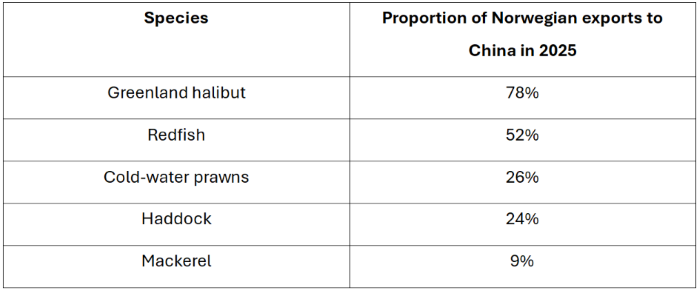
Chinese consumers’ willingness to try new species
China’s vast size and population give way to a host of diverse cultures with different food traditions. The country’s eight regional ‘great cuisines’ are defined by heritage and flexibility, with different tastes based on centuries of tradition combined with a consumer willingness to try new things due to the variety on offer.
Bjørgo elaborates: “In fact, this is very much part of the Chinese philosophy of always being on the path of learning. This openness has only increased over recent decades as Chinese spending power has grown.”
This openness extends to imported food too, Bjørgo explains. But do imported foods always need to cater to local flavours and tastes?
In the case of salmon, Bjørgo says: “So far, salmon isn’t widely relevant to local tastes. In China salmon equals sashimi – full stop. And sashimi is by definition a foreign food. It is Japanese food and most people eat it for the first time in a Japanese restaurant. There isn’t even much focus on sushi – that is a small slice of the salmon category. It really is mainly sashimi.”
Though Norwegian salmon is cold-chain reliant, the fact that the product is favoured by the rising middle class as a high-value species serves as further proof that this is a product that arrives fresh – and can be trusted.
Showcasing new research and industry insight
In addition to insights from Bjørgo and NSC Marketing Advisor Savindar Xie, Seafood Trends 2026: The China Report features interviews with Rabobank analyst Novel Sharma and Undercurrent News journalist Louis Harkell, as well as the latest insights on the Chinese consumer.
Differing from previous reports, the NSC’s approach to consumer research this year was a case study of 24 shoppers, as they planned and shopped for their meals. The shoppers were split across the traditional tier-one cities of Shanghai, Beijing, Guangzhou and Shenzhen, and consumer habits were tracked across seven days of purchasing in October 2025.
According to NSC Consumer Analyst Lars Moksness:
“We wanted to dive deeper into the specifics of consumer behaviour and get detailed insights and answers from the people who participated. Through this new research, we’ve gained powerful new understanding of what influences the Chinese consumer.”
As China continues to evolve into one of the world’s fastest growing and most dynamic seafood markets, understanding the forces shaping consumer behaviour is crucial. To explore these insights in greater detail, access Seafood Trends 2026: The China Report and discover the intricacies of this rapidly expanding market.


