Farming in coastal ponds, often in rotation with shrimp, is an option for this pompano, but largequantity seed availability is a bottleneck
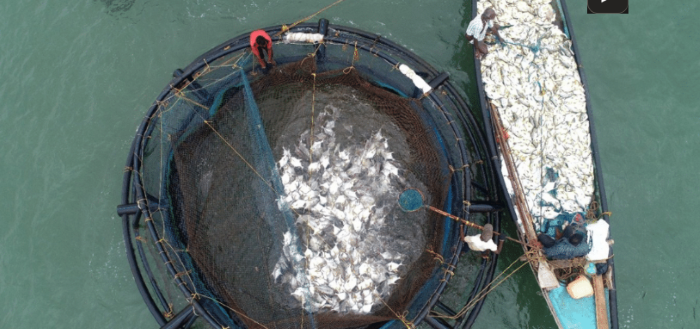
Indian pompano: an emerging candidate for coastal aquaculture and mariculture in India Farming in coastal ponds, often in rotation with shrimp, is an option for this pompano, but large quantity seed availability is a bottleneck By Sekar Megarajan, Ritesh Ranjan, Biji Xavier, Joe K. Kizhakudan, Jayasree Loka, Boby Ignatius and K Madhu48Industry Review – Marine Fish India has emerged as a global leader in fisheries, ranking second in aquaculture production, third in capture fish production, and second in total fish production, contributing to 8% of global fish output. India is a global player in shrimp farming in brackish and low saline waters. However, it lags behind in production from mariculture and coastal aquaculture despite having vast marinere sources, supported by an 11,098.81 km-long coastline. The projected mariculture production potential is 4-8million tonnes annually, yet current mariculture production remains below 0.1 million tonne.
Therefore, to enhance mariculture production, several fisheries research and development organisations have taken initiatives under various government schemes, such as the Pradhan Mantri Matsya Sampada Yojana(PMMSY) through the National Fisheries Development Board (NFDB), Hyderabad. The promotion and adoption of some mariculture technologies and practices will certainly require established husbandry protocols; well-developed breeding and seed production systems; and nursery, farming and feeding protocols for selected commercial species, with adequate hands-on trainingand skill-sharing to support upscaling.
However, availability of fish species with closed-cycle and hatchery seed production and suitability for farming is key to developing a mariculture industry.
Together, institutions such as the Central Marine Fisheries Research Institute (CMFRI) and Central Brackish Water Aquaculture (CIBA) under the Indian Council of Agricultural Research (ICAR) have achieved breeding for more than a dozen marine and brackish water finfish species. At present, half a dozen finfish, namely the Asian seabass (Lates calcarifer), pearl spot (Etroplus suratensis),cobia (Rachycentron canadum), orange-spotted grouper(Epinephelus coioides), silver pompano (Trachinotusblochii) and Indian pompano (Trachinotus mookalee) havebeen introduced for farming in different farming systems.
The Indian pompano is one of the fast-emerging candidate marine finfish for mariculture and coastal aquaculture. Success in captive breeding and seed production was achieved in 2016 by ICAR-CMFRI at Visakhapatnam Regional Centre (CMFRI), according to Ranjan et al. (2018).Following this success in seed production, the farming feasibility of the species was tested, and technology standardised for sea cages, coastal cages, and coastal earthen pond-based farming systems under the All India Network Project on Mariculture (AINP-M) funded by ICAR.
All the developed farming methods were demonstrated on a large scale under the Blue Revolution Schemes by NFDB. Following successful farming demonstrations and performances in a range of systems, farmers are interested in farming the Indian pompano. The species has several advantages. It is easy to breed, readily accepts formulated pellet feed and adapts well to different farming systems. It can be farmed with other species such as white shrimp, mullet and milkfish. It also demonstrates moderate growth, has a pleasing appearance and offers good taste and nutritional value. Strong consumer preference and solid domestic and export market potential have attracted growing interest from a diverse range of stakeholders(Megarajan et al., 2021).
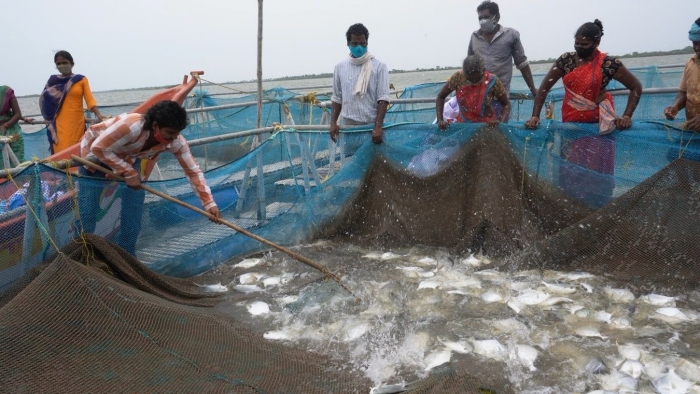
R&D have helped promote the species through several schemes implemented by the Government of India (GOI).For example, the Indian pompano is included as one of the major thrust areas of research in aquaculture and marine biotechnology programs by the Department of Biotechnology (DBT) and the species has been prioritised to be developed and scaled up under a Nucleus Breeding Centre (NBC) for marine fish species under the PMMSY scheme of the Department of Fisheries, Ministry of Fisheries, Animal Husbandry & Dairying, GOI.
Farming systems for the Indian pompano
Marine finfish farming can be carried out in land-based artificial facilities such as tanks and ponds, cage-based onshore aquaculture and recirculating aquaculture systems (RAS) with complete control over water quality parameters. In well-sheltered land-based aquaculture systems, fish are closely monitored according to management practices.
“Studies have shown that the fish species is suitable for nursery rearing in RAS and grow-out farming in sea cages, coastal cages and coastal earthen ponds.”
In offshore aquaculture which involves enclosed sections in open waters, fish are kept in cages and exposed to diverse natural conditions such as currents and nutrient cycles. Each approach has its unique advantages and challenges. The selection of culture system depends on species, environment, sustainability, and technology. Years of trials and commercial demonstrations for Indian pompano have produced an evolved, turn-key approach for standard operations. Studies have shown that the fish species is suitable for nursery rearing in RAS and grow-out farming in sea cages, coastal cages and coastal earthen ponds.
Sea cage farming
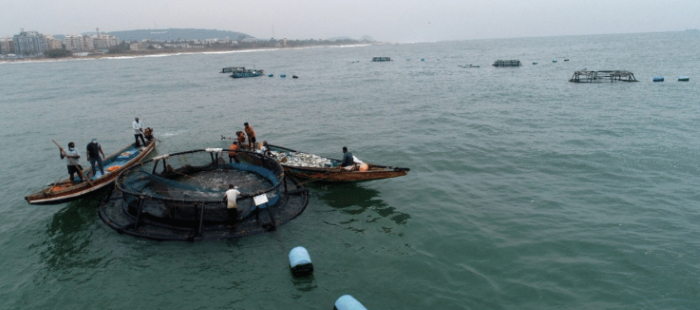
In India, trials on sea cage farming were initiated under research and demonstration activities by ICAR-CMFRI from 2006-2007. The cage culture technology has under gone several modifications in terms of design, anchorage, materials, minimum stocking sizes, stability in different climatic conditions and standardisation with different culture methods and material fabrication. At present, sea cages with HDPE frames of 6m diameter and a 4m depth (~110m3volume) are considered to be best suited for marine finfish farming in India’s coastal state.
To increase cage culture production, a preliminary survey estimated that a total of 134 sites covering an area of46,958.2ha are suitable for marine cage farming in India’s territorial waters. Sea-cage fish farming demonstrations have been carried out in Andhra Pradesh and Odisha on the east coast under NFDB-sponsored programmes. Also, research on larger-diameter (15m) cages for Indian pompano farming is being conducted by ICAR-CMFRI at the Visakhapatnam Regional Centre.
The developed technology suggested stocking pompano fish fingerlings of around 20g and growing for ~10 months to reach 750g-900g, with a feed conversion ratio (FCR)varying from 1.8 to 2.2. The recommended stocking density is 25 fingerlings/m3and the optimum carrying capacity is a maximum of 15-18kg/m3. Sea cage farming of the species in a cluster of 10 cages will generate an annual profit of approximately INR1.7 to 2.0 million (1USD = 85 INR).However, the profit margin varies with factors such as feed cost, FCR and farmgate price at harvest.
Coastal cage farming
Estuaries and backwaters are important ecosystems for improving the livelihood of marginal coastal farming communities. India has about 2.0 million haof backwaters, coastal lagoons and low-lying areas, potential sources for cage farming.
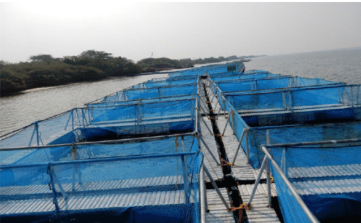
At present, coastal backwater cages made of galvanisediron (GI) pipes (5x5m in size with a 3m net depth and ~75 m3volume) are considered the best-suited design for marine finfish farming in different regions. Coastal cage farming technology for Indian pompano was initially standardised and demonstrated in more than 300 cages under different schemes by NFDB. ICAR-CMFRI promoted community-based development schemes.
The culture period for coastal cage farming is limited toa maximum 7-8 months due to the different monsoon seasons in India. The established farming technology showed that pompano fingerlings of 15-20g stocked at an optimum stocking density of 20 fingerlings/m3, reach an average size of 650-700g in 7 months. Feeding fish with formulated floating pellet feeds with 40-45% crude protein (CP) and 10% crude fat (CF) gave better results. FCR ranged from 1.7 to1.9. The net profit was calculated at up to INR70,000-85,000/cage when there was a cluster of 10 cages. Coastal cage farming of pompanohas emerged as an important livelihood option for coastal fishing communities and small-scale aquafarmers near the backwaters.
Coastal pond-based farming
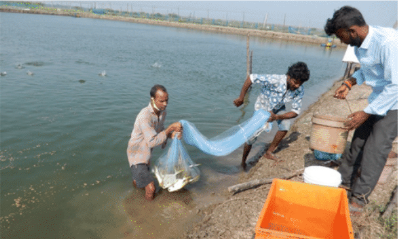
India has significant potential for coastal aquaculture, with approximately 1.2 million ha of suitable brackish water areas, of which only about 15% is currently developed. India’s coastal aquaculture is predominantly dominated by farming of shrimp Litopenaeus vannamei and Penaeusmonodon and a small portion is used for fish such as Asian sea bass, milkfish, mullet and, more recently, pompanos (silver and Indian pompano).
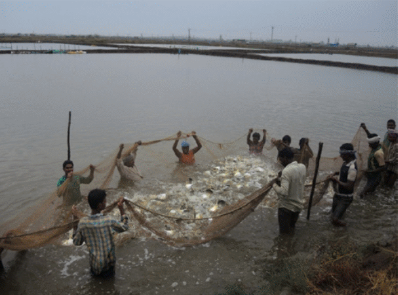
Coastal pond farming technology for the Indian pompano was initially demonstrated under an NFDB-funded project from 2018-2020 in Andhra Pradesh. Now the species has been cultured in approximately 100ha in different Indian states. Observations on coastal pond-based farming showed that the pompano can be cultured at salinities ranging from 5-35ppt, either in newly constructed ponds or existing shrimp ponds. The optimum stocking density for 10g fingerlings is 1.5 fish/m2. Under these conditions, the fish can grow up to 850 to 1000g within 11-12 months, achieving a maximum production of 8.5 to 9.0 tonnes/ha.
Rotation of pompano and shrimp
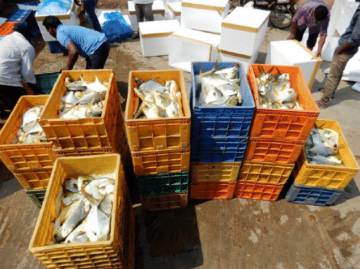
However, many farmers prefer to culture the species in shrimp ponds as part of a short-term crop rotation cycle. Nursery-reared fish of 30-35g are stocked in ponds and harvested at 500g in 5-6 months. Thereafter, the same pond is used for shrimp farming in the next cycle. In coastal ponds, fish are fed a commercial formulated feedof 40-45% CP and 10% CF. FCR ranges from 1.5 to 1.8 and can still be further reduced with higher natural productivity in pond waters. The average profit margin was INR100/kg and better margins achievable through effective feed management.
With uncertainties in shrimp farming operations, farmers can now look at finfish species in demand in domestic markets as alternatives. Thus, Indian pompano has become an emerging species due to immediate acceptance of pellet feed and comparatively fewer issues with size variation, cannibalism, marketability and growth duration.
Conclusion
Globally, the pompanos are emerging as an importantmarine finfish. Among the 20 different species in thegroup, the snubnose pompano (Trachinotus blochii)and golden pompano (Trachinotus ovatus) have a highmarket value. They are widely farmed in Asia, includingChina, Taiwan, India, and Indonesia. Florida pompano(Trachinotus carolinus) is a highly desirable species in theUnited States, with a significant market price. As a result ofincreased farming operations, the pompano is now listedin FAO’s marine and coastal aquaculture finfish productionstatistics, with 1.9% (0.16 million tonnes) of marine finfishproduction in 2020.
Similar to other pompano species, the Indian pompanois gaining momentum in Indian aquaculture and addingvalue to the existing farmed pompano species. Thefarming of pompano is gaining interest to its appealingcharacteristics such as quick adaptation to differentfarming conditions, acceptance of formulated feed andlow likelihood of cannibalism.
The fish is highly esteemed among culinary circles forits mild flavour and delicate, flaky texture, and it lendsitself well to whole-fish preparations, especially whengrilled and presented in various styles. With these positivecharacteristics, pompano farming is gaining popularityamong farmers, but the lack of seed availability is abottleneck to its potential expansion.
To overcome this issue, ICAR-CMFRI have entered intoa Memorandum of Understanding (MOU) with variousprivate and government hatcheries. Progress in the seedproduction and farming technology for the species willhelp expand the production of farmed pompano.
References
Gopalakrishnan, A., Ignatius B., Suresh VVR. 2022. MaricultureDevelopment in India: Status and Way Forward. Indian J. PlantGenet. Resour. 35(3): 317–321.FAO. 2024. The State of World Fisheries and Aquaculture 2024– Blue Transformation in action. Rome.https://doi.org/10.4060/cd0683en
Above authors are with the ICAR-Central Marine Fisheries Research Institute, Regional Centre in Visakhapatnam, Andhra Pradesh, India.