
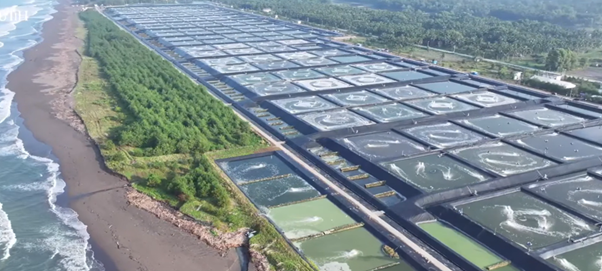
President Prabowo Subianto conducted a shrimp harvest and inspected the harvest sorting process at the Area-Based Shrimp Farming (BUBK) in Kebumen, Central Java, on Saturday, May 23, 2026.
The project was developed using the best practices of modern shrimp farming through an integrated management system that includes intake channels, reservoir ponds, separate inlet and outlet channels, production ponds, a wastewater treatment plant (WWTP), and other supporting facilities.
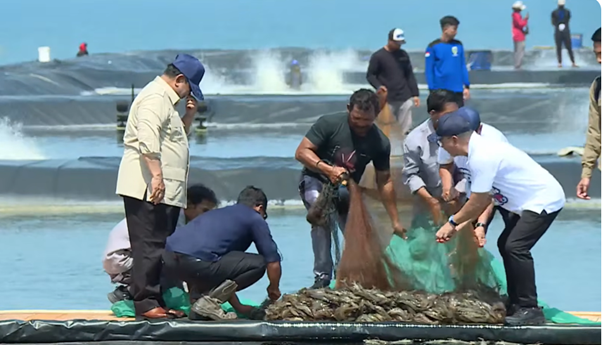
This is the 8th shrimp harvest. “A hectare can produce 40 tonnes. It’s extraordinary, 40 tonnes, and the price is very good, IDR70,000/kg and IDR70 million per tonne” said the Head of State.
The Kebumen shrimp farm project, located in Tegal Retno Village, Petanahan Sub-district, is a national strategic project built during the 2022-2023 period. The 100-ha area currently operates 65 ha of land equipped with a seawater intake system, 139 production ponds, and integrated waste-water treatment facilities.
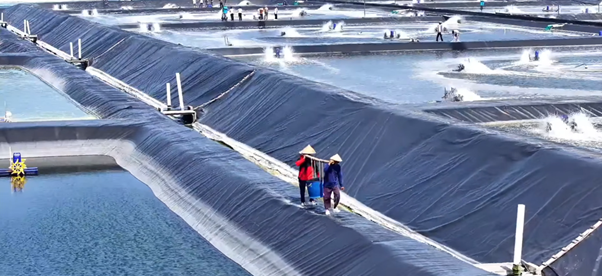
It is a driving force for the regional economy, employing 145 permanent workers and 500 casual workers daily, and has also become a model for the modernisation of national shrimp farming.
The Kebumen BUBK has a significant economic impact. With 206 ponds, the area’s production value reaches around IDR 67.2 billion per cycle, or potentially IDR 134.4 billion per year. The presence of this modern aquaculture area can also absorb hundreds of workers.
Furthermore, the government is currently implementing a similar project on a larger scale in Waingapu, East Sumba Regency, East Nusa Tenggara Province. Meanwhile, the Kebumen BUBK is positioned as an example of transforming traditional aquaculture into a modern system based on technology and better environmental management, as well as serving as a model for the development of the national fisheries sector.
“So this is very good, very productive. It can now employ 650 local people, and we have already developed 2,000 ha in Waingapu,”
added President Prabowo.
“We are developing 2,000 ha of pond in Waingapu, 65 ha here, 200 ha in Gorontalo, and 14 ha in Pantura (North Coast Area) route in West Java. Unlike here in Kebumen, which focused on shrimp farming, such project in North Coast will focus on fish farming.”
The government views shrimp as a national strategic commodity that not only contributes to food security but also has great potential to increase the competitiveness of Indonesian fishery exports in the global market.
Furthermore, Indonesian shrimp has the potential to become a sustainable foreign exchange earner with modern pond management and the implementation of good aquaculture practices, as modeled at the Kebumen BUBK.
This shrimp harvest also underscores President Prabowo’s consistency in developing the marine and fisheries sector. From Kebumen, the policy direction is increasingly clear: modern cultivation, high productivity, labour absorption, and export orientation are a combination that positions shrimp as a new engine of national economic growth.


