
This is a Singapore’s first high-tech, land-based rainbow trout farm — engineered to scale to a final design capacity of up to 3,000 tonnes of premium trout a year.
According to Blue Aqua, this trout farm shows how a land-scarce, tropical city can produce premium cold-water seafood locally — through proven recirculating aquaculture, controlled-environment engineering, data-driven monitoring and disciplined biosecurity. It is a working contribution to Singapore Food Story 2 and the national goal of producing 30% of local protein needs by 2035.
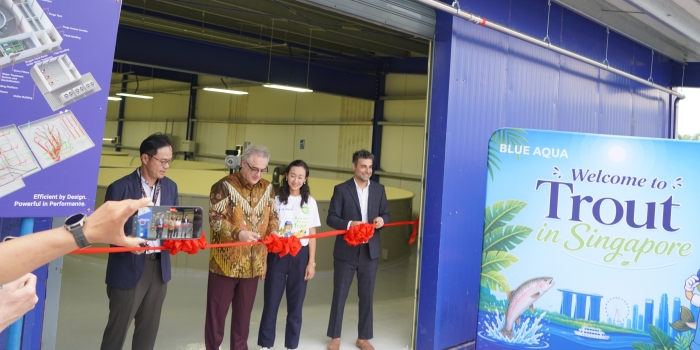
On June 4, at the sidelines of World Aquaculture 2026 Singapore (held over 2-6 June) Blue Aqua International Group organised a soft launch of its rainbow trout farm, a high-tech, land-based aquaculture facility producing premium rainbow trout (Oncorhynchus mykiss) locally — the first of its kind in Singapore.
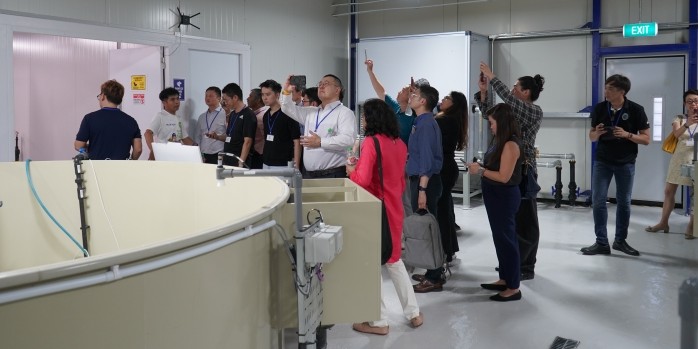
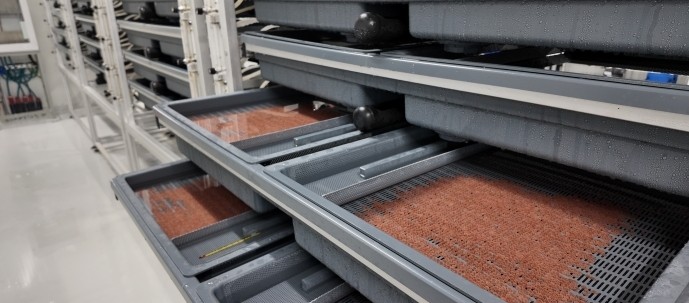 Recently commissioned, the farm will start production with an initial capacity of 1,200 tonnes a year and is engineered to scale to a final design capacity of up to 3,000 tonnes annually. It runs on an advanced recirculating aquaculture system that manages water quality, oxygen, temperature, feeding, fish health and biosecurity within a fully controlled environment — allowing a cold-water species to be grown reliably in Singapore’s tropical climate.
The project is a practical contribution to Singapore Food Story 2, the national food-resilience strategy under which Singapore is working towards producing 30% of its local protein needs by 2035, with seafood counted as protein.
“This is a new chapter for aquaculture in Singapore. We are showing that even in a land scarce, tropical country, you can produce premium cold-water fish locally — with the right technology, the right science and real operational discipline,” said Dr. Farshad Shishehchian, Founder & Group Executive Chairman, Blue Aqua International Group.
Backed by a planned SGD 45 million investment, the facility integrates controlled environment engineering, advanced water recirculation, data-driven monitoring and strict biosecurity to improve production predictability and reduce exposure to external environmental risk.
“Food resilience cannot rest on importing more. It has to include building real local capability. This farm is part of that answer — a practical, scalable way to produce high quality seafood close to the people who eat it.” added Shishehchian.
Rainbow trout was chosen as it is is a premium, nutritious, widely appreciated fish that has not been produced
locally in Singapore before. Local production offers a fresher, more resilient alternative to relying entirely on imported cold-water fish. Through a controlled recirculating aquaculture system, temperature, oxygen, water quality, feeding and biosecurity are closely managed inside the facility, so the climate outside does not constrain the fish inside. With regards to energy use, Blue Aqua noted that the controlled system is designed for efficient water reuse, strong biosecurity and controlled waste management, with far less exposure to external environmental risk than open systems. Energy is an honest consideration for any RAS facility, and Blue Aqua is exploring clean-energy partnerships to improve energy and carbon efficiency over time.
Blue Aqua International Group was founded in Singapore in 2009 and has grown into an international aquaculture group spanning farm care, nutrition, breeding, diagnostics, shrimp and fish farming, and AI-enabled farm intelligence. The soft launch begins phased commissioning and commercial ramp-up. The farm is designed as a replicable template that
Blue Aqua intends to adapt for other markets across Southeast Asia, the Middle East and North Africa.


