Driven by retailer demand in Europe, Shrimp Welfare Project is collaborating with farms to replace ‘chill kill’ methods.
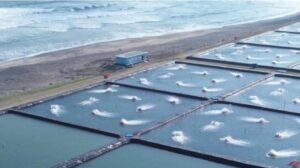
As a growing number of seafood markets adopt increasingly stringent animal welfare policies, the use of pond-side electrical stunners prior to slaughter is emerging as a way to elevate the welfare of farmed shrimp.
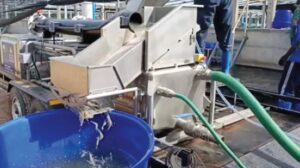
While shrimp stunners have been commercially available for only a few years, the technology has recently gained significant momentum. Thanks to Shrimp Welfare Project, whose Humane Slaughter Initiative’s most eyecatching promotion is the provision of these devices to select shrimp farms, for free, as well as technical support to help producers to integrate the stunner into their harvest process.
While the non-profit’s main goal (as its name suggests) is to promote the welfare of farmed shrimp, they realised that the best way to do so is to provide farmers with effective tools that require minimal intervention and deliver maximum impact. A single stunner has the capability to reduce the suffering of millions of shrimp every year while also opening up high-welfare markets for the farmers’ produce.
It is a compelling theory and has been gaining increasing momentum along the shrimp value chain – with 31 agreements to take part in the initiative now signed and over 20 stunners already supplied to producers – in countries as diverse as Vietnam, Indonesia, Thailand, India, Sri Lanka, Nigeria, Ecuador and Honduras.
“We had the first interest in Latin America and it is still going strong there but now we are having more MOUs in Asia than any other region,”
notes Lien-Huong Trinh, Shrimp Welfare Project’s Director of Programm Implementation, who has played a key role in the nonprofit’s corporate engagement since the initiative was launched in 2023.
How it works
While traditional slaughter methods involve crowding the shrimp, then transferring them by pumps or nets into an ice slurry, a method known as ‘chill kill’, the electrical stunners render the shrimp unconscious before they are immersed in ice.
Isamel Wong, CEO of Seajoy, which produces around 4,000 tonnes of shrimp a year in Honduras, has embraced the use of electrical stunning, following initial trials early last year and is currently awaiting the delivery of a third stunner as part of the Humane Slaughter Initiative.
Wong, who has been in the shrimp sector for four decades, points to Seajoy’s early adoption of other welfare measures, including the move away from eyestalk-ablated broodstock, an impressive 14 years ago, making them a natural fit for more humane slaughter methods.
From a practical perspective, according to Wong, the technology has been relatively straightforward but not without its challenges, to implement.
“We needed to make some adjustments and small modifications based on our farm conditions, in order to keep the flow of the harvest. It takes time to do all these adjustments and to understand the equipment for maintenance. But it works,” he reflects.
William Davies of Young’s Seafood, whose shrimp sources include producers in Vietnam who use the stunners, emphasises that process design is critical.”It is important to make sure the machines are fed right – how the shrimp are moved from their ponds or tanks into the stunner,” he stresses.
While initial training is provided by Shrimp Welfare Project, ensuring adherence to best practice is critical from a welfare perspective. As Trinh stresses, shrimp must be stunned as quickly as possible after removal from the ponds and then immediately transferred into the ice slurry under controlled conditions. Delays, insufficient voltage or poorly managed ice temperatures can allow shrimp to regain consciousness, negating welfare benefits.
“We can relate to the challenges, but we really appreciate the effort to improve animal welfare,”
Trinh notes.
Welfare, reputation and market access
The case for electrical stunning rests on both ethical and commercial foundations. Shrimp sentience is increasingly backed by research and the precautionary principle is gaining ground, particularly among European retailers.
For suppliers, this shift is already reshaping sourcing strategies. Jozua Koffeman of Umios Food Europe B.V. (formerly Seafood Connection), another supplier that sources shrimp killed with pre-slaughter electrical stunning points to the influence of retailer demand.
“It is not only a prestige project, but there is also a market in Western Europe for products specifically marketed as increased animal welfare. This is absolutely relevant for shrimp as well,” he notes.
In an environment of increasing scrutiny, this reputational dimension is significant. Davies highlights the pressure from NGOs:
“There have been very targeted direct attacks… creating website content to target the issues on shrimp.”
Electrical stunning, therefore, serves not only as a welfare intervention but also as a form of risk mitigation.
“Our markets are more and more demanding the use of stunning systems,” – Isamel Wong
It is a trend that Wong is also very aware of. “It is more ethical and it has been easy to understand the trends in the industry towards more humane slaughter methods. Our markets are more and more demanding the use of stunning systems.”
However, while the reputational and access benefits are clear, price premiums for farmers remain elusive.
“There is no increase in price but the buyers show a preference for producers that implement better practices like this slaughter system. It opens doors to clients that appreciate a higher standard,” Wong reflects.
“And when we go to the Barcelona trade show (Seafood Expo Global), most of the potential buyers from the European Union will ask if we use stunners.”
Quality: reassurance with caveats
One of the most persistent concerns surrounding electrical stunning is its potential impact on product quality, but these concerns have largely been dispelled by those using the devices.
“If you pick the right parameters… then it has no negative impact on your product quality,” says Trinh, adding that some producers have even seen an improvement in quality parameters.
“Because of the reduction of stress to the animal, we have seen an improvement in the quality of the harvest,” “The slaughter process is faster. The animal does not moult during the harvest process and the product is more homogenous when it arrives at the packing plant.”
agrees Wong.
Davies is less effusive but believes the quality of stunned shrimp is generally high: “We have essentially not been able to find any differences at all… with colour, texture, etc.”
Caveat on post-stunning handling
However, he emphasises that post-stunning handling remains critical. “If anyone is not putting the shrimp into an appropriate ice slurry… there will be quality issues,” he reflects.
There are also technical risks. As Davies cautions: “If the voltage is too high… it can create burn marks on the shell. That can be a quality negative.”
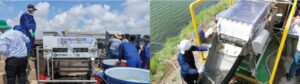
While electrical stunning achieves quality parity with chill-killed shrimp, others favour another emerging technology.
“What I hear in the sector is that the perceived quality of the taste of the product of flash frozen is highest, and ice slurry and electric stunning are about the same,”
Koffeman explains.
However, according to Davies, flash freezing has not been accepted by animal welfare groups (including reference to the lobster industry) and for the shrimp side, it requires bulky and expensive machines, hence it cannot be done pond-side, meaning that live shrimp can face long journeys between the ponds and the processing plants, raising welfare concerns.
Cost, complexity and uneven adoption While technological advances have made stunners more compact and accessible, barriers remain. “It still adds complexity and eventually also some cost, because they have to have a longer harvest process,” Koffeman explains.
For producers operating on small margins, even modest increases in time or capital expenditure can be significant. Adoption is therefore uneven, with countries such as Vietnam leading the way; however, the geographical spread is expanding as demand for stunners increases and a growing number of producers are demonstrating that
adding stunners is feasible.
As Koffeman observes, “When producers hear that others already have installed a shrimp stunner, it becomes a
physical thing and they need to compete on this.”
However, stunning is unlikely to become an industry standard until there is an increase in the availability, affordability and adaptability of stunners. As Davies points out: “There is no capacity for all the welfare commitments as it (the availability of stunning technology) stands today. There need to be more supply chains coming online.”
Scaling electrical stunning will also support systems, including training, auditing and certification.
Innovation and the road ahead
Encouragingly, the technology itself continues to evolve. According to Trinh, the manufacturers of the two devices,
currently being used as part of HSI – Ace Aquatec and Optimar – are working closely with producers in a ‘cocreating’ process, resulting in more adaptable and userfriendly designs, as well as advances in accompanying software.
Looking ahead, the development of ‘stun-to-kill’ systems (combining stunning and killing in a single step) could represent a major breakthrough. “It would alleviate a lot of burden for producers,” Trinh says, potentially simplifying operations, while further improving welfare outcomes.
For industry players, the move towards high-welfare production and slaughter protocols is increasingly clear,with shrimp stunning following in the footsteps of the slaughter process expected for other farmed species.
“There is no doubt about the direction of progress,” reflects Davies, who has witnessed a move towards more humane slaughter across a wide range of seafood species during his three decades in the sector.
Wong agrees, with plans to have 100% of Seajoy’s shrimp electrically stunned by the end of 2027, up from 70% this year. Despite benefitting from the market opportunities of being an early adopter, he would like to see more farmers improve the welfare of their shrimp.
“I hope in the future more farms will be more aware on the importance of programmes like the Humane Slaughter Initiative,” he reflects.