
Low soybean meal prices, pushed by US led tariffs supported feed millers, while the benefit of lower fishmeal prices for shrimp feed was short-lived.
A bright spot in 2025 was the fall in soybean meal prices, which helped lower feed costs. Despite continued concern over feed prices, many aquafeed players still viewed 2025 positively overall. In Indonesia, shrimp feed millers were affected by the caesium-137 contamination incident, while producers across the sector faced higher fish and shrimp production costs and lower productivity due to disease. This annual AAP report reviews developments in the aquafeed industry across selected countries, based on input from industry sources. It covers 2025 and, in some cases, developments through to May 2026.
Feed commodities
The aquafeed industry is generally affected by the major ingredients – fishmeal and soybean meal, the supply and consequently their prices. International fishmeal prices are highly influenced by Peru. In Q1 2025, prices started at a low of USD1,600/tonnes due to a successful late 2024 season and strong H1 2025 landings, resulting in a rebound in supply. By year end, even with an increased supply of +8% Y-o-Y, prices moved up to USD1,825 per tonnes.
Soybean meal prices have been in a multi-year low in 2025, driven by higher crush output, weather related supply risks and trade conflicts. Soybean meal traded in the range of USD360–420/tonnes FOB US Gulf, while China as the world’s largest soybean importer remained the price setter at USD430–480/tonnes CIF. The U.S. tariffs pushed U.S. soybean prices down, because China sharply reduced purchases and that decline flowed directly into lower soybean meal prices due to oversupply and weak demand. When whole bean prices fall due to oversupply, soybean meal prices also decline.
This price divergence accelerated the use of poultry byproduct meal as a partial fishmeal substitute, as well as fermented soy, soy protein concentrate and rapeseed meal where available. The trials of insect meal increased, although still a niche ingredient.
Rising feed costs
Rising fishmeal prices pushed up the cost of premium feeds (for shrimp, marine fish). Falling soybean meal prices helped offset some of that increase but not enough for species that rely heavily on fishmeal. Shrimp feed producers in competitive markets – India and Vietnam could not fully pass on costs, thus compressing margins. Overall, feed producers still faced higher average formulation costs.
The industry faced supply insecurity; driven by cost pressures, there was a need to reposition for a more volatile raw material environment. China’s aquaculture sector showed stronger demand for marine ingredients, supported by higher farmgate prices for species requiring fishmeal rich diets. Pig farming recovery in China also increased fishmeal demand for piglet feed, resulting in the tightening of supply for aquafeed. Rising prices of soybean meal, corn and rapeseed meal in H2 2025,
further complicated feed formulation.
Feed prices
In Vietnam, VASEP reported that prices for key imported raw materials, including soybean meal, corn and wheat, were lower than in the same period of 2024. As a result shrimp feed prices fell by about VND1,000–1,500/kg (3%), while pangasius and tilapia/red tilapia feed prices declined by VND500–1,000/kg (5%). Some companies introduced promotional programmes to support farmers as market demand had not fully recovered. Sheng Long Bio-Tech cut prices mainly because raw material costs fell sharply in the first half of 2025. In Indonesia, no changes were reported in fish or shrimp feed prices. Che Wen Wei, Export Director, Uni President Vietnam (UPV), said that because fishmeal prices rose to USD1,600/tonne in November 2025, the full impact of those higher costs would likely be felt in April 2026.
In India, Kumaresan, Senior Deputy General Manager and Pan India Technical Head at Sheng Long Biotech India, said that feed millers reduced prices after the imposition of a 50% tariff by the US government. In April 2025, feed companies cut shrimp feed prices by INR4/kg, and increased by INR4/kg in February 2026. At Certitude Farms in Tamil Nadu, Balasubramaniam, said his shrimp feed price in April 2025 was nearly 4% lower per kg than in April 2024. By March 2026, prices had returned to April 2024 levels, before rising by INR8/kg, or nearly 9%, in May 2026.
In May 2026, farmers in Andhra Pradesh protested on proposed feed price increases of INR12/kg for vannamei shrimp feed and INR14/kg for black tiger feed. IPR Mohan Raju, President of the Prawn Farmers Federation of India (PFFI) called for consultation and intervention by the Government of Andhra Pradesh. At press time, the increase had been put on hold.
Aquafeed production in 2025
According to Alltech’s Agri-Food Outlook 2026, Asia produced 38 million tonnes, a 2.4% increase from 37.12 million tonnes in 2024. China remained the largest aquafeed producer, while India recorded the fastest growth, rising 5.5% to nearly 2.9 million tonnes, driven by commercialisation and inland aquaculture. The report said China’s structural modernisation and industry consolidation continue to support feed demand, although environmental constraints remain a limiting factor. (Table 1)
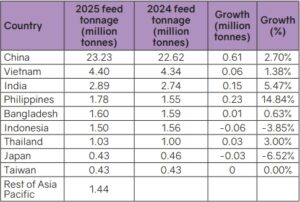
Table 2 presents industry estimates of aquafeed production in 2025. According to the 2026 Shrimp Crop Review by the Society of Aquaculture Professionals (SAP), India’s shrimp feed production rose to 1.57 millions tonnes, supporting shrimp output of 1.05 million tonnes up from an estimated 1.2 milliom tonnes of shrimp feed in 2024. India’s top five aquafeed producers- Avanti Feeds, CP India, Deepak Nexgen Feeds, Dewi Seafoods and Growel Feeds- account for 82% of this volume….
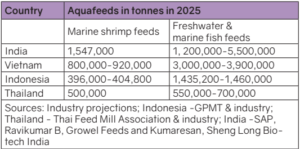
Industry estimates put Vietnam’s shrimp feed production at up to 920,000 tonnes in 2025, supporting shrimp output of nearly 800,000 tonnes. Most of this feed was used in intensive vannamei farming, while black tiger shrimp remain largely in semi-intensive systems. The industry said that farmers were improving disease management, although water quality remained a challenge. The top six producers- Sheng Long, CP Vietnam, Uni-President Vietnam, Tongwei, Grobest and Gromax- supplied a combined 640,000 tonnes of shrimp feed.
Fish feed volumes in 2025 were estimated at 3.0-3.9 million tonnes. In the north, U.S tariffs on China’s tilapia export increases interest in producing tilapia for the U.S market. Processors, including Dabaco and livestock feed millers quickly diversified into aquafeed- such as tilapia and carp production. The estimated fish feed demand was 2.0-2.5 million tonees for the pangasius, 400,00 – 500,000 tonnes for the tilapia and up to 300,000 tonnes for the snakehead fish. The estimate for the marine fish feeds was 80,000- 100,000 tonnes.
According to Jeff Jie-Cheng Chuang, General Manager Sheng Long Bio Tech has made major investment in southern Vietnam in red tilapia feed production, broodstock breeding and fry production. How ever, site limitation have prevented large-scale expansion of black tilapia production. Data from Indonesia’s Feedmills Association (Gabungan Perusahaan Makanan Ternak (GPMT) showed that total fish and shrimp feed production rose 1% to 1.84% million tonnes. This comprised 0.4 million tonnes of marine shrimp feed, of which 99% was for vannamei shrimp, and 1.43 million tonnes of fish feed, mainly for catfish, tilapia, carp, milkfish and pangasius. In August 2025, the US Food and Drug Administration rejected Indonesian shrimp export because of caesium-137 contamination. GMPT expected shrimp feed sales to fall, but output remained flat, while feed millers faced delayed payment as farmers sought new markets for their harvest.
For fish farming, the association expected lower feed demand as climate change disrupted freshwater fish production cycles. however, a government campaign encouraging fish consumption once a week helped lift fish prices, and stocking resumed in January 2026, especially for pangasius.
Thailand’s Feed Mills Association (TFMA) projected that 2025 aquafeed production to be stable, with shrimp feed rising slightly to 500,000 tonnes and fish feed reaching 550,000 tonnes. In contrast, an idustry source estimated a higher fish feeed demand at 600,000 -700,000 tonnes, comprising feeds for the tilapia at 300,000 tonnes and Asian seabass at around 800,000 tonnes.
Production versus installed capacity
At TARS 2019 B.Ravikumar, Vice President- Sales & Technical (Shrimp Feed Division) at Growel Feeds, said India’s installed aquafeed capacity was 3.8-4.0 million tonnes. His 2025 update put installed capacity at 5.5 million tonnes, with 3 million tonnes for shrimp feed. the top five feed millers produced 1.3 million tonnes in 2025. Ravikumar said the feed capacity was planned to meet seasonal demand: feed mills use at least 80% of capacity during the peak farming season from March to June but less than 40% at other times of the year. He added the commercial fish feed volumes were 1.2 million tonnes, representing about 60% capacity utilisation.

With no seasonal disruptions, aquaculture in Vietnam operates year-round. With installed aquafeed capacity estimated at up to 5.5 million tonnes, utilisation was 60–70%. In recent years, Indonesia’s installed production capacity increased by about 8% for fish feed and 5% for shrimp feed, with much of the investment coming from China. Haris Muhtadi, Deputy Commercial Director – Shrimp Business at PT De Heus, estimated Indonesia’s installed shrimp feed capacity at 0.927 million tonnes in 2025, implying utilisation of 42.6%.
Feed certification
Over the past two years, ASC (Aquaculture Stewardship Council) feed certification is a key market requirement, particularly in the EU shrimp market. In Asia, Thai Union Feedmill was the first feed producer with an ASC feed certification in 2024. In November, Sandhya Marines in Andhra Pradesh, became the only shrimp feed mill in India certified to the ASC feed standard. Wei said,
“For UPV, the main driver for its ASC certification was demand from certified farms that wanted feed suppliers to meet ASC sustainability and traceability requirements.”
Chuang said,
“Sheng Long’s ASC certification in 2026 showed that it met international standards for aquafeed quality management, product safety, traceability and supply chain management. The certification is an important gateway for Vietnamese aquaculture products to enter high-end markets such as the EU, the United States and Japan.”
Expansion and acquisitions
In June 2025, Cargill exited Vietnam’s aquafeed market. Sheng Long then acquired three Cargill factories, including a micro-feed facility, boosting its capacity for grow-out fish and shrimp feed. Sheng Long now operates eight feed mills in Vietnam with total annual fish and shrimp feed capacity of 1 million tonnes. Other expansion and acquisition reports on the AAP website included:
• In June 2025, India’s IFB Agro Industries Ltd acquired Cargill India’s commercial shrimp and freshwater fish feed business.
• In 2026, Royal De Heus completed its acquisition of CJ Feed & Care’s operations in Vietnam, Indonesia, South Korea, Cambodia and the Philippines.
• In 2026, China’s Guangdong Haid Group launched two major feed projects in Vietnam and Laos for livestock and aquafeed.
Outlook in 2026
In Indonesia, GPMT expects feed production to grow by 9.8% in 2026. Deny Mulyono of PT Central Proteina Prima, who also chairs GPMT’s Aqua Divison, said the industry is focusing on sustainability, farm productivity, disease management and feed efficiency to support long-term growth.
Vinij Tansakul, A consultant in Thailand, outlined the country’s strategy for 2025-2026. He said the aquafeed industry aims to shift towards higher-margin functional feed and expand into high-growth aquaculture hubs to offset limits in the domestic market. In 2026, Thai Union together with India’s Avanti Feeds, entered the Ecuadorian shrimp feed market.
Chung said
“In 2026 we will continue expending production capacity. we expect feed sales to rise to 15%. We aim strengthen our competitive advantage through the Thang Long Smart System (TLSS, see page 6) which integrates feed, seed, animal health products and farming models to improve farmer’s efficiency and profitability”
For Wei, stability is his top priority for 2026.
“The industry’s main challenge is adapting to sharp increases in raw material prices, which are putting heavy pressure in feed formulation, pricing strategy and market response.”
Impact of the Middle East war
Wei, said the instability has created major challenges for planning , logistics and market development. “It has significantly affected us because the Middle East is a key emerging market, forcing us to slow our expansion plans.”
Chuang added, “This had raised global raw material, fuel and supply costs, increasing costs across the aquafeed industry. Given the uncertainty, we continue to monitor raw material prices, logistics cost and market confidence closely”


