
In the 1980s, India’s black tiger shrimp Penaeus monodon farmers were dependent on wild-caught post larvae (PL) for their culture ponds. The Government of India (GOI) under its Ministry of Commerce, then commissioned two hatcheries- TASPARC and OSSPARC which were set up by MPEDA (Marine Products Export Development Authority). This not only led to the availability of monodon shrimp PL for shrimp culture but also helped farmers to switch over to hatchery-reared PL instead of wild-caught ones. More importantly, these projects provided the impetus for the development of the commercial hatchery technology for PL production. We witnessed two paradigm shifts.
The first was that these monodon shrimp hatcheries helped India reach an eight-fold increase in farmed shrimp production within 18 years (between the late 1980s to mid-2000s) to around 160,000 tonnes. The second was the introduction of the white shrimp Penaeus vannamei, an exotic species, to India in 2009, which resulted in the rapid development of shrimp aquaculture.
Scenario changes with vannamei shrimp
Since 2009, we have seen hatcheries increase from 200 to 600 in 2024; built-up capacity expanded from 14 billion PL in 2009 to 150 billion PL by 2024, although currently they are operating at about 60% efficiency. Farm production increased from 100,000 to reach approximately a million tonnes in 2025.
Today, these 600 hatcheries produce about 90 billion PL/year from only 4 billion PL in 2009. The average daily production is calculated at around 300 million PL based on 300 days of production. The specific pathogen free (SPF) broodstock imported was around 90,000 pairs in 2024.
Some experiences on vannamei shrimp hatchery operations in India
The team at Vaisakhi Marine Resources describes results from a 12-year case study comparing broodstock lines to production in the hatchery and farm Nauplii production was calculated at around 300 billion annually at an average production of 1 billion nauplii/day. Furthermore, nauplii output was estimated at more than 3 million/female. Approximately, 40% of broodstock efficiency is lost due to fluctuating market demand and broodstock mortality.
Views on hatchery operations in India
In this two-part article, we discuss hatchery operations for Penaeus vannamei under the following three headings – broodstock management, live feed production (algae culture and Artemia hatching) and larval rearing, with special reference to our own experiences at our hatchery projects in India. We discuss these operational aspects at one of the many projects at M/S Vaisakhi Marine Resources (P) Ltd.
Our company operates eight hatcheries, all on the east coast of India in Andhra Pradesh and Tamil Nadu, with an annual production of around 5 billion PL. We import around 15,000 broodstock annually. The mean annual nauplii production is 27 billion. Out of the eight hatcheries, three have the additional broodstock maturation facility.
Broodstock management and nauplii production
Broodstock facilities are isolated and biosecure. All SPF broodstock are imported from several sources. According to regulations, they need to pass through the GOI’s quarantine facility before being used by hatcheries.
Broodstock management comprises the following activities, namely: broodstock holding, maturation, spawning and hatching, and nauplii holding and supply.
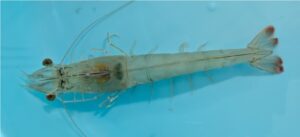
Maturation
Induced maturation is the general practice; in our case, however, approximately 50% of spawning is achieved from natural maturation. Throughout the maturation process, we ensure biosecurity with egg and nauplii washing, including fortnightly health surveillance of broodstock with laboratory tests for disease/pathogens (mainly white spot syndrome virus and Enterocytozoon hepatopenaei-EHP). Locally sourced fresh feeds are pasteurised or frozen before use. Our shutdown
disinfection procedure includes an additional sodium hydroxide (NaOH) treatment, expanding on the standard practice of chlorine disinfection and drying.
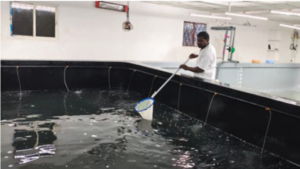
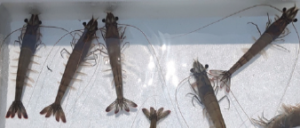
The major activities in broodstock maturation include broodstock acclimatisation, water and feed management, natural/induced maturation, health and photoperiod management and sourcing for spawners. Male and female broodstock are held separately.
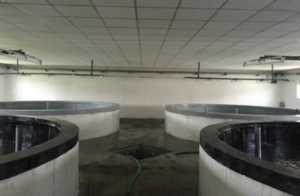
Spawning and hatching
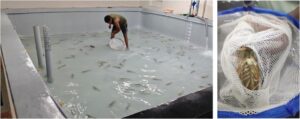
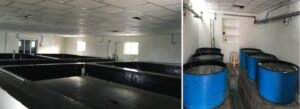
Sourcing is done twice daily, in the morning for spawners and in the evening for mated spawners. Spawning and hatching tanks are bigger, at 10-15 tonnes capacity.
Nauplii holding and supply
Nauplii are harvested from hatching tanks. They are counted and kept in nauplii holding tanks before supply. In summary, the salient features on technical management of broodstock include the following (Table 1).

“Observations showed that broodstock source does affect performances at three levels: farm production, hatchery larval rearing and nauplii production. “
Summary on broodstock lines
During the last 12+ yeras at the Srikakulam project Andhra Pradesh (Vaisakhi Marine Resource), we have used approximately 25,000 pairs of broodstock in 66 batches of 20 different lines. Observayions and result are subsequently detailed. Sources of broodstock used include Kona (Hendrix Genetics, Hawaii); OI (Ocean Institute, Hawaii); SIS (Shrimp Improvement Systems,Florida);SyAqua, Florida Benchmark Genetics, Hawaii and Blue Genetics, Texas.
Broodstock reproductive performance
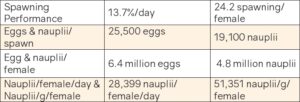
Within 150 days, we observed that the number of spwaning per female was 24.2, but spwaning per day average around 13.7. Eggs per spawning were 255,000 and nauplii produced per-spwaning 191,000, with a mean% hatch of approximately 75%. Overall productivity was observed to be 6.4 million eggs and 4.8 million nauplii per female. Each female produced 28,3999 nauplii per-day whereas 51.351 nauplii were produced per gram of female (Table 2).
Broodstock vs farm, hatchery and nauplii output
Observations including those from our own farm showed that broodstock source does affect performances at three levels: farm production, hatchery larval rearing and nauplii production. However, while broodstock age does not affect farm production and hatchery larval rearing, age does affect nauplii production.
Selecting broodstock lines
When selecting broodstock, we look at the following four important factors:
• Productivity of broodstock in terms of nauplii output;
• Survival in larval rearing in the hatchery;
• Response of broodstock to natural maturation; and
• Farm performance of PL produced from a particular broodstock line.
Productivity of broodstock
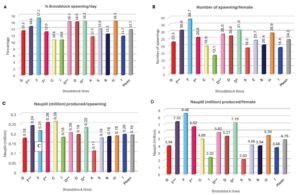
This is the summary of our observations on broodstock productivity over the last 12 years. We have included data from one of our three broodstock maturation facilities. In Figures 1A-D, we show the different productivity indices such as broodstock spawning/day, spawning/ female and output of nauplii/spawning and nauplii per female, which vary considerably between different broodstock lines. In these figures, we assigned letters to maintain the confidentiality of the broodstock lines used.
Survival during larval rearing
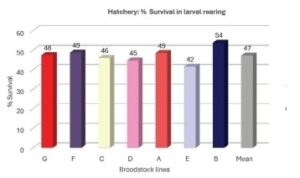
This year-long observation with different broodstock lines resulted in a mean survival rate of 47% in larval rearing. Although there were some differences in % survival between nauplii produced from different broodstock lines, these were not significant (Figure 2).
Induced vs natural spawning
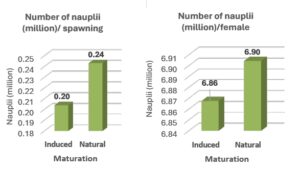
As mentioned earlier, our priority is natural spawning. Unfortunately, not all broodstock lines respond to natural maturation. Therefore, we have been compelled to use induced maturation (via eyestalk ablation) when broodstock do not respond favourably to natural maturation.
This could be a concern in the future. It is not clear why all broodstock sources do not respond equally to natural maturation. This is one major aspect broodstock suppliers may wish to focus on in the future.
Farm performance
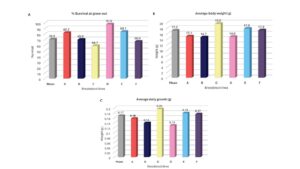
This is the most important factor we consider when selecting a broodstock source or line. This weighs higher than broodstock performance and larval rearing performance. In Figures 4 A-C, we show that there is considerable variation between PL produced from different broodstock lines in farm performance in terms of % survival, average body weight (ABW) and average daily growth (ADG).
“We also go by farmers’ choice; even if that means, a compromise of nauplii productivity and larval rearing performance.”
However, selecting between different broodstock sources based on farm performance as observed above, is challenging. Often there are seasonal and geographic preferences, and variations in performance. Also, survival and growth are often negatively correlated; hence, it is difficult to find an optimal spot with reasonable growth and good survival. All the same, given the tough farm grow-out situation in India, the general preference for the farmer is observed to be towards ‘robust’ lines. We also go by farmers’ choice – even if that means, a compromise of nauplii productivity and larval rearing performance.

All authors are with Vaisakhi Marine Resources (P) Ltd., Visakhapatnam, India.
Next issue: The second part of this article will cover live feed production in hatchery operations; algae culture and Artemia hatching. It will discuss aspects in larval rearing from costs of production, PL demand to biosecurity in the hatchery.


