
In aquaculture, we talk every day about water quality, survival rate, feed cost and farm gate prices. Yet there is another word that is increasingly entering these conversations: ‘aquatic animal welfare,’ which is not a new or distant concept for farmers at all. The World Organisation for Animal Health (WOAH) defines animal welfare as a state in which; “An animal has good welfare if it is healthy, comfortable, well fed, safe, able to express its innate behaviour and does not suffer unpleasant states such as pain, fear or distress.” Put simply for farmers, animals with good welfare have good health, live comfortably, receive enough feed, feel safe, can express their natural behaviour and do not suffer from pain, fear or distress.
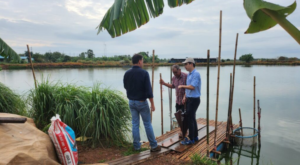
If you have been farming tilapia or whiteleg shrimp for many years, this definition will sound familiar – it is exactly what you have been trying to achieve all along. The only difference is that, until now, we may not have grouped all these efforts under the formal term ‘animal welfare.’
Welfare principles help organise what farms already do At the farm level, aquatic animal welfare is not about adding another checklist that makes farmers’ lives harder for no reason. Instead, it helps to organise the things you already monitor by asking what the basic natural needs of fish and shrimp are and how well we meet those needs in intensive farming systems.
Common examples that most farmers know well include:
• When fish are gasping at the surface, this indicates dissolved oxygen is low, animals are stressed, feed intake drops, growth slows and feed conversion ratio (FCR) will worsen.
• When only some groups of fish come up to feed at certain corners or feeding takes too long and uneaten pellets remain floating, this often signals stress or emerging water quality problems.
• When harvested shrimp show broken antennae, black spots on the body, or reddened tail tips, this indicates stress before and during harvest, which can lead to lower product quality and higher rejection rates at processing.
All of these are, in fact, part of the ‘language of welfare’ that farms already use in daily practice. Today, scientists and organisations such as FAI are helping to frame this language into practical indicators for tilapia and whiteleg shrimp, covering areas such as suitable water quality ranges, swimming and schooling patterns signalling abnormality, visible lesions or injuries, appropriate feed particle size for animal size and how far feed should be distributed across the pond surface.
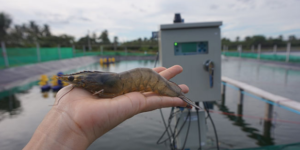
FAI has translated species’ natural needs into tools that enable farms to assess whether animals in the pond are living in conditions that closely match their natural requirements. When the answer is ‘yes,’ we know farm management is broadly on the right track; when it is a ‘not yet,’ this becomes a starting point for stepwise improvement instead of relying only on habit or trial and error.
Good welfare = good health = sustainable production
Looking back at the WOAH definition, animal welfare is not an abstract ideal but directly connected to what farmers already value: health, growth, survival and feed conversion ratio (FCR). Aquaculture specialists often say that good welfare underpins good health and good health is the foundation of stable, efficient production.
In Brazil, tilapia farms working with FAI Farms have shown that introducing welfare indicators into farm routines and farmer selection, can reduce the proportion of damaged fish arriving at processing plants, improve fillet quality and lower trim loss, thereby reducing total system cost rather than increasing it. These experiences challenge the common fear that welfare is only an added cost with no economic returns.
The awareness gap between farms and consumers
While aquatic animal welfare is now a familiar term in academic circles and in international standards, many supermarket shoppers and even conference participants still say they have never heard the words ‘tilapia welfare’ or ‘shrimp welfare.’ This matches awareness surveys at livestock and aquaculture trade shows in Bangkok in March 2026, where several general consumers are unfamiliar with the term but become more interested in products from welfare focused farms once the concept is explained.
Interestingly, when asked whether they would be more likely to buy products clearly labelled as coming from animals raised with good welfare standards, most consumers answered in the affirmative. However, when asked the follow up question, if they would still consider buying if the price is higher, many shift to ‘I’d have to think about it’ or ‘not sure yet.’
This reflects international research showing that consumers genuinely care about welfare, but their willingness to pay depends on both the level of the price increase and whether they trust that farms are truly doing what the label claims.
For producers and farm managers, this gap presents an opportunity rather than a problem. It means the market still has room for us to clarify, demonstrate and show buyers and consumers how ‘animal welfare’ links to food safety, meat quality, as well as credibility of the entire supply chain.
From care in the pond to a shared global language
Returning to the WOAH definition, aquatic animal welfare does not insist that every farm instantly becomes an ideal model or completely change its production system. Instead, it invites us to ask new questions about our daily work:
• How well are our tilapia or whiteleg shrimp really living, from their own point of view, not just from the farmer’s?
• How closely does what we consider normal on the farm match the animals’ natural requirements?
• Where could small management adjustments improve both animal welfare and long term production stability?
Online courses from FAI Academy, together with tools such as the Tilapia Welfare App, HydroNeo App’s Shrimp
Welfare Assessments and FAI’s welfare badges, function as the translators between farmers’ on the ground experience and scientific or international standard language.
FAI has already done the background work of bringing together what tilapia and whiteleg shrimp need in nature and shows how farmers can provide these conditions in real production systems, whereby turning these into clear on farm indicators that can be measured. When farms use these indicators, they are not just ticking boxes: they are checking whether animals are really living in the conditions they need, correcting problems, and then being able to demonstrate this care to the market.
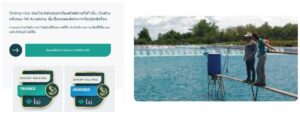
Within this approach, the welfare badges are not something that you simply ‘receive’ for signing up; each badge marks a specific level of learning and implementation. Through the Shrimp and Tilapia Hubs, farms and companies can first earn a welfare trained badge by completing the foundation course and building basic skills in welfare assessment. They then progress to a welfare assessed badge by running regular welfare assessments, collecting data, and showing verifiable
improvement in farm outcomes. The badges, therefore, help make existing practices more visible and systematic, and provide buyers and consumers with independent proof that welfare is being taken seriously in day to day management, and not just used as a marketing term.
At the same time, these courses and badges are built on the same underlying principles as other animal welfare training programmes, namely the WOAH definition of animal welfare and its focus on health, nutrition,environment and natural behaviour. Farmers can learn these foundations for free through FAI’s online hubs or via other organisations, then use the welfare badges and similar tools to show that they have applied these knowledge into practice.
As global certification organisations such as the Aquaculture Stewardship Council (ASC) introduce requirements on fish and shrimp welfare, these steps also help farms prepare to demonstrate responsible farming and animal health and welfare performance during the certification process.
“This is essential at a time when the world cares about both food quality and the quality of life of the animals behind that food.”
In many supply chains, buyers are already asking producers to demonstrate that they farm responsibly. Therefore, linking welfare badges and indicators to ASC and other international standards is starting to turn better welfare into a concrete marketing and economic advantage, and not just a cost.
Ultimately, aquatic animal welfare is not a fashionable buzzword or just another item in a long list of standards. It is a way of organising the care that farmers already practice for their animals into a clear strength for the business. This is essential at a time when the world cares about both food quality and the quality of life of the animals behind that food.
Farmers can learn these foundations for free through FAI’s online hubs or via other organisations, then use the welfare badges and similar tools to show that they have applied this knowledge into practice.
How to start if you are in the supply chain
For whiteleg shrimp and tilapia farms, processing plants, researchers and all in the seafood supply chain wanting to go beyond slogans and to truly understand aquatic animal welfare, we suggest the following.
• Discover the Shrimp Welfare Hub on FAI Academy, which offers complimentary principles, on-farm indicators, and online courses accessible in multiple local languages. The same resources are also available through the Tilapia Welfare Hub.
• Explore FAI Farms’ welfare concepts and their practical application on farms, in processing plants, or research projects. We invite small-scale farmers, large farm managers, processing plant staff, and technical teams to trial these ideas in their own
operations.

Both authors are with Creative Labs Asia, FAI Farms Representatives. Find the Shrimp Welfare Hub at https://fai.academy/en/shrimp-hub and Tilapia Welfare Hub at https://fai.academy/en/tilapia-hub


