
From testing new approaches to more inclusive shrimp supply chains to bringing retailers together to advance animal welfare, the Aquaculture Stewardship Council (ASC) helped turn discussion into practical action at the 2026 Global Shrimp Forum (GSF), held in Utrecht from 1–3 September.
As a co-founding partner of GSF, ASC continues to support the Forum through its organisation, sponsorship of side events and engagement with stakeholders across the shrimp value chain to address shared challenges.
This year, ASC experts contributed across the programme, with a particular focus on inclusive supply chains, animal welfare and strengthening connections between producers and markets.
Putting inclusive supply-chain solutions to the test
One of the highlights was the Inclusive Supply Chain event, sponsored by ASC with support from the Sustainable Fisheries Partnership (SFP) and GSF.
Building on previous discussions about the barriers facing small- and medium-scale producers, this year’s event shifted the focus towards testing potential solutions.
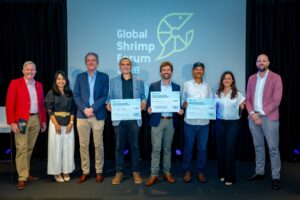
In a live pitch competition, three teams presented practical ideas to improve smallholder inclusion in shrimp supply chains to an expert judging panel, competing for funding to help develop and implement their concepts.
The winning proposal came from Jonas Walker of Blueyou, who received €6,000 for a concept focused on integrated mangrove-shrimp farming. By restoring mangroves in Indonesian extensive shrimp ponds alongside improved farming practices, Blueyou has been able to double farm productivity while improving environmental outcomes.
The two runners-up – Umesh N R from Aqua Saathi and Jacob Adzikah and Flavio Corsin from the Chamber of Aquaculture Ghana – each received €2,000 to support further development of their projects.
Roy van Daatselaar, Head of ASC Improver Programme, said,
“Over the past years we have had great discussions and heard examples of inclusive supply chains at GSF. This year, we wanted to take things a step further. Thanks to the generous support of GSF, ASC and SFP, we’ve awarded the pitches with a small prize to support further uptake of the models and help bring concepts of inclusive supply chains into reality. By doing so, we want to make an active contribution and give back to the industry, in support of the small and independent producers who play such a crucial role in the sector.”
The audience was also an integral part of the session. Following the pitches and initial feedback from the judging panel, participants divided into small breakout groups, where they engaged directly with the pitchers to help strengthen the proposals, share lessons and identify opportunities to build on existing networks.
The pitchers then returned to the stage to present the insights from these discussions to the judging panel. After deliberation, Jonas Walker’s proposal was selected as the winner. All three pitches received strong support from both the audience and the judges.
Roy added,
“We hope that the prize money will be used to bring these concepts to life, helping to implement and strengthen inclusive supply chains. Hopefully, at next year’s GSF, we’ll hear how the pitchers have progressed and what they have learned along the way.”
Bringing the market into the animal welfare conversation
ASC joined a closed-door discussion with international retail and foodservice businesses exploring shrimp animal welfare and progress towards ending eyestalk ablation.
Maria Filipa Castanheira, Standards Manager – Health and Welfare at ASC, shared insights into industry readiness to move towards non-ablated broodstock, including the different challenges facing L. vannamei and P. monodon.
“Moving away from eyestalk ablation isn’t simply a question of producer willingness. While non-ablated broodstock is increasingly available for L. vannamei, progress for P. monodon is at an earlier stage. Broodstock availability remains a key challenge, making cooperation with genetics companies essential.
“At the same time, retailers want confidence that welfare claims are backed by credible evidence. The challenge is to provide that assurance in practical ways, aligning welfare indicators with existing traceability systems rather than creating additional reporting burdens.”

Moving beyond audits on human rights
Froukje Kruijssen, ASC Human Rights Programme Manager, joined an industry panel exploring what more can be done to improve labour and human rights conditions across shrimp supply chains.
Froukje commented, “The discussion reinforced the need to go beyond and complement social audits by better understanding local realities and strengthening worker and community voice. That means strengthening mechanisms that focus on remediation and can also provide data directly from workers and communities to provide insights that complement audits. ASC is already exploring how to strengthen these voices within our certification system, and collaboration with others will be key.”
Connecting producers and markets
ASC experts also contributed to discussions on the European shrimp market, branding and value creation, and connections between producing countries and international buyers, including engagement with Vietnamese producers and European buyers.
Ahead of GSF, ASC hosted an invitation-only Shrimp Table in Utrecht, bringing together leading shrimp suppliers and ASC senior leaders for networking and an open exchange on the challenges and opportunities facing the sector. A key focus was how ASC can increasingly act as a practical business enabler alongside its certification role – helping partners scale good practices, strengthen transparency, respond to changing market expectations and prepare their supply chains for the transition to the ASC Farm Standard.
Across the Forum, resilience emerged as a recurring theme, with discussions highlighting how changing market conditions are placing new pressures on producers and supply chains.
At the same time, conversations around feed, market access, human rights, animal welfare and consumer expectations reflected a wider shift: sustainability is increasingly becoming part of how the shrimp sector does business, rather than a separate consideration.
Reflecting on the event, Chris Ninnes, ASC CEO said, “GSF highlighted just how quickly the operating environment for shrimp is changing. Producers are navigating climate pressures, changing feed markets and trade uncertainty, while at the same time expectations around animal welfare, human rights, traceability and environmental performance continue to grow.
“What gives me confidence is that the industry is increasingly treating these issues as interconnected, rather than as separate challenges. Building a resilient shrimp sector will require collaboration across the value chain and practical solutions that work for producers while giving buyers and consumers confidence in how shrimp is produced. As a co-founding partner of GSF, that is exactly the kind of progress ASC wants to help accelerate.”


