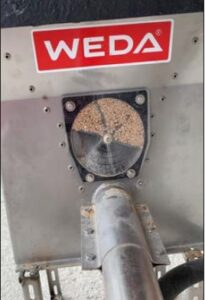
MultiPhase Opti.Mum: Cost-effective multi-phase feeding via frequency-controlled feeders in the farrowing unit
With the MultiPhase Opti.Mum, WEDA Dammann & Westerkamp offers a highly efficient system for the automatic multi-phase and multi-stage feeding of lactating sows in the farrowing area. It enables precise, individual feed formulation for each animal directly on the transport route, without the usual, costly detour via a feed preparation area with scales and a batch mixer.
MultiPhase Opti.Mum revolutionises the process
Until now, precise multi-phase feeding in farrowing units has required capital-intensive feed preparation facilities with weighing hoppers, batch mixers and several separate feed lines per pen. For cost reasons, therefore, in practice only a standard feed was usually provided throughout the entire lactation period. The new MultiPhase Opti.Mum revolutionises this process: it lowers the investment threshold by enabling precise recipe mixing via frequency control of the discharge hoppers directly on a single, existing feed line.

Resource-efficient shared use of silos
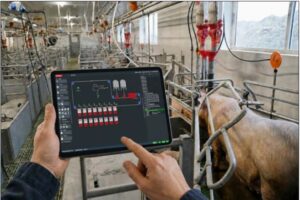
Two frequency-controlled screw conveyors – Starfeeders – dispense the respective feed components directly from the silos in the desired proportions simultaneously onto a shared feed chain. The feed chain then fills the individual Opti.Mum dispensers in the barn. Each weekly group thus receives a feed mix precisely tailored to its requirements. The Excellent 4PX barn computer controls the frequency of the Starfeeders along a continuous multi-phase feeding curve. For instance, following housing, a pre-birthing feed is introduced; over the course of lactation, this is seamlessly transitioned into two successive lactation feeds—Lac1 and Lac2. The alternating use of silos is resource-efficient: on a three-week cycle, the silo that was initially used for the pre-birthing feed is simply refilled with the subsequent feed (Lac2).
Key features and benefits at a glance
– Targeted preparation for farrowing: The continuous supply of specialised farrowing feed ensures a steady energy supply during farrowing, regulates electrolyte balance (urinary acidification to prevent MMA) and stimulates calcium metabolism (important for strong uterine contractions and rapid milk production).
– Increased piglet vitality: This optimised preparation has been shown to lead to an increase in the number of live-born piglets and a significant reduction in stillbirths.
– Maintaining gut function prevents constipation in the sow around the time of farrowing.
– Minimal investment costs: Avoiding the need for a full feed preparation facility saves considerable capital expenditure.
– The piglets in the test groups (Lac1 and Lac2) consumed 33 per cent less supplementary feed than the control piglets, yet achieved higher weaning weights. (Source: Land&Forst 48/2025)