
For shrimp, feed quality is about more than what goes into the formula. It is also about what happens to that formula once it enters the feed mill.
Unlike fish that can often locate feed visually, shrimp rely heavily on smell and taste to find their food. A pellet may remain submerged for minutes — or even hours — before it is consumed. During this time, its physical integrity determines how well it retains its nutrients and remains attractive to the shrimp.
This makes water stability one of the most important indicators of shrimp feed quality.
Poorly stable pellets can lose significant amounts of nutrients through leaching before shrimp have the opportunity to consume them. Feed producers therefore commonly test water stability by immersing pellets in water under controlled conditions and measuring how much remains intact after a defined period.
But water stability is only one part of the picture.
A high-quality shrimp feed pellet needs the right combination of nutritional value, physical durability, water stability, consistency, and production efficiency.
Feed Quality Starts with More Than the Formula
Formulation is fundamental, but even a nutritionally well-designed formula can produce inconsistent feed if the manufacturing process is not properly controlled.
Final pellet quality is influenced by several stages, including:
- Formulation and ingredient selection
- Particle size and mixing
- Moisture distribution
- Conditioning
- Pelleting
- Drying and cooling
- Screening and handling
The finished pellet should have good water stability, uniform size and length, a smooth surface, a clean cut, good durability, and minimal fines.
In other words, feed quality is a production system, not a single production step.
High-Moisture Pelleting: A Small Adjustment with a Big Impact
One technique used in premium shrimp feed production is high-moisture pelleting.
Increasing mash moisture before pelleting — for example, from around 13–14% to approximately 15–16%, depending on the formulation and equipment — can improve starch cooking and binding.
The principle is straightforward:
Better moisture distribution → improved starch cooking → stronger binding → fewer fines → better pellet durability and water stability
However, simply adding water is not enough. Moisture needs to be distributed evenly throughout the material. Pre-hydration or wet mixing can help, particularly when oil and other ingredients make moisture penetration more difficult.
After pelleting, effective drying and cooling are equally important to achieve the appropriate final moisture level for safe storage without compromising pellet quality.
Conditioning: Where Heat and Moisture Come Together
Conditioning prepares the mash for pelleting by combining heat, moisture, time, and mechanical action.
Steam raises temperature and adds moisture, helping prepare the material for better starch cooking and binding. For shrimp feed, conditioning time and temperature need to be controlled according to the formulation, equipment, and desired pellet characteristics.
Post-conditioning can provide another opportunity to develop pellet structure and improve water stability, durability, yield, and fines.
When conditioning is insufficient or poorly controlled, producers may see increased energy use, lower throughput, more fines, poor pellet durability, and greater mechanical stress.
The Mechanical Side of Pellet Quality
Even with good formulation and conditioning, mechanical problems can compromise the final product.
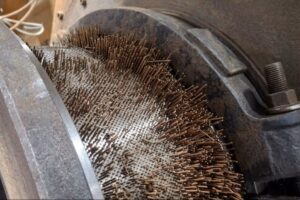
Dies, rollers, cutters, clamps, and clearance settings all influence pellet formation. Worn dies, incorrect roller-to-die clearance, or misaligned cutters can contribute to irregular pellet length, cracked surfaces, poor durability, and increased fines.
Handling after production also matters. Excessive dropping or mechanical transfer can damage otherwise good pellets, while inappropriate screening can allow too many fines into the finished product.
Raw Material Handling Matters Too
Quality control starts before the material reaches the pellet mill.
Poor mixing, inconsistent feeding, or ingredient segregation during storage and transfer can create variations in the final product. This is particularly important when handling combinations of dry ingredients, oils, water, and particles with different characteristics.
Consistent storage, weighing, conveying, and mixing are therefore essential for producing consistent pellets.
Putting It All Together
High-quality shrimp feed is the result of multiple stages working together:
Good formulation → consistent mixing → effective pre-hydration → controlled conditioning → optimised pelleting → proper drying and cooling → careful screening and handling
The ultimate goal is simple: a pellet that retains its shape, nutrients, and feeding value long enough for shrimp to find and consume it.
The best formula can only perform as well as the process used to manufacture it. Understanding how formulation, moisture, conditioning, pelleting, equipment, and handling interact is essential for producing consistent, high-quality aqua feed at commercial scale.
Take the Next Step in Aqua Feed Milling
For professionals looking to put these principles into practice, Progressus’ Aqua Feed Milling Management AgriSchool provides a practical opportunity to explore the production challenges behind high-quality aqua feed.
The 4-day training covers raw material handling, grinding, mixing, conditioning, extrusion, pellet quality, drying, cooling, coatings, and process optimisation, with a commercial aqua feed mill visit and practical workshops connecting technical concepts to real-world production.


