
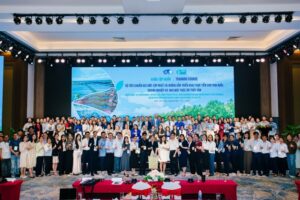
Almost 200 participants from across Vietnam’s aquaculture sector gathered in Can Tho as the Aquaculture Stewardship Council (ASC) stepped up support for producers preparing to transition to the ASC Farm Standard. Bringing together producers, processors, exporters and other industry stakeholders, the session provided an opportunity to engage directly with ASC experts, understand the new requirements and explore how they can be applied in practice.
The organisations brought producers, exporters and other industry stakeholders together in Can Tho for a practical dialogue on the changes underway in the ASC programme. Rather than simply outlining new requirements, the session gave businesses the opportunity to put real-world questions directly to ASC experts and discuss the challenges they face in applying the standards on the ground.
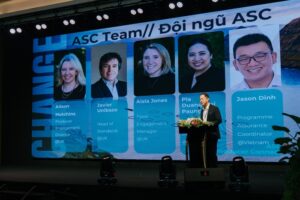
Alison Hutchins, Producer Engagement Director at ASC, said “Certification standards have to work in the real world if they are going to drive meaningful improvements. That is why direct engagement with producers is so important. We want to understand what businesses are experiencing, clarify requirements where there are questions and identify where additional guidance or support can make implementation more straightforward.”
From new rules to practical solutions
The discussions come as the industry prepares for the transition to ASC’s new Farm Standard, which brings together requirements previously covered by multiple species-specific standards into one global framework.
For producers, the transition represents a significant change in how certification requirements are structured. For ASC, it is also an opportunity to work more closely with producers and understand where technical requirements can present practical challenges.
Vietnam is a particularly important market in this transition. The country has more than a decade of experience with ASC certification and is currently the third-largest producer of ASC-certified shrimp and the largest producer of ASC-certified pangasius.
Questions raised during the Can Tho session included antibiotic use, traceability through TraceASC, buffer zones, groundwater monitoring, waste management and certification validity – illustrating the practical issues businesses need to resolve as they prepare for changing requirements.
Koji Yamamoto, General Manager Japan and Producer Engagement Lead South-east Asia at ASC, said
“Producers are often dealing with very practical questions: What does this requirement mean for my farm? How do I demonstrate compliance? What happens when conditions differ from one production area to another?”
“Our role is not simply to publish a standard and leave producers to interpret it on their own. Engagement is a two-way process. We explain the requirements, listen to the experience of producers and use that dialogue to identify where clearer guidance or better tools are needed.”
Keeping pace with a changing sector
The discussions also highlighted that certification increasingly extends beyond individual farms.
ASC’s programme addresses performance across the aquaculture value chain, including feed production and sourcing, traceability and supply-chain assurance. The ASC Feed Standard, for example, introduces requirements covering areas such as environmental performance, labour conditions, governance, supplier due diligence and ingredient traceability.
For businesses, this means that understanding certification requirements is no longer just a farm-level exercise. Greater coordination across producers, feed suppliers, processors and other supply-chain partners is becoming increasingly important.
The session also introduced the Aquaculture Improvement Programme (AIP) as a structured pathway for businesses that are not yet ready to meet all ASC certification requirements. The programme enables participants to identify gaps, work towards defined improvement milestones and demonstrate progress through independent verification.
Building confidence through dialogue
ASC has extended the transition period for the Farm Standard to 1 May 2028, giving producers additional time to prepare for the new requirements while ASC continues to strengthen implementation support.
For Hutchins, maintaining an open dialogue with producers is central to making that transition work.
“Vietnam has a highly experienced and engaged aquaculture sector, and we learn a great deal from the questions and challenges producers bring to the table,” she said. “The goal is ultimately the same: to have a certification programme that is credible, robust and practical enough to be implemented effectively across very different production environments.”
Yamamoto added:
“The transition to the Farm Standard is a major step for ASC and for producers. We want businesses to see this not simply as a new set of requirements, but as an opportunity to strengthen practices and build confidence in certified aquaculture. Our engagement with the Vietnamese sector will continue throughout that journey.”
ASC and VASEP will continue working with Vietnamese stakeholders through technical engagement, training and dialogue as the sector prepares for the next phase of the ASC programme.


