
Feed accounts for 50 to 70% of total operational costs in fish and shrimp farming. Asia-Pacific dominates the sector, producing roughly 70% of the world’s farmed aquatic animals and around 26% of global aquafeed output. Yet aquaculture nutrition in the region, as in the rest of the world, still lags behind terrestrial livestock production in feed efficiency. Two factors explain this gap: the science of species-specific nutritional requirements is still young, and the sector is under growing pressure to replace marine-derived proteins with plant-based alternatives, for both economic and environmental reasons.
Closing this gap is the central objective of precision nutrition in aquaculture: formulating feeds that match, as closely as possible, the real digestive and metabolic capacities of each species, so that plantbased ingredients can be used at higher inclusion rates without sacrificing growth performance. The practical payoffs are a reduction in nutrient waste and feed cost, and less pressure on wild fish stocks and aquatic ecosystems. Reaching this level of precision requires two prerequisites that remain underdeveloped in aquaculture compared with terrestrial livestock: robust
ingredient-level digestibility data and exogenous enzymes capable of working reliably across the wide temperature range and alkaline pH typical of aquatic environments.
Terrestrial monogastric nutrition — poultry and swine — offers a useful point of comparison. Decades of research have produced standardised digestible amino acid values and ideal-protein models for these species, and exogenous enzymes such as phytases and proteases have been routine formulation tools since the 1990s, allowing higher plant-ingredient inclusion at lower crude protein levels. Aquafeed formulation is only now approaching that level of precision and does so under constraints that terrestrial nutrition does not encounter hundreds of farmed species with very different digestive anatomies, far less complete digestibility databases, and an enzymatic activity that depends directly on water temperature and pH, since
fish and shrimp — unlike homeothermic livestock — cannot regulate their internal digestive environment Closing this gap means adapting, rather than simply transposing a precision-nutrition toolkit already proven for livestock production.
Enzymatic gap of fish and shrimp However, farmed aquatic organisms — whether finfish or shrimp — have evolved a digestive system optimised for marine and aquatic food sources, not for the plantbased ingredients that now increasingly dominate commercial aquafeed formulations. This fundamental mismatch between the enzymatic capacity of these animals and the biochemical composition of terrestrial plant ingredients remains a critical bottleneck for feed efficiency across the region. Key cultured species such as Litopenaeus vannamei. whose feed segment is projected to grow at 6% compound annual growth rate (CAGR) through 2029, and pangasius. which dominates the Asia-Pacific aquafeed market with approximately 43% market share, are particularly affected by this challenge.
Exogenous enzymes
The use of exogenous enzymes offers a practical and cost-effective solution to bridge this gap. By breaking down molecules that aquatic organisms cannot efficiently digest on their own, these feed additives have the potential to significantly improve nutrient utilisation and unlock the full nutritional value of plant-based aquafeeds — a critical lever for competitiveness in a region where feed ingredient prices surged by 20 to 30% in 2022, directly squeezing farm profitability. These enzymes also show an effect to limit the impact of ANFs.
Plant-based proteins are long-chain and poorly digested by aquatic organisms. Multi-component fermentation extracts are enzymes that break them down into absorbable peptides and/or free amino acids, but they require specific pH and temperature conditions to work. The addition of exogenous proteases, through their action, also helps modify and optimise the amino acid profile of these plant proteins.
Since aquatic organisms are cold-blooded and live in generally alkaline environments, exogenous multi component fermentation extracts used in aquafeed must be able to work across a wide temperature range and at alkaline pH.
This study investigates the augmentation of aquafeed digestibility with inclusion of a commercial multi component fermentation extract, Jefo Pro Solution (JPS, JEFO Nutrition, Canada). which exhibits a high multi-component fermentation extract activity under broad thermal and alkaline pH conditions.
Evidence from in vivo apparent digestibility trials Raising ADC of nutrient and energy digestibility with trout
A study conducted by Lee et al. (2020) evaluated the efficacy of an exogenous multi-component fermentation extract (JPS), in enhancing nutrient digestibility of feed ingredients in rainbow trout (Oncorhynchus mykiss) diets. It included in vivo
measurements of nutrient digestibility of 17 ingredients (plant and animal origin) with or without the supplementation of JPS in the diets of rainbow trout.
The experimental diets were formulated by blending 70% of a reference diet – based on fishmeal, sardine and yttrium oxide as an inert tracer – with 30% of each selected test ingredient. A total of eight alternative protein sources were screened under both supplemented and unsupplemented conditions. Fish were housed in duplicate tank units throughout the trial. Faecal collection was carried out on day 5 following light anaesthesia, yielding approximately 70g of wet faeces per tank. The pooled samples were subjected to a comprehensive analysis covering proximate composition, energy content, amino acid profiles and mineral concentrations. Nutrient digestibility was subsequently determined by comparing test and reference diet compositions using established calculation methods (Bureau et al., 1999).
The findings underline the versatility of JPS in significantly boosting the apparent digestibility coefficients (ADC) of plant- and animal-based ingredients intended as fishmeal alternatives in commercial aquafeed.
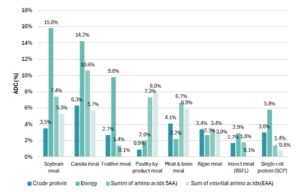
The results (Figure 1) demonstrated that exogenous protease activity supplementation is an effective tool to improve the nutritional value of common aquafeed ingredients, particularly plant-based ones, in rainbow trout diets. This supported its potential use in commercial aquaculture feed formulations. The most frequent improvements were seen in individual amino acid digestibility values. Of 18 ingredients tested, 12 showed improved digestibility of at least one amino acid with JPS supplementation.
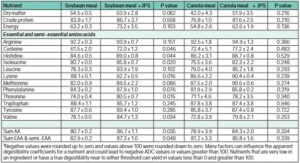
The greatest improvements were observed when the protease complex was added to soybean meal, in apparent digestibility of dry matter and that of 13 amino acids, including key limiting amino acids such as methionine, lysine and threonine (Table 1). This is particularly relevant for trout diets, since these amino acids are often deficient and require synthetic supplementation. These improvements are likely due both to direct proteolytic activity on soy proteins and the degradation of ANFs such as trypsin inhibitors, which can otherwise hinder protein utilisation.
Digestibility of aquafeed for striped catfish
This study conducted at Can Tho University (2023) investigated how supplementing diets with a multi component fermentation extract JPS, affected the digestibility of nutrients in striped catfish Pangasianodon hypophthalmus, using five dietary treatments varying in crude protein level (28% or 26%) and whether canola meal partially replaced soybean meal (Table 2).
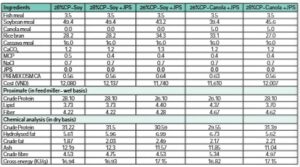
Fish of around 50g were reared over 8 weeks in a recirculating aquaculture system with six replicate tanks per treatment. A digestibility trial was then conducted using chromic oxide (Cr O ) as an inert marker, with 2 3 faeces collected and analysed for ADCs of protein, fat, energy and amino acids.
The results (Table 3) showed that supplementing JPS enzyme consistently improved protein digestibility across treatments.
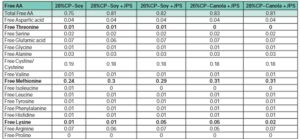
However, total free amino acid of diet adding JPS was higher than the control diet (Table 4).
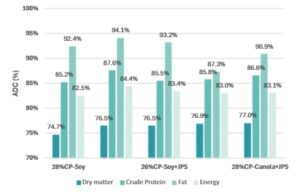
The 28%CP diet with soybean meal and JPS achieved the highest protein digestibility; the equivalent diet using canola meal performed similarly, suggesting that canola meal can partially substitute soybean meal without significantly reducing digestibility when the enzyme is present (FigurTere2at)m. eNnot tably, JP2S8 supplementation also allowed a 2% reduction in dietary protein while maintaining comparable digestibility levels, pointing to a potential cost and efficiency benefit.
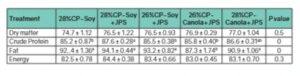
Regarding fat digestibility, most treatments performed similarly, except for the 26%CP canola + JPS diet, which stood out. The authors noted that canola inclusion was partly intended to challenge digestibility, and the reduced protein level was designed to test performance under less optimal dietary conditions.
Overall, the findings confirm that JPS multi-component fermentation extract supplementation improved both protein and fat digestibility in striped catfish diets. This supports the feasibility of using canola meal as a partial soybean meal replacement when the enzyme is included.
Conclusion
Across two species — rainbow trout and striped catfish, supplementation with the multi-component fermentation extract JPS consistently improved apparent digestibility of protein, energy, and key amino acids in plant-based aquafeed formulations. These results demonstrated that exogenous supplementation with high enzymatic activity is an effective and practical strategy to bridge the digestive gap between aquatic species and plant based ingredients, through targeted enzymatic activity on proteins and anti-nutritional factors.
From an economic standpoint, the implications are significant. With feed representing a large part of total operational costs in aquaculture, and plant-based ingredient prices having surged by 20 to 30% in recent years, improving nutrient utilisation directly translates into better feed conversion ratios and lower production costs. JPS supplementation also demonstrated the potential to reduce dietary protein levels while maintaining comparable digestibility, and to support the partial replacement of pricier soybean meal with more affordable alternatives such as canola meal — both of which represent meaningful cost-saving opportunities for feed formulators and farmers alike.
Taken together, these findings position JPS as a valuable tool not only for enhancing feed efficiency and supporting more sustainable aquaculture practices, but also as a lever for improving farm profitability in a sector under sustained economic pressure.
References
Seunghan Lee, M.A. Kabir Chowdhury, Ronald W. Hardy, Brian C. Small, 2020. Apparent digestibility of protein, amino acids and gross energy in rainbow trout fed various feed ingredients with or without protease. Aquaculture, 524, 2020, https://doi. org/10.1016/j.aquaculture.2020.735270. Tran Thi Thanh Hien, Tran Le Cam Tu, Pham Minh Duc, Pham Thanh Liem, Tran Nguyen Duy Khoa, Nguyễn Hong Quyet Thang, Tran Minh Phu. Effects of Jefo Pro Solution supplement dietary on growth performance and feed efficiency of striped catfish (Pangasianodon hypophthalmus), Can Tho University 2023
(Unpublished)

July/August 2026 AQUA Culture Asia Pacific


