
Part 1 of this two-part series (AQUA Culture Asia Pacific July/August 2026) looked at how supplementing rainbow trout and striped catfish diets with a multi component fermentation extract improved nutrient digestibility in finfish. This second and final part turns to one of Asia Pacific’s most farmed crustacean species, the Pacific white shrimp Litopenaeus vannamei — with its feed segment projected to expand at a compound annual growth rate of 6% through 2029 to examine how the same exogenous enzyme in shrimp performs in a very different digestive system from that in finfish.
That growth reflects a broader shift already under way in Asia-Pacific aquafeed. The region’s aquafeed market, valued at close to USD 26 billion in 2025, is forecast to grow at more than 7% a year through 2031, with crustacean feed the fastest-expanding species segment — outpacing fish feed itself, according to industry market analysis. Soybean meal remains the single largest ingredient category across that market, which is precisely why its digestibility, not simply its price,
is becoming the variable that formulators most need to manage. Functional feed additives, a category that includes exogenous enzymes and fermentation extract products such as Jefo Pro Solution (JPS), are themselves the fastest-growing additive group in the region, a sign that digestibility optimisation is moving from a nice-to have to a core part of feed reformulation strategy across the Asia Pacific.
Shrimp digest feed differently from finfish. Digestion relies heavily on the hepatopancreas, transit time through the gut is short, and the gut environment is markedly alkaline — conditions that put additional pressure on the enzymatic breakdown of plant-based proteins before nutrients can be absorbed. As in finfish, closing this gap matters commercially: feed represents 50 to 70% of total operational costs in shrimp farming, and the 20 to 30% rise in plant-based ingredient prices recorded in 2022 means that every percentage point of digestibility gained from an ingredient counts directly toward farm profitability.
The physiological picture explains why closing that gap is harder in shrimp than in finfish. Shrimp produce a notably diverse suite of digestive proteases in the hepatopancreas — more than a dozen distinct enzymes, by some counts, each with its own optimal pH and temperature range — rather than the smaller, more uniform enzyme complement typical of finfish.
“In practice, endogenous enzyme output shifts with life stage, moult cycle, feeding rhythm and diet composition.”
In principle, that diversity should make shrimp efficient protein digesters. In practice, endogenous enzyme output varies with life stage, moult cycle, feeding rhythm and diet composition, so the enzymatic capacity available at any given meal is variable rather than fixed.
Plant-based ingredients add a further layer of difficulty: their proteins are often bound within fibrous matrices and accompanied by anti-nutritional factors — such as trypsin inhibitors and non-starch polysaccharides — that can further hinder digestion, making these proteins less readily hydrolysed than those in fishmeal.
Exogenous enzyme supplementation, delivered directly through the feed, is designed to complement this variable endogenous capacity during the short passage of digesta through the shrimp’s alkaline gut, providing a more consistent enzymatic environment from meal to meal and reducing reliance on the animal’s own digestive enzyme output.
Evidence from in vivo apparent digestibility trials
ADC of feeds for the Pacific white shrimp
This study was conducted at the CIBNOR, Baja California Sur. Mexico from November 26-27, 2025 to determine the in vivo apparent digestibility coefficients (ADC) for dry matter, protein, energy and essential amino acids in diets containing different dietary levels of JPS for Pacific white shrimp, Litopenaeus vannamei.
In principle, that diversity should make shrimp efficient protein digesters. In practice, endogenous enzyme output
varies with life stage, moult cycle, feeding rhythm and diet composition, so the enzymatic capacity available at any given meal is variable rather than fixed.
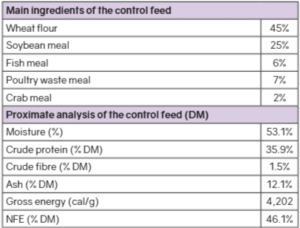
A commercial feed was used as the control (Table 1), and the same feed was supplemented with 1x and 2x the commercial dose of the JPS (Table 2). Pacific white shrimp (~6.42g) were distributed among nine fiberglass tanks, with 5 shrimp per tank. Three tanks were randomly assigned to each diet. Water conditions were closely monitored, with daily measurements of temperature, salinity, and dissolved oxygen and weekly checks for pH, ammonium, nitrate and nitrite.
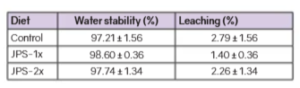
Shrimp were fed ad libitum three times daily and allowed a 7-day acclimation period before faecal collection began.
Faeces were collected at least twice a day by gentle siphoning approximately 1.5 hours after each feeding, rinsed with distilled water and frozen at −20°C. Daily faecal samples from each tank were then pooled, frozen at −80°C, freeze-dried and homogenised. Collection continued until approximately 18g of wet faeces per tank were obtained. At the end of the trial, the faecal samples were analysed for protein, gross energy and amino acid content.
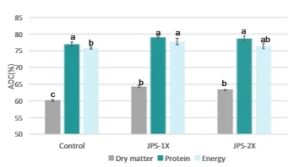
Supplementing shrimp diets with the multi-component fermentation extract at both inclusion levels yielded clear and promising improvements in nutrient digestibility compared to the standard control diet. Dry matter ADC reached 64.3% and 63.3% in the JPS x1 and JPS x2 diets respectively, both significantly outperforming the control at 60.1%. Similarly, protein ADC improved notably, rising from 76.9% in the control diet to approximately 79% in both enzyme-supplemented diets, confirming the beneficial effects of JPS X1® on the apparent in vivo digestibility of diets. Energy bioavailability also benefitted from enzyme supplementation, with the JPS x1 diet achieving the highest value of 77.8% compared to 75.9% in the control, though the improvement was only statistically significant for the JPS x1 diet (Figure 1)
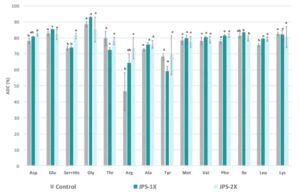
When looking at individual amino acids, the picture becomes more nuanced. ADCs spanned a wide range, from 46.4% to 92.8%, highlighting the complexity of amino acid utilisation across different dietary formulations. The JPS supplemented diets stood out for several amino acids, showing significantly higher digestibility for aspartic acid, serine, histidine, arginine, isoleucine and leucine compared to the control diet.
This variability is consistent with what is known of shrimp protein digestion: shrimp draw on a notably diverse suite of hepatopancreatic proteases, each targeting different peptide bonds, so an exogenous enzyme blend tends to complement some endogenous activities more effectively than others, and the resistance of individual amino acids to hydrolysis varies with the specific plant protein fraction in which they are bound.
Total amino acid digestibility and total essential amino acid digestibility were also highest in the JPS supplemented
diets, while no significant differences were detected for key essential amino acids such as threonine, methionine, valine, phenylalanine and lysine (Figure 2). Even where JPS supplementation did not reach statistical significance, the
numerical trend still favoured the enzyme-supplemented diets over the control for most of these amino acids, suggesting a directionally consistent, if more modest, effect across the full amino acid profile.
These results indicate a similar response in amino acid and protein digestibility, with both tending to improve with JPS x1 supplementation. These findings support the use of JPS at commercial dose as a valuable tool for enhancing nutrient utilisation in aquafeed formulations, with potential benefits for feed efficiency and shrimp performance.
Conclusion
Across the two parts of this series — rainbow trout and striped catfish in Part 1, and Pacific white shrimp here in Part 2 — supplementation with the multi-component fermentation extract Jefo Pro Solution (JPS) consistently improved apparent digestibility of protein, energy, and amino acids in plant-based aquafeed formulations, across both finfish and crustacean digestive systems. In shrimp specifically, both JPS inclusion levels raised dry matter, protein, and total amino acid digestibility compared with the control diet, with the standard commercial dose (JPS x1) showing the strongest and most consistent gains, including in energy bioavailability.
From an economic standpoint, the implications extend across the whole value chain. With feed representing 50 to 70% of total operational costs in fish and shrimp farming, and plant-based ingredient prices having surged by 20 to 30% in recent years, even modest gains in nutrient utilisation translate directly into better feed conversion ratios and lower production costs. That pressure is compounded by how quickly the crustacean feed segment itself is expanding across Asia Pacific, growing faster than any other species category — meaning that any efficiency gained per tonne of feed is
multiplied across a rapidly growing production base. As shown across all three species covered in this series, JPS supplementation also opens the door to reformulation srategies such as lower dietary protein levels, or partial
replacement of more expensive ingredients, including soybean meal, without sacrificing digestibility, giving
feed formulators additional room to manage costs.
Overall, the results presented across both parts of this series position JPS as a valuable, cross-species tool for
enhancing feed efficiency, supporting more sustainable aquaculture practices, and improving farm profitability in a sector under sustained economic pressure, across both fish and shrimp production.
References
Civera-Cerecedo R., Zamora-Méndez S., De La Paz-Reyes S., Robles-Villega G., Lahaye L., Servin K. & Lucien-Brun H. (2025). Effects of supplementation with a multicomponent fermentation extract on the apparent in vivo digestibility of feed for juvenile Pacific white shrimp Litopenaeus vannamei. Presented at CONACUA ’25. 26–27 November 2025, Los Mochis, Mexico. Lucien-Brun, H. (2026). Enhancing feed digestibility and profitability with exogenous fermentation extracts: Part 1 – Finfish. AQUA Culture Asia Pacific, July/August 2026, p24-28. https://issues.aquaasiapac.com/view/922095528/26/

September/October 2026 AQUA Culture Asia Pacific


