
Following a letter from 179 organizations in the Aquatic Animal Alliance, Taiwan’s Ministry of Agriculture confirms policy commitments to eliminate the practice
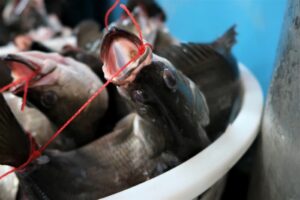
Taiwan’s Ministry of Agriculture has announced several concrete policy commitments that advance the objective of eliminating fish-binding, known as arching fish (活體弓魚, C), practices nationwide. The decision comes following a long-standing campaign by local organization Environment & Animal Society of Taiwan (EAST) and a joint letter from 179 member organizations of the Aquatic Animal Alliance (AAA), in partnership with EAST and Aquatic Life Institute (ALI), submitted to the Office of the President on August 27.
Taiwan’s Animal Protection Act is among the most comprehensive in Asia; it extends protection to fish as vertebrate economic animals, and Article 6 prohibits harassment, abuse, or injury to any animal. However, the practice known as arching fish remained an oversight from the enforcement of the existing legal standard. Arching fish involves threading a nylon cord through the lip of a live barramundi (giant sea perch, Lates calcarifer) and pulling it taut to the tail, bending the fish into a U-shape. Vendors display fish in this condition, out of water, for periods of up to eight to twelve hours. EAST estimates that approximately three million Barramundi are subjected to this handling each year. Research funded by the Fisheries Agency of Taiwan found that 100% of tightly bound fish died within six hours, with more than half dying within three, alongside marked elevations in cortisol and blood lactate consistent with severe acute stress. These physiological responses also degrade meat quality by accelerating deterioration and increasing the risk of bacterial contamination, contradicting the commercial and outdated premise that the practice preserves freshness.
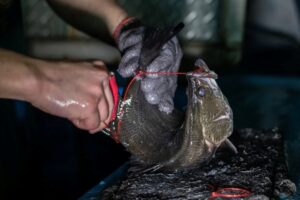
The recent letter from the AAA, a global coalition representing 179+ organizations from 75 countries working to improve the welfare of aquatic animals in the food system, called on the Taiwanese government to enforce existing provisions of the Animal Protection Act towards the prohibition of binding and prolonged out-of-water display of live barramundi.
The Ministry of Agriculture’s response confirms several concrete policy commitments that advance the objective of eliminating fish-binding practices:
-
Wholesale market prohibition: The government confirmed that wholesale fish markets are required to prohibit fish binding and incorporate the prohibition into their market management regulations.
-
Government-wide coordination: Established a coordinated approach involving the Fisheries Agency, Ministry of Economic Affairs, and local governments to address fish binding across wholesale and retail markets.
-
National implementation directive: The Fisheries Agency committed to issuing an official directive to all 13 wholesale fish markets nationwide that trade barramundi, explicitly stating the government’s policy of phasing out fish binding.
-
Enhanced monitoring and guidance: Local governments have been asked to conduct active on-site inspections, while authorities will continue engaging market operators and stakeholders throughout the production and marketing chain.
“For more than six years, EAST has documented the practice, engaged agencies, and supported awareness campaigns alongside the Fisheries Agency. These commitments mean that the practice of binding (Fish Arching) itself is no longer considered as a necessity of handling, but instead literally an act of animal cruelty,”
noted by WuHung, Chief Executive at EAST.
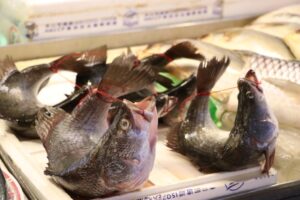
The Ministry has not yet confirmed that the practice is categorically prohibited under the Animal Protection Act in all circumstances. Instead, it states that potential violations must be assessed case by case. The announced measures also focus on wholesale market prohibitions and discouraging sales in other markets. Follow-up will be needed to verify implementation, enforcement, and measurable reductions in reported cases. EAST will continue their role in ensuring locally that implementation is carried out.
“Binding live fish for display and sale raises serious animal welfare concerns, as it forces fish into an unnatural body position, restricts movement, and causes severe physical injury and physiological stress. This practice must end. Taiwan’s commitments are an important step toward strengthening the enforcement of existing animal protection legislation and advancing meaningful protections for fish. Ending harmful handling practices in live animal markets must be a global priority, with clear prohibitions and effective enforcement to ensure that fish welfare is protected in practice,”
said Catalina Lopez, Director of the Aquatic Animal Alliance


