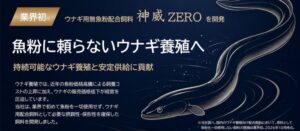
In eel feed with a high dependence on fishmeal, achieving low fishmeal while maintaining necessary performance and aiming for feed without using fishmeal is considered a major challenge.
Japan’s Feed One has announced that it has succeeded in developing ‘Kamui ZERO,’ a compound feed for eels that does not use fishmeal, aiming to reduce dependence on fishmeal in eel compound feed. Currently, field trials are underway in collaboration with eel farming producers, and efforts are underway to verify its effectiveness and challenges in actual aquaculture environments.
While the global production of farmed fish is increasing, fishmeal—the main ingredient in seafood feed—faces challenges such as soaring prices and supply instability due to changes in the marine environment such as fish catches and El Niño phenomena.
In light of these circumstances, Feed One has been advancing research and development of compound feed that does not rely on fishmeal to contribute to the sustainable development of the aquaculture industry.
In eel compound feed, high-quality fishmeal is required not only for nutrition but also to ensure the “kneading properties” when mixed with water. Traditionally, feed containing about 70% fishmeal has been used. In 2016, the company developed and launched feed (eel balls) with a 60% fishmeal content (product name: Unagi Maru) and have continued research and development since then.
In 2023, it commercialised feed (product name: Econic) with a fishmeal content reduced to 40%, and are currently conducting research toward the practical use of fishmeal-free feed that does not use fishmeal.
Results of in-house tests on low-fishmeal feed
In an internal trial conducted at Feed One Fisheries Research Institute from August~October 2026, the team compared conventional feed (70% fishmeal content) with ethical-grade feed with a 40% fishmeal content. The trial had 125 eels per tank
As a result, in the ethical feeding group, feed efficiency was slightly lower than in the conventional feed group, but the daily feeding rate was confirmed to be equal to or better than that of the conventional feed group.
Field test results of fishmeal-free feed
In August- September 2026, with the cooperation of eel farming producers in Kyushu, The company conducted field trials using feed with a 60% fishmeal content (eel balls) and fishmeal-free feed. The trial compared the rearing performance of approximately 38,000 eels over approximately two months.
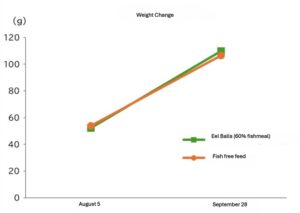
The result was that although feed efficiency in the fish-meal feed group was lower than in the eel ball feeding group, the growth rate in both groups was about double, confirming that eels could feed and grow even with feed without fishmeal (Table 1).
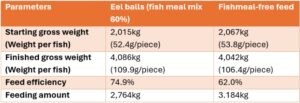
Through this trial, Feed One confirmed the potential for practical application of fish-free feed and identified issues that need improvement going forward. The company will further verify ingredient composition, formulation design, and manufacturing conditions to further improve feed efficiency.
Future Outlook
The fishmeal-free feed for eels, ‘Kamui ZERO,’ is scheduled for release within 2026. Going forward, Feed One will further improve product performance through field trials and promote widespread adoption in collaboration with producers. Additionally, by proposing phased reductions in fishmeal usage according to each rearing environment, including the use of already sold low-fishmeal feed, it will contribute to sustainable eel farming production.
Going forward, it will continue to work with producers through on-site testing to develop eel feed formulations that balance productivity and sustainability.