
Prolonged disconnections, self-generation costs and the increase in the price of inputs and services compromise production and export compliance.
The National Chamber of Aquaculture warns that the energy crisis is leading the shrimp chain to a critical situation. The extension of the cuts and the uncertainty about the restoration of the service put at risk the survival of living organisms, the conservation of the product and the continuity of companies that sustain employment and exports.
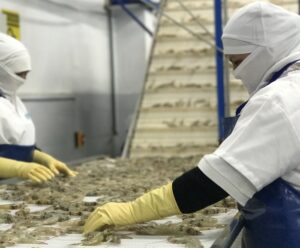
In a few weeks, the restrictions have escalated from 24 to 48 and then to 72 hours a week. In addition to this, there is a disconnection notification for medium voltage users from October 14, with reconnection from 06:00 on the 21st. For users included in this provision, this means remaining approximately one week without supply from the network. For companies that do not have their own generation, a disconnection of this duration is equivalent to the total paralysis of their operations. This deepening confirms the urgency of making transparent the seriousness of the energy crisis that the country is once again going through.
The shrimp chain requires power 24 hours a day, seven days a week. We work with living organisms: energy continuity is essential to protect the survival of farmed larvae and shrimp, as well as to sustain the production of balanced feed and the cold chain of the product destined for export.
“Pumping and aeration cannot be suspended and recovered by working another day. An interruption that exceeds the backup capacity can destroy the months-long effort in hours,”
says José Antonio Camposano, executive president of the National Chamber of Aquaculture.
The impact extends to the entire chain, including small producers and laboratories with less capacity for self-generation. The restrictions alter harvest scheduling, processing, transportation, and shipments. In addition, delays of up to four hours have been reported in reconnections with respect to the announced schedules, which aggravates uncertainty and makes it difficult to manage fuel reserves.
Added to this scenario is the announced increase in the electricity rate and the cost of sustaining operations through own generation, with more expensive fuels than during the previous crisis. The CNA has also received one-off reports of difficulties in obtaining diesel, which it is documenting. Self-generation can only function as a backup if there is timely and sufficient access to fuel.
The economic impact is also accumulated through the suppliers of the shrimp chain. Electrical constraints and higher operating costs also make manufacturing and supplying packaging, ice, lubricants, spare parts and other inputs, as well as transportation, storage and maintenance services more expensive. These cost overruns are in addition to those that producers, laboratories and processing plants already face directly. Therefore, the impact must be evaluated considering all this accumulated effect, which raises the cost of producing and exporting Ecuadorian shrimp and deteriorates its competitiveness.
The consequences transcend the days of disconnection. Uncertainty about the ability to fulfill shipments may lead international buyers to look for other suppliers, especially in the face of Christmas and New Year’s Eve demand. Recovering those customers and business confidence can take much longer than restoring electric service.
Faced with this situation, the CNA considers it essential that the authorities make transparent the real availability of energy, the expected scope of the restrictions and the measures to recover supply, with those responsible and verifiable deadlines. Effective coordination with distributors is needed to protect critical processes, meet reconnection schedules, and ensure fuel supply in line with additional self-generation demand. It is also urgent to speed up the incorporation of private generation and the necessary procedures to put it into operation.
Protecting production is also protecting the families that depend on it. The country needs immediate decisions to sustain operations: each new extension of the cuts compromises production, employment and markets that Ecuador has built over decades.


