
Korea’s effort to grow Atlantic salmon locally, in a market long dominated by imports, has been fruitful.
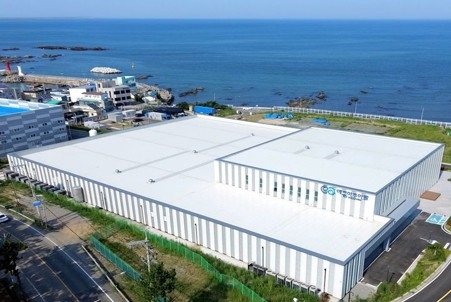
On September 30, 2026, Eco Aquafarm, a subsidiary of GS E&C, held a “Clean K-Salmon Shipment Declaration Ceremony” at the Busan Smart Aquaculture Cluster, located within the Fisheries Science Institute of Pukyong National University in Gijang County, Busan.
Atlantic salmon stocked in 2024 have now reached market size, bringing a two-year land-based demonstration to the commercial sales stage. The significance of this achievement lies in more than the fact that Atlantic salmon grew in Korea.
From eyed-egg stocking to market-size salmon
The facility managed every life stage on land, from eyed-egg stocking through hatching, fry, smolt, intermediate rearing and adult grow-out. It combined a recirculating aquaculture system (RAS) with advanced water treatment, temperature control and ICT-based environmental management to produce fish that are ready for market.
It is also the first of the six smart aquaculture clusters promoted nationwide to progress from actual production to commercial sales.
This event was largely a showcase of the land-raised fish and the results of the demonstration to date, ahead of full-scale sales, which are scheduled to begin at the end of 2026. In other words, what has been established is that a land-based RAS designed for a maximum annual output of 500 tonnes has raised Atlantic salmon from eyed eggs to marketable size.
Localisation of salmon
Korea’s salmon market is dependent on imports. According to the Korea Maritime Institute (KMI), domestic salmon supply in 2025 totalled 73,588 tonnes, of which 73,354 tonnes, or about 99.7%, were imported. Domestic production amounted to just 234 tonnes. This increasing salmon consumption benefits producing countries such as Norway and Chile.
Farming salmonids has been attempted in Korea before, but producing Atlantic salmon at scale has proven difficult. Atlantic salmon is a cold-water species that thrives in cold, clean water. With Korean coastal water temperatures in summer now reaching 25–28°C or higher, it is hard to rely on natural seawater to grow the fish reliably year-round.
Eco Aquafarm has chosen land over sea. GS E&C established Eco Aquafarm in May 2020 as a fisheries corporation to apply its in-house water treatment technology to the aquaculture industry.
That same year, Busan City and GS E&C signed a memorandum of understanding (MOU) to develop the Busan Smart Aquaculture Cluster, followed by the design of the recirculating system and infrastructure construction before the land-based salmon project got under way in earnest.
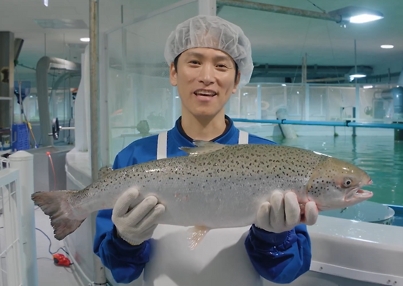
In July 2024, Atlantic salmon eyed eggs for research purposes were stocked, marking the start of the large-scale demonstration. Eyed eggs for production and commercial sales were added in November of the same year. In December 2024, the facility was finally completed and a “K-Salmon Localization Declaration Ceremony” was held. By September 2026, the salmon that began as eyed eggs had grown to adult size and reached the commercial sales stage.
More Than Salmon: A RAS that reuses up to 99% of its water
At the core of the Busan Smart Aquaculture Cluster is the recirculating aquaculture system (RAS). Eco Aquafarm’s facility is built on GS E&C’s water treatment technology, with ICT-based smart aquaculture technology integrated into the RAS.
One step beyond this is the Zero Water Concept (ZWC).
ZWC adds an advanced water treatment process to a conventional RAS to remove nitrate, fine suspended solids and other substances that accumulate in the rearing water, raising the water reuse rate to as high as 99%. Land-based aquaculture uses a great deal of water, reducing makeup water consumption and effluent discharge is a key determinant of a facility’s environmental performance and economics.
Eco Aquafarm has also moved to secure intellectual property for its water treatment technology. Following the 2023 patent on the recirculating aquaculture facility and raw water treatment method, it obtained a further patent in 2025 for a “desalination-based aquaculture facility and desalination treatment method for a desalination-based aquaculture facility.”
Salmon is not the only subject of demonstration at the Busan Smart Aquaculture Cluster. Using a demanding cold-water species, the project is testing a “land-based aquaculture platform” that integrates water treatment, environmental control, culture management and facility operation into a single system. GS E&C plans to develop the technology and operating data obtained in this demonstration into a platform that can be applied to other land-based aquaculture projects.
Turning Korea’s summer into a “Norwegian Sea”
Water temperature is another critical factor in land-based Atlantic salmon systems. To produce this cold-water species year-round in Korea, rearing temperatures must be kept stably low even in midsummer.
In recent years, abnormal weather has made it common for summer water temperatures along the East Sea and other coastal areas to rise to 25–28°C or higher, conditions that can be fatal to Atlantic salmon.
Using chillers, heat exchangers and a precision temperature control system, Eco Aquafarm kept rearing water at 12–16°C, a range suited to Atlantic salmon growth, even in summer.
Simply chilling the water is not enough. Salmon are anadromous fish: they hatch in freshwater, grow at sea, and return to rivers to spawn.
The culture environment must therefore shift between freshwater and seawater according to life stage. In particular, smoltification, the physiological transition that prepares juvenile salmon living in freshwater for life in seawater, is one of the most decisive processes in salmon farming.
Eco Aquafarm has established a production system in which hatched fry are reared in freshwater, passed through the smolt stage, moved into a seawater environment, and then managed through intermediate rearing to the adult stage. At an earlier open day, the company described the major stages in the culture process.
Eyed eggs are hatched, and once the fry begin feeding, they are moved to the fry production facility. When they reach about 30 g, they are transferred to the smolt production facility, where physiological changes enabling seawater adaptation are induced.
At about 450g, they move to a seawater-based intermediate rearing stage and are grown to about 2kg. Finally, they are raised to market size in the adult production stage.
Throughout this process, not only temperature but also salinity, dissolved oxygen, flow velocity, water quality and many other environmental variables must be precisely controlled at each life stage.
A farm managed by data
ICT is another feature that sets the Busan Smart Aquaculture Cluster apart from conventional farms. The facility employs a SCADA (Supervisory Control and Data Acquisition) system. Sensors collect, record and analyse water quality and facility data in real time, and equipment can be controlled automatically when needed.
When water temperature or dissolved oxygen moves outside the set range, the system detects it and controls the relevant equipment. The aim is to shift farm operation from reliance on human experience and intuition to a data-driven management system.
The fish themselves are also objects of data collection. Eco Aquafarm has developed a technology that uses underwater cameras to assess salmon growth status and determine the right time to transfer fish to the next life stage and has filed a patent application for a “device and method for determining salmon transfer timing.”
The salmon stocked since 2024 are not raised all at once but managed in multiple batches. According to the production status released by Eco Aquafarm, research and production fish have been moved in sequence from 2025 through the rearing systems RAS1, RAS2, RAS3 and RAS4, and new batches of eyed eggs for production and shipment continue to be stocked in 2026.
This indicates that the first production run is not a one-off trial, but part of a batch production system being built for year-round output.
Traceability, HACCP and antibiotic-free certification
Successfully growing salmon does not mean they can immediately be sold. Alongside demonstrating its production technology, Eco Aquafarm has been building food safety and quality management systems.
It completed registration under the National Fishery Products Quality Management Service’s fishery product traceability system in March 2025, and received Hazard Analysis and Critical Control Point (HACCP) registration approval for its farm in September of the same year.
In June 2026, it also obtained antibiotic-free certification for its Atlantic salmon. The company is also working to secure fish health management technology.
In November 2025, it signed an MOU with the National Institute of Fisheries Science (NIFS) on cooperation in disease management technology, including research on diseases of aquatic organisms, Atlantic salmon among them, and the development of preventive vaccines, and joint research is now under way. In March of the same year, it signed an MOU with LG Electronics on strengthening hygiene at land-based aquaculture plants.
Because no industry can be built on farming technology alone, and seed supply, feed, disease management, hygiene, processing and distribution all have to be linked, such partnerships could form the foundation of a K-Salmon industry ecosystem.
A KRW 40 billion test: Commercialisation is picking up speed
The Busan Smart Aquaculture Cluster began in 2019, when Busan City was selected in the Ministry of Oceans and Fisheries’ call for smart aquaculture cluster projects. According to press reports, a total of KRW 40 billion was invested in building the testbed: KRW 22 billion from the national government, KRW 12 billion from Busan City and KRW 6 billion in private capital.
The facility has one basement level and two above-ground floors, with a gross floor area of about 9,100 m². It includes freshwater and seawater intake and discharge systems, large rearing tanks, research and business support facilities, and a central control room.
Eco Aquafarm is also continuing to invest ahead of full-scale commercialisation. On August 18, 2026, the company decided on a KRW 3 billion rights offering to existing shareholders to secure operating funds. The offering involves issuing 300,000 new shares at KRW 10,000 per share and is the company’s second capital increase of 2026. The company is not yet a commercial farm generating large profits but is in transition from demonstration to commercial production, so securing stable operating capital and scaling up production will be important variables for the business going forward.
Proving the economics
How much, then, could 500 tonnes of K-Salmon a year change the domestic salmon market? For now, the term “import substitution” should be used with caution.
Domestic salmon supply in 2025 was roughly 73,600 tonnes. Against that, the Busan cluster’s maximum production capacity of 500 tonnes is less than 1% of total supply.
This is therefore not yet a stage at which Korean fish can compete with Norwegian salmon on volume.
Korea has long had an Atlantic salmon consumer market but has effectively lacked a large-scale production base running from seed to adult fish. Through this demonstration, the operators have actually run an integrated production system spanning eyed-egg stocking, hatching, fry production, smoltification, seawater acclimation, intermediate rearing, adult production, water quality management, automatic control, disease management and sales. This gives them a technical starting point for scaling up production.
Land-based RAS minimises the influence of the external environment and allows stable year-round production, but it demands enormous upfront capital investment. In particular, raising cold-water Atlantic salmon in Korea requires holding rearing water at 12–16°C even in summer.
Energy is consumed continuously in nearly every production process, including cooling, water pumping, oxygenation, filtration, disinfection and pump operation. When costs of feed, seed, labour and equipment maintenance are added, the key question for commercialisation is how far production costs can be brought down toward the level of imported salmon.
It is equally important to consistently assess survival rate, growth rate, feed conversion ratio (FCR), production per unit area, energy consumption and harvest turnover at commercial scale.
In judging the success of the K-Salmon project going forward, these productivity indicators deserve more attention than the label “Korea’s first.”
A test for the Korean Land-Based Aquaculture Platform
For this reason, the real value of the Busan Smart Aquaculture Cluster may lie less in the 500 tonnes of salmon themselves than in the data accumulated behind them.
Atlantic salmon is a difficult species for land-based farming. Environmental requirements change with each life stage as the fish move between freshwater and seawater; low water temperatures must be maintained; and water quality and oxygen must be kept stable even at high stocking densities.
If such a species can be produced reliably in a large-scale RAS, the water treatment, environmental control and culture management technologies accumulated here could be extended to land-based farming of other high-value species.
This is why GS E&C describes the project as the building of a “land-based aquaculture technology and operations platform,” rather than simply a “salmon production business.” Indeed, alongside salmon production, Eco Aquafarm is integrating technologies across water treatment, culture management, automatic control, disease management, feed and hygiene.
In the end, the final destination of the K-Salmon project that began in Busan may not be “a single salmon.” The past two years of demonstration have confirmed that Atlantic salmon can be raised on land in Korea, from eyed eggs to market size. The test now shifts from technology to industry.
Some questions persist: Can the technology secured at this 500-tonne testbed be repeated reliably, production costs lowered and operations scaled up? What lessons can be applied to other species and other land-based farms?
That is why the full-scale commercial sales beginning at the end of 2026 mean more than simply “the first shipment of Korean-grown salmon.”
This English version was provided by AquaInfo.kr


