
Aquafeed formulation is entering a more demanding era. With fishmeal prices reaching USD3–3.50/kg FOB Peru and another major price increase occurring within just three years, reducing dependence on marine ingredients is becoming less a choice than a necessity.
Piet Verstraete, Managing Director at 4SEA Investment and Technology, Thailand, presented his views on how to build more flexibility and resilience in aquafeeds. “Replacing fishmeal and fish oil is not simply a matter of matching protein, amino acids or energy. The challenge is maintaining the functional properties, digestibility and palatability that marine ingredients bring to the diet. The negative impact from indigestible matter, oxidised lipids and gut inflammation also require attention.”
Beyond amino acids
Fishmeal supplies digestible amino acids, docosahexaenoic acid (DHA) and eicosapentaenoic acid (EPA), but also soluble proteins containing nucleotides, taurine and bioactive peptides. These contribute to osmoregulation, immune support and importantly, palatability.

“As the salmon industry has demonstrated, integrating sustainable and novel ingredients early can create longer-term advantages,” – Piet Verstraete
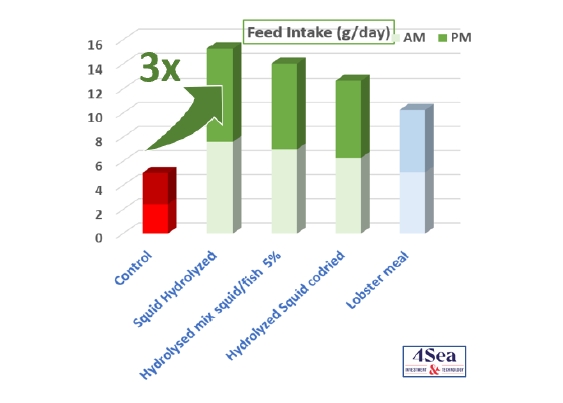
As marine ingredients are reduced, formulators therefore need to consider metrics beyond the traditional nutrient profile, including essential amino acid ratios, soluble protein, free nucleotides and other functional components. Hydrolysed marine co-products offer one potential solution. Trials in shrimp showed that foods containing marine hydrolysates substantially reduced the time needed for shrimp to detect and consume feed. Squid hydrolysate, for example, increased feed intake threefold compared with the control (Figure 1).
The problem of nutrient leaching
Crystalline amino acids can support fishmeal-free diets, but only if the nutrients remain in the pellet long enough to reach the shrimp.
Laboratory trials confirmed that fishmeal can be reduced or eliminated from shrimp diets when crystalline amino acids and methionine are properly balanced. However, Verstraete noted that this is far more difficult under field conditions. An Australian study found that crystalline lysine and methionine leached from fishmeal-free diets over time but were retained in fishmeal-based diets, while taurine leached equally from both. This emphasizes the importance of using auto-feeders or demand feeders to optimise performance of next generation shrimp feeds.
Rethinking lipid nutrition
Verstraete suggested that the same precision is applied for lipid nutrition, as it has been for amino acid nutrition. DHA and EPA demand is rising from aquaculture, pet food and human nutrition, pushing prices higher. He added that emulsifiers, PUFA and medium chain fatty acids can contribute to the solution.
“In Asia, we need to establish precisely how much lipid is required for energy, phospholipids, cholesterol as well as target levels and ratios for highly unsaturated fatty acids: polyunsaturated fatty acids (HUFAs: PUFAs) at culture stages and functional purposes, Since these are expensive nutrients, more economical use is required and to pay attention that nutrients are not oxidised.”
said Verstraete.
Flexibility and resilience in salmon feed
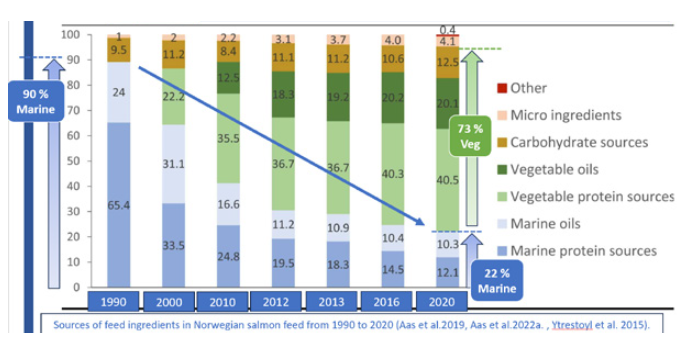
By 2020, Norwegian salmon feeds contained just 12% of fish meal, down from 65% in the 1990s, with greater use of processing co-products (Figure 2). Marine oils also fell to 10%, with plant protein and oils providing 73% of the replacement while DHA and EPA were retained for fish health and product quality. Formulators favoured low-ANF plant proteins, including soy protein concentrate instead of soybean meal, and had begun using mediumchain fatty acids and insect meal. Verstraete expects further changes by 2026.
Feed must follow genetics
New and faster-growing genetic lines require more nutrients for growth and maintenance- feeds must evolve with them. In India, diets tailored to improved Penaeus monodon lines can efficiently produce 50–80g shrimp. Verstraete estimates that this could generate 120,000– 150,000 tonnes of additional monodon feed demand in 2026.
Health, environment and new ingredients
As marine protein levels decline, health additives are becoming more important. Trials of functional ingredients such as polyphenols show promise against Vibrio parahaemolyticus, while gains in survival and FCR may justify their cost even without an acute disease challenge.
Environmental stress adds further complexity. Temperature shifts can impair liver function, immunity, digestion and membrane fluidity while altering the microbiome in favour of opportunistic bacteria. In shrimp, salinity and ionic imbalances may also require dietary mineral adjustments and osmoregulatory support.
From replacement to value
Novel ingredients should be assessed for their overall value- not as direct replacements. Black soldier fly meal, for example, provides antimicrobial peptides, medium-chain fatty acids, lauric acid and chitin, with studies reporting better stress resistance in marine fish and improved hepatopancreas condition, less enteritis and faster postinfection recovery in vannamei shrimp.
The message was, “As the salmon industry has demonstrated, integrating sustainable and novel ingredients early can create longer-term advantages. In Asia, we need to embrace sustainability and integrate this into our feed concepts too. We need to work towards creating formulations that are not merely cheaper or less dependent on marine ingredients, but genuinely more flexible and resilient.”


