
On 9th November, Rabobank released its Global Aquaculture Outlook 2027, where aquaculture growth is expected to remain positive in 2027, but increasingly divergent as emerging-markethet and lower-value species expand. This report is based on the results of the Global Seafood Alliance (GSA) and Rabo Research 2027 Global Aquaculture Survey.
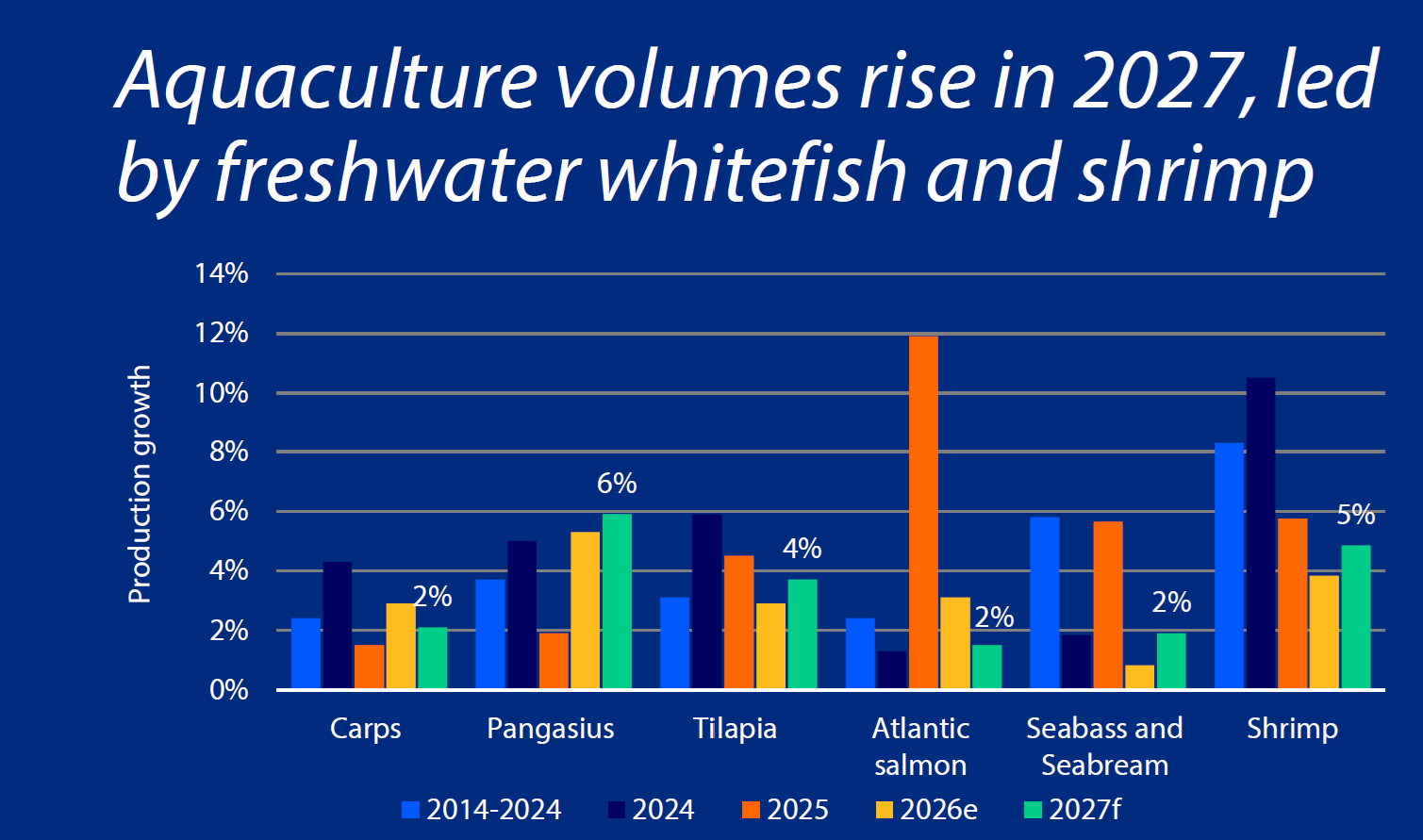
Aquaculture volumes rise in 2027, led by freshwater whitefish and shrimp.
- Whitefish: Pangasius and tilapia production are forecast to expand by 6% and 4%, respectively, in 2027. Atlantic salmon, seabass and seabream are forecast to expand around 2% year on year.
- Shrimp: Global volumes to grow by 5% in 2027, led by expansion in Ecuador.
The report gave key takeaways on production by region. In Southeast Asia and India, it expects
- Indian shrimp production to exceed 1 million tonnes.
- Indonesian shrimp production to contract by 3%.
- Vietnam’s shrimp production to decline by a low single-digit percentage.
- China’s tilapia production to grow less than 1% in 2027 and the combined production of pompano, grouper, Japanese seabass to grow in 2027, exceeding 1 million tonnes.
In terms of global production by species, the GSA team with Gorjan Nikolik and Novel Sharma, forecasted:
Atlantic salmon
Global growth is forecast at 1.5% in 2027, with 1.763 million tonnes in Norway and 820,000 tonnes in Chile. A sharp shift in the salmon supply cycle is expected across Norway and Chile, with volumes slowing substantially after the exceptional expansion of the previous two years.
Tilapia
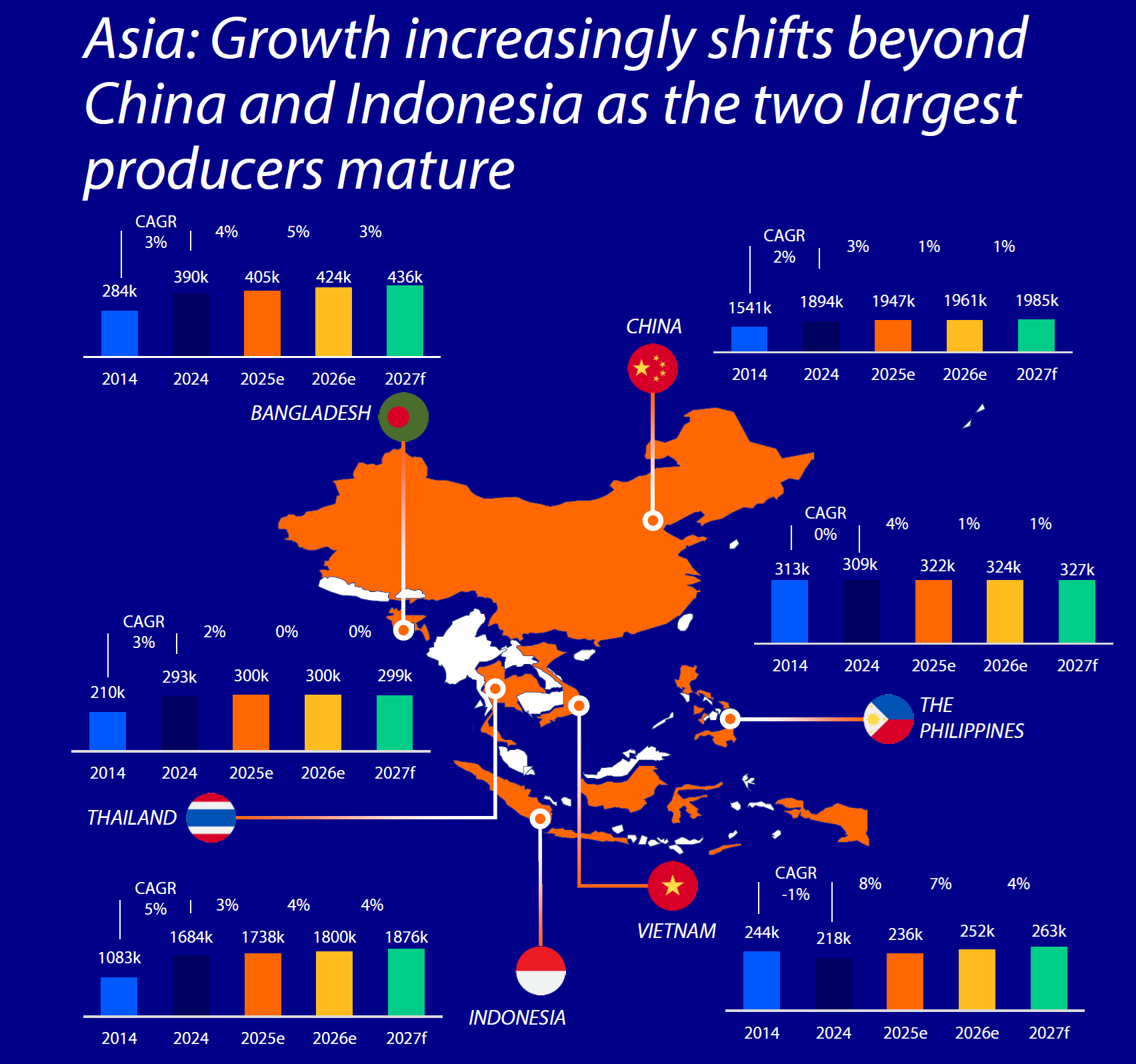
In 2027, global production will surpass 8 million tonnes at 3.7% growth over that in 2026. Supported by local markets and technological advances, Asia’s tilapia production is expected to increase by 3% in 2027, dominated by China and Indonesia. Elsewhere in Asia, growth is proving more resilient with volumes expected to increase by 2.4% in 2027, led by Vietnam growing 4% in 2027, after a 7% in 2026.
African tilapia production is expected to accelerate to 7% in 2027, driven by rapid expansion in sub-Saharan Africa, Uganda, Ghana, Nigeria, Zambia and Kenya. Egypt remains the dominant producer with an expected >1.2 million tonnes in 2027.
Latin American tilapia production is expected to grow 5% in 2027. Brazil remains the largest producer, but growth forecast at only 3% while growth in Colombia will accelerate at 12% in 2027.
Pangasius
Global pangasius production is expected to approach 4 million tonnes, an increase of 6% in 2027, led by Vietnam and India. Vietnam’s production will grow 3% in 2027, bringing output to 2 million tonnes. India will show stronger growth and production is expected to increase by 12% in 2027 to 1 million tonnes. Its production is driven by domestic consumption contrasting with the export focused industry in Vietnam.
Shrimp
Global shrimp production will grow at 4.9% in 2027. Asian shrimp production is forecast to expand by 3% to 4.8 million tonnes. India has proven to be resilient with an expected 8% growth in 2027. After a sharp expansion in 2024, growth slowed in China in 2026, but the team forecasts 4% growth in 2027. Elsewhere in Asia, the 2027 outlook is considerably weaker.
In Latin America, Ecuador is expected to follow its remarkable growth in 2025 and 2026. There’s a strong probability that growth will surpass 15% in 2027 and output exceed 1.6 million tonnes. The team noted rising feed and fuel costs as two pressure points on Ecuadorian producers. Mexico is forecast to rebound by 15% in 2027 after a 9% contraction in 2026. Brazil production will grow 9% in 2027, supported by strong domestic demand.
Marine fish
China’s marine finfish sector with pompano, large yellow croaker, grouper, Japanese sea bass have been expanding rapidly. The combined production of the five species doubled to 1.2 million tonnes in 2024 from 490,000 tonnes in 2014, led by grouper, pompano and Japanese seabass. In 2027, the forecast is continued growth but at a moderate pace. The combined output in 2027 will exceed 1.5 million tonnes with pompano approaching 400,000 tonnes. The Japanese seabass will retain its growth momentum at 11%, and grouper will slow to 6% in 2027.
Slower growth in Mediterranean sea bass and seabream production is expected, at 2% in 2027 and 1% for Greece. Industry increasingly points to a plateau as fish meal, fish oil and aquafeed costs put pressure on margins.
Source: Global Aquaculture Outlook, 2027. Published by the Global Animal Protein Sector team. Authors: Novel. Sharma, Gorjan Nikolik, November 2026. Rabobank Research Food and Agribusiness.


