
On December 4, Daily Star’s Dipankar Roy wrote that with the slump in prices from lower demand, black tiger shrimp Penaeus monodon farmers in the southwestern region, the main belt of export-oriented shrimp and prawns in Bangladesh, reported losses.
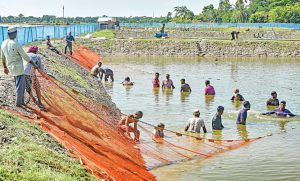
The price has declined by USD 6.84/kg (BDT700/kg) over the last month with declining demand in the major western markets, arising from higher inflation and a growing fear of recession, according to farmers and shrimp processors and exporters. Frozen shrimp exporters are now buying at lower prices and storing them. However, owing to strong demand in the local market, the price of small-size shrimp is comparatively high.
Shrimp farming has been the only source of income for tens of thousands of farmers in Khulna, Satkhira and Bagerhat for years. Some 90% production in the region are exported to 32 countries. Post pandemic, at home and abroad, farmers had expected to recoup the losses during the pandemic. The industry now faces a challenging situation due to various reasons, including natural calamities and the increase in prices for feeds and post larvae.
Due to the decrease in the prices in the global markets, more shrimp are being sold in the local market. Biprodas Bairagi, who carries out semi-intensive shrimp farming in Choksoilmari village of Batiaghata Upazila in Khulna, for the last seven years, sold shrimp at BDT 1,200 to BDT 1,300/kg (USD 11.72 -12.70/kg) in 2022. Current prices are around BDT 730 to BDT800 (USD 7.11-7.80/kg) . In the first week of September, the 44-year-old farmer sold medium-sized shrimp for BDT 1,260 to BDT 1,350/kg (USD 12.31- 13.18/kg) and small-sized shrimp for BDT 950 to BDT 1,100 (USD 9.27-10.75/kg). But within two months, the price decreased sharply. (AAP assumption: medium size=33g; small size – 20g).
“Buyers did not show any interest in buying shrimp from our ponds. So, we were bound to sell at lower prices,” added Bairagi who recently bought a 25kg bag of fish feed for BDT 4,325 (USD42.14/bag or USD 1.68/kg), which was 20% higher as compared to BDT 3,600 (USD 35.11 or USD1.40/kg) in May. In the past four months, the farmer has spent more than BDT 8 lakh (BDT 800,000) or USD 7,812 to purchase fish feed and medicines and pay for labour and other costs.
“I would have made a profit if I could get a fair price,” he said. Now, he worries if he will be able to repay loans.
Monoj Bairagi in Khalashibunia village, carries out semi-intensive culture of black tiger over the last five years, has spent Tk 22 lakh for the current season. He borrowed BDT 8 lakh (USD7,812) from microfinance institutions and relatives, but does not know how he would pay them back. “How will I survive in this situation?” he questioned.
More than 250 shrimp farmers in Khalashibunia village are experiencing losses with the low prices of shrimp. Most of them have borrowed money from banks or microfinance institutions, said Pabitra Roy, a member of the local union council and a shrimp farmer. Farmers in Khulna, Satkhira and Bagerhat say buyers are reluctant to visit shrimp ponds to make direct purchases. Many farmers sell at a low price in the local market to reduce losses. At least five businessmen told The Daily Star that they were not buying shrimp now.
Insan Ali, a businessman in Khulna, is sending small-sized shrimp to local markets as prices are better, although these are also decreasing day by day. Inflation has remained at elevated levels in Bangladesh for several months as well for the war-induced crisis. It was at 8.52% in October.
Tariqul Islam Zahir, Director of the Bangladesh Frozen Foods Exporters Association, and managing director of Achia Sea Foods Limited, says the demand has decreased in the international market. “Due to higher inflation, we are not getting orders. Prices have fallen as the risk of the world falling into recession is growing.”
Shrimp farming is in 59,322 ponds covering a total area of 31,135 ha in the Khulna district. Some 33,271 tonnes of shrimp were exported from Khulna, Bagerhat and Satkhira in the last financial year. Md Tofazuddin Ahmed, deputy director of the fisheries department in the Khulna division, said generally, prices remain low from October to January. After February, it will rise again.
The fisheries department has trained 7,000 shrimp farmers in Khulna, Bagerhat, Satkhira, Jashore, and Gopalganj under the World Bank-supported Sustainable Coastal and Marine Project. It is providing shrimp post larvae and funds to 3,000 farmers.


