
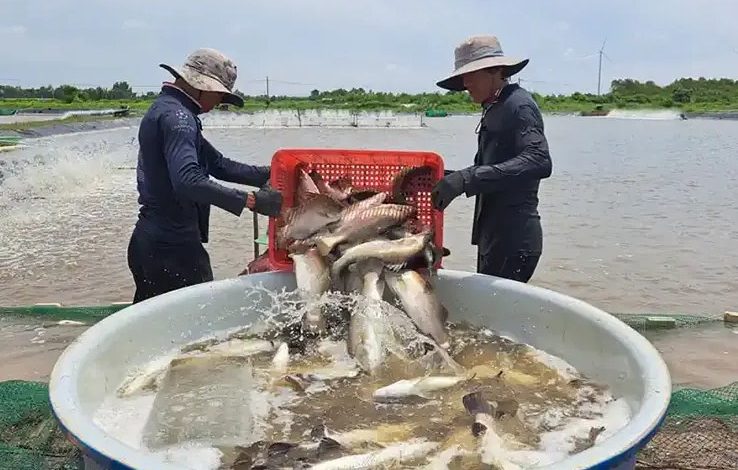
In brackish water areas of the Mekong Delta, seabass farmers are having a bumper harvest and fetching high prices for their fish.
The Dai NgÆ° Nghiep Company in Soc Trang province has just harvested their seabass ponds to deliver to customers in Ho Chi Minh City. Dung, director of the company, mentioned that the seabass in these ponds were raised for 8 months and have reached a size of 1.2-1.5 kg. Currently, the small-size seabass (0.5-0.9 kg each) is sold at VND73,000/kg (USD2.98), while the larger-size fish (1.2 kg and above) is priced at VND75,000/kg (USD3.06), resulting in a profit of VND5,000-7,000/kg (USD0.20-0.29) for the fish farmers.
Tuan, one of the large-scale seabass farmers in Vinh Chau, Soc Trang, explained that the price of seabass was very high earlier this year. It reached as high as VND90,000/kg (USD3.68). The average price was VND80,000/kg (USD3.27). According to Tuan, a heactare of land can yield an average of 50 tonnes. Some farmers can harvest 100 tonnes. If the harvest is bumper, farmers can have at least VND500 million in profit (USD20,460).
Raising seabass is not difficult; the domestic and export markets, which are not yet completely stable, are the main problems. Dung’s company operates two farming areas of more than 40ha, with an annual harvest of about 2,000 tonnes, of which 85% is seabass and 15% is silver croaker. In addition, Dung collaborates with local farmers by supplying them with fingerlings, fish feed, and purchasing their commercial fish, about 2,000 tons each year. Dung shared, “Expanding the farming area is not difficult if there is an export market, because currently, everything from fingerlings to feed and the farming process in Vietnam is well-managed.â€
Soc Trang has the highest seabass production in the country, exceeding 20,000 tonnes annually. Khanh Hoa has around 10,000 tonne and other provinces like Quang Ninh, Hai Phong, Thai Binh produce a few thousand tonnes each. Seabass are also exported to several Asian countries, European, American, and Canadian.
“Exporting to Asian countries is the easiest, as they only require fish weighing 0.5-1.2 kg each ( about 0.95 kg each on average) and a culture period of 6.5 months. However, when exported to Europe, the United States, or Canada, the fish must reach a size of 2.5-2.7 kg each, thus, the culture period ust extend to 12-14 months, but the selling price is obviously higher, †said Dung.
“Currently, in terms of cost, Vietnamese seabass can compete with those from Thailand and Malaysia. Therefore, in my opinion, the agriculture sector should pay more attention to this species.â€


