
IFFO announced that a review* led by Dr Brett Glencross, along with a team of renowned fish and human nutrition experts, assessed the current landscape of Long-Chain Omega-3 Polyunsaturated Fatty Acids (LC-PUFAs) as well as their benefits and explored their realistic growth potential. The report, published in Reviews of Fisheries Science and Aquaculture, relies on insights gleaned from a technical workshop held in Stirling, Scotland, in May 2023.
Known benefits, growing needs
LC-PUFAs like eicosapentaenoic acid (EPA) and docosahexaenoic acid (DHA) have a wide range of effects both on fish and human physiology: cell membrane structure, regulation of inflammation and disease resistance. Current estimates of EPA and DHA production are around 160,000 tonnes/year, with more than 90% of this coming from fishery and aquaculture resources:
Estimates of global fish oil production are around 1,200 ktonnes / year with an increasing contribution of by-products from various fisheries and aquaculture (53%). Among these oils, EPA and DHA can make up from <2% to almost 60% of the total fatty acids.
Aquaculture is a net producer of EPA + DHA relative to its inputs and a greater contributor to human EPA + DHA supplies than the direct consumption of wild fish.
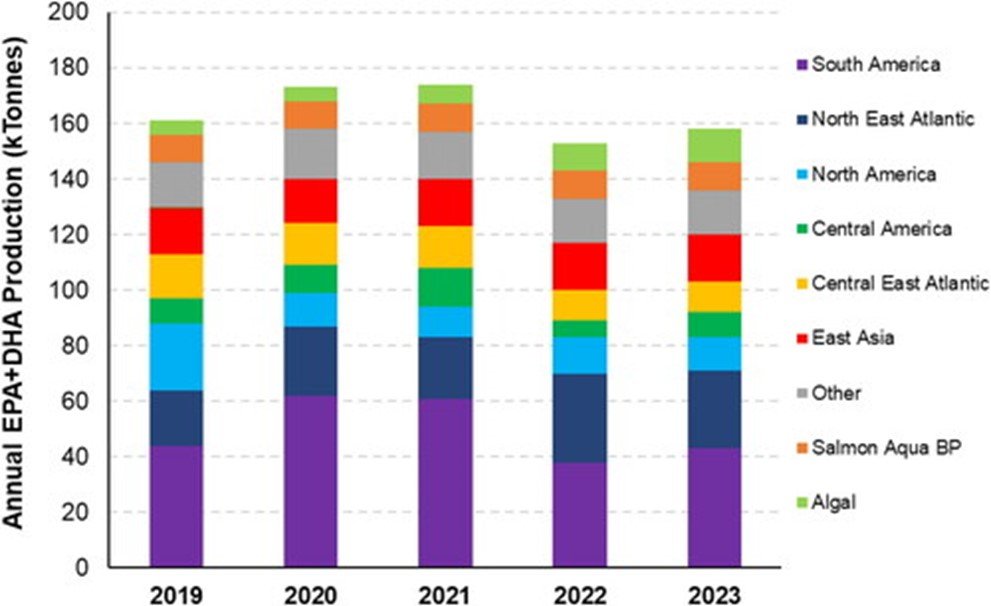
Global commercial production of EPA + DHA by origin. All are fish derived except “Algalâ€. Salmon Aqua BP is derived from salmon aquaculture. Data derived from Holtermann (2023).
Glencross explains.
“Among the aquaculture sectors that are the largest users of LC-PUFA resources (salmonids, shrimp, and marine fish), there are varying degrees of capacity by each to synthesize LC-PUFA: this affects the degree to which they must be obtained via the diet†Deficiency symptoms vary, but often include a reduced growth rate and poorer survival, as well as various pathologies.”
Limited capacity for additional growth
Prospects for expanding the volumes of available EPA and DHA are limited and include:
– improvements in circular-resource thinking. The scale of the losses of the omega-3 LC-PUFA resources through food wastage alone is equivalent to about 50% of that consumed. The model used by the scientists in this review estimates that a total pool of 272 ktonnes of EPA + DHA is available from the combined unutilized by-product resources.
– the development of other sources of these fatty acids, including those produced from zooplankton, algae, and genetically modified (GM) plants. So far though, only algal oils contribute any significant volume, with an estimate of 12,000 tonnes for 2023.
Gaps in knowledge
Glencross added,
“Much remains to be done to both improve the understanding of the physiological roles of omega-3 LC-PUFA in aquaculture species and better define their requirement for the myriad of species now being farmed in aquacultureâ€,
For instance, the prior nutritional history of an animal and how this affects subsequent requirement responses have not yet been examined. Additionally, dietary formulation strategies have changed significantly over the last decades and should be considered to determine intake levels of all the nutrients needed by the fish. Finally further research is needed to elucidate the multi-faceted role that it is likely that LC-PUFAs play, including interactions among the different PUFAs.
* Glencross, B. D., Bachis, E., Betancor, M. B., Calder, P., Liland, N., Newton, R., & Ruyter, B. (2024). Omega-3 Futures in Aquaculture: Exploring the Supply and Demands for Long-Chain Omega-3 Essential Fatty Acids by Aquaculture Species. Reviews in Fisheries Science & Aquaculture, 1–50. https://doi.org/10.1080/23308249.2024.2388563
A report on the technical seminar was also published in issue the print edition of Aqua Culture Asia Pacific (November/December 2023) and available online here.


