
After 10 years of prior collaboration, Skretting announced in 2023, that it will work with Zooca Calanus to develop high-quality, nutritionally optimised feeds using the copepod Calanus finmarchichus-based ingredients and whole fresh canned copepods.
At larvi 2024, held in September 9-12 in Ostend, Belgium, the team from Skretting, led by Dr Eamonn O Brien, Skretting Global Product Manager LifeStart and Dr Philip Dhert, Senior Researcher and Hogne Abrahamsen, group CSO at Zooca Calanus jointly launched Ignis – 510g of concentrated pasteurised copepods in a can, manufactured by Zooca Calanus.
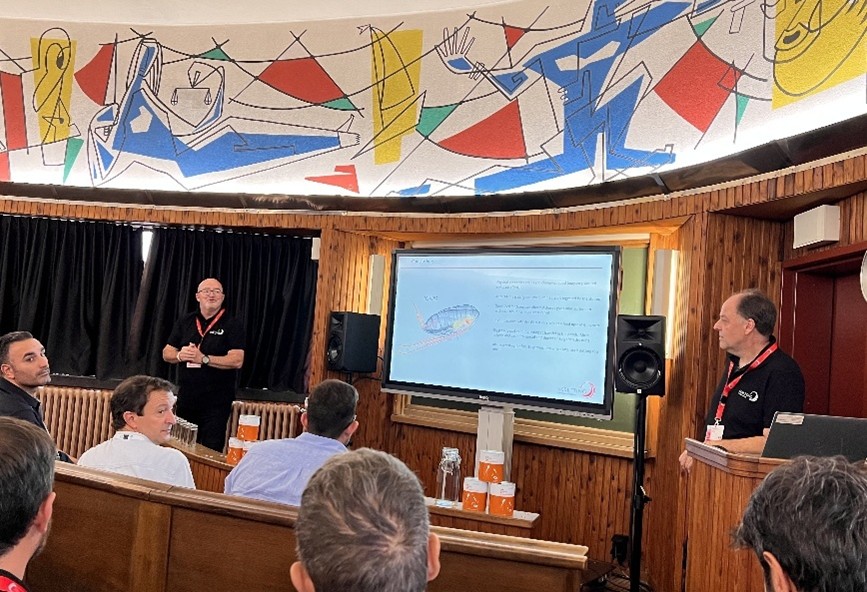
Present at the launch were around 45 larvi 2024 participants, including industry from the Mediterranean countries and India.
Here, attendees saw how the product, a ready to use pasteurised copepods `seem to come alive once the can was opened.
The copepods are of course not alive but exhibit a natural neutral buoyancy that keeps them in suspension with any water movement. The team said that this is a new level of convenience, as well as opportunities to refine larval production and shrimp broodstock feeding.
Dhert explained that the product is 95% water and does not need cold chain. Size-wise, it is 3mm and so it is not to replace Artemia. It can be fed to post larvae (PL12) or earlier and is immediately ingested. Attractability is very high. For fish, it can be a transition live feed after Artemia. In an acclimation trial, Ignis was fed to PL12-PL18. According to Dhert, switching from the dry diet (Elevia) to wet diet (Ignis) and vice versa is not an issue.
A 4-week nursery trial with PL18-40 using 100L RAS tanks had three treatments: control with dry diet Elevia, Ignis fed straight from the can and Ignis fed after rinsing out the water. Shrimp grew fast eating all the copepods resulting in reddish faecal pellets. In the first week, the result was 97% survival, an extra 3-4% survival over that of the group fed the control diet. Dry weight increased from 42mg/g (control) to 44mg/g (Ignis rinsed). After 3 weeks, survival was 93% for the Ignis rinsed group and body weight was close to 300mg. Dhert added that the copepods stay in the water column.
Calanus finmarchichus is a tiny marine copepod rich in essential nutrients. This abundant resource offers marine juveniles high-quality nutrition, promoting efficient feed intake and digestion. Ignis will be made available through the Skretting network and is currently being rolled out in European hatcheries, with more countries to follow.


