
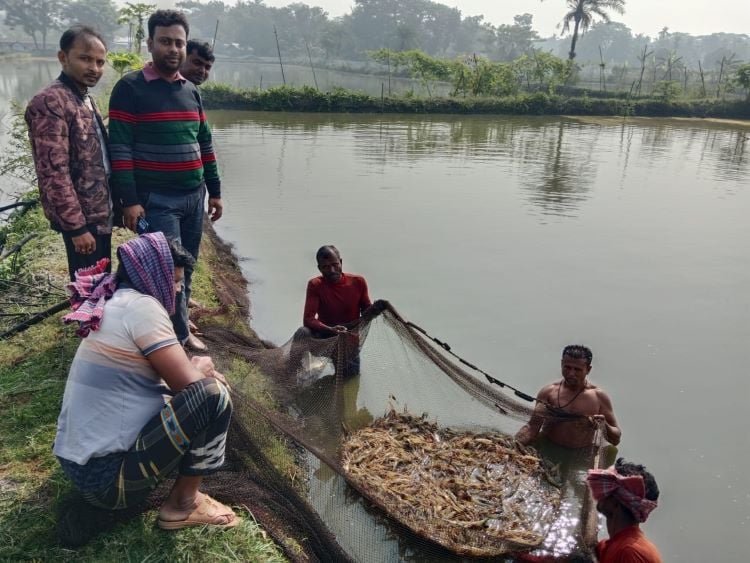
Farming Penaeus vannamei (white leg) shrimp in Kulna, Bangladesh is possible. Dr Latiful Islam, Chief Scientific Officer of Brackish Water Center at Paikgasha, Khula, said shrimp is one of the main foreign currency earning sectors. Commercial farming of vannamei shrimp, side by side, with other shrimp can be the best way of increasing shrimp exports.
Islam said that, vannamei shrimp are cultured in saline water, the water is directly collected from the Bay of Bengal, treated, and supplied to designated ponds. This process eliminates bacterial and viral contamination from seawater. The farms feature multiple ponds with pollution protection and environmental safeguards. Seamark BD imports feed, fry, and technology from abroad while adhering to strict standards. They seek foreign assistance for technology implementation.
The Department of Fisheries (DoF) gave the go-ahead to culture vannamei shrimp in the region, after years of concerns that such a foreign species may have a negative impact on their native shrimp species such as black tiger shrimp Penaeus monodon.
Following the success of the first pilot project, the DoF allowed 27 firms, including M.U. Sea Foods Ltd, Grow tech Aquaculture ltd, and Fahim Seafood Ltd, to farm the shrimp on a trial basis.
Sheikh Abdul Baki, Vice-president of Bangladesh Frozen Foods Exporters Association (BFFEA), said commercial production of this shrimp is possible, provided necessary steps are taken.
Pabittra Kumar Das, Senior Upazila Fisheries Officer, Paikgasa, Khulna, said result of a pilot project has given hope for shrimp processing plants and farmers for better productivity. Farmers can grow black tiger shrimp once a year whereas vannamei can have three cycles a year. At the same time, productivity of the vannamei shrimp is much higher than black tiger shrimp; 300-400 kg/ha for the black tiger shrimp versus 7,000-8,000 kg/ha for the vannamei shrimp.
“We do not have an alternative to increase shrimp exports without vannamei shrimp and I think it will not have any effect on the environment,” said Mostafa Nuruzzaman, chief executive officer of Sushilan, a nongovernment development organization.
Abdul Baki said the production cost of black tiger shrimp is higher than that of vannamei. He added that “We are unable to cater to the global market at this price. People want shrimp at cheaper rates.”
The industry expects that shrimp exports from Bangladesh to double within five years with this addition of vannamei shrimp farming. It will also help meet the local demand for shrimp.
In 2024, Bangladesh’s shrimp exports continued to decline to 25,000 tonnes, down from 55,000 tonnes in 2016. The lower volume was attributed to increased consumption in the domestic market, about 50%-70%, according to Kabir Chowdhury, Maverick Innovation BD. Exports in 2024 comprised 17,500 tonnes of black tiger shrimp and the rest a combination with freshwater prawn. Additionally, the industry faced various challenges such as low shrimp prices and a supply shortage, leading to many processing plants closing down. The EU accounts for 70% of the export volume, the UK 12%, and the US 6% (shrimpinsights.com).


