
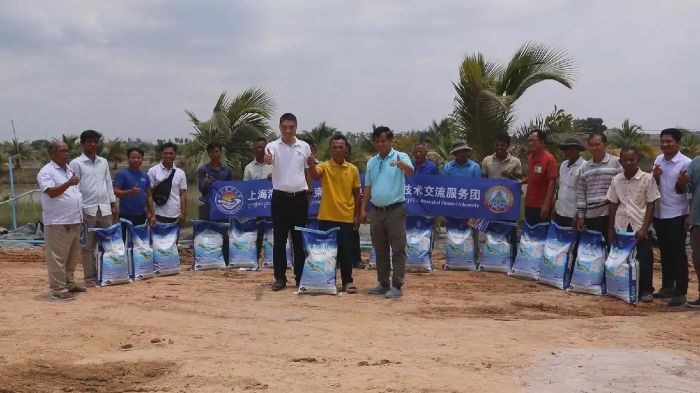
A research team from China’s Shanghai Ocean University is helping Cambodian farmers cultivate high-quality shrimp by bringing innovative techniques and homegrown talent development, and by bridging scientific expertise with local needs.
Led by Professor Wu Xugan, the team has adapted China’s successful rice-shrimp co-cultivating model to Cambodia’s unique conditions.
“China benefits from better foundation conditions, including the use of oxygenation technology and relatively convenient transportation. In contrast, Cambodia relies primarily on harvesting wild shrimp seeds of varying sizes from rivers to raise, which means survival rates cannot be guaranteed,”
said Wu.
Wu’s team conducted extensive field investigations across 174 farms in Battambang, Kampong Thom, and Takeo provinces. Their solution centers on three key innovations: introducing aeration systems for high-density rearing, supplying high-quality feed from China, and implementing real-time water quality monitoring.
“The first priority was to solve the issue of cultivating large-sized prawn seeds. In our pilot projects, we introduced aeration, because with higher density, aeration is essential. Second, we provided high-quality feed from China. Third, we implemented water quality monitoring. Through these three techniques, we developed the large-sized shrimp seed cultivation technology, resolving the problem of mass seed production,”
said Wu.
The results speak for themselves: the temporary rearing survival rate of giant river prawn seeds has risen to approximately 70 percent, with average body weight reaching 5.2 grams.
Since 2021, Professor Wu’s team has brought their research findings directly to Cambodian farmlands through the Lancang-Mekong Rice-Fishery Technology Cooperation project.
Zhang Dongdong, a core team member, has been instrumental in organizing hands-on training and adapting technologies locally.
“My work focuses on two main areas. First, organizing local technical training sessions and inviting Cambodian farmers and frontline practitioners to participate. Second, developing local fishery technologies in Cambodia, including rice-shrimp co-cultivating techniques suited to the region, and integrating and promoting these methods,”
said Zhang.
Embracing the adage “Give a man a fish, and you feed him for a day; teach a man to fish, and you feed him for a lifetime,” the team has conducted more than 10 technical training sessions in Cambodia since 2024, reaching hundreds of farmers and aquaculture workers.
Yet sustainable impact requires more than technology transfer; it demands local expertise. Recognizing this, Shanghai Ocean University established a dedicated scholarship program to enroll students from Cambodia and other countries.
Among them is Chheng Ly, who plans to return home after graduation and contribute to sustainable agricultural development in Cambodia.
“I hope to continue my studies or work in fields related to agriculture, food, or aquaculture, applying the knowledge and experience I gained in China to the actual conditions in Cambodia. I want to contribute my part to Cambodia’s food security and sustainable agricultural development,”
said Chheng.
From relying on outside support to nurturing local talent, a homegrown team of experts is taking shape across Cambodia’s fields and laboratories. They are learning, experimenting, and gradually making the work their own.
Looking ahead, Professor Wu and his team plan to set up a joint China-Cambodia laboratory for sustainable aquaculture, a place where science and practice meet and ideas take root.


