
Dragoș Mircea discussed his battle with TPD at his two farms in Vietnam and the lessons learnt
In early 2025, translucent post larvae disease (TPD) became a major issue in Vietnam. At TARS 2025, held in August, Dragoș Mircea, CEO of Good Tôm (a shrimp farming startup), discussed his experience tackling TPD at his two shrimp farms and shared relevant field data and insights gained from managing this disease.
Good Tôm (Good Shrimp) operates a 2ha research farm and a 10ha production farm in Bac Lieu, Mekong Delta. The farms use intensive, circular, HDPE-lined ponds (350–1000m³), with biosecurity fencing, automated feeding and waste removal, together with data-based, precise protocols. He runs 3–4 annual cycles targeting size 30-40/50 per kg. Stocking density is typically 200 PL/m² during grow-out. The aim is an antibiotic-free, profitable and sustainable farming, adjusting stocking density as needed to ensure that carrying capacity is not exceeded.
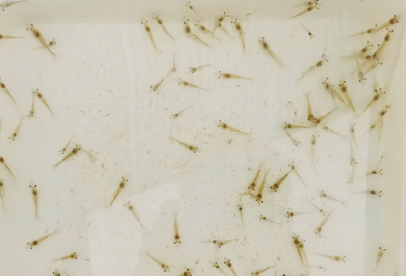
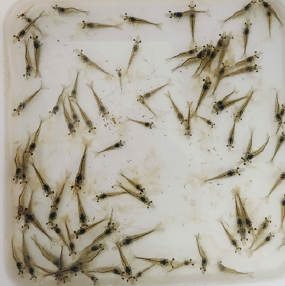
“We had some great, very profitable crops, with shrimp sizes 27-40/kg and 70-83% survival rates. We also had EHP outbreaks, producing size 80-100/kg, and some crops with 50-60% survival rates. TPD was a different experience,” said Dragoș Mircea.

Three TPD outbreaks
Both farms encountered TPD outbreaks. The first occurred in December 2024, the second in February 2025, and both were in Farm 1. The third case was in May 2025 in Farm 2. In two outbreaks, he linked the source to hatcheries and for one of them, a water borne source. Mortality was high, usually well over 50%, but not precisely measured until harvest. TPD diagnosis was confirmed by PCR.
Case one
“In the beginning, my technicians reported unusual observations. The shrimp exhibited pallor, mortality began at DOC6, transparency increased, and the gut was no longer visible. Despite interventions, mortalities could not be contained,” stated Dragoș. Mortality rates rose sharply, with estimated losses exceeding 50% within several days (Figure 1). In ponds 2 and 3, mortality persisted through DOC75 and remained unmitigated. By DOC110, survival was recorded at 33%, with FCR of 1.75. In pond 1, significant mortality continued for an additional 20 days before stabilising. Although these ponds showed improved survival, managing them remained highly challenging, said Dragoș.
An outlier
This is pond 4 where shrimp showed sharp mortality(~75%) until DOC 25-30 at the nursery phase, but as they were transferred to grow-out ponds, it was an easy cycle with survival at 85-90%, resulting in strong economic outcomes. “In the prolonged nursery phase which began with PL12, the shrimp recovered somewhat, and mortality stabilised. Shrimp grew to size 27/kg. How did we do this? To reduce Vibrio parahaemolyticus in the gut and water, we used water disinfectants, feed probiotics, organic acids and phytogenics, along with extended probiotic and carbon use in the grow-out pond before transfer from the nursery. I was hoping that V. parahaemolyticus TPD will reduce below its lethal threshold and/or evolve into a no nor less deadly strain.
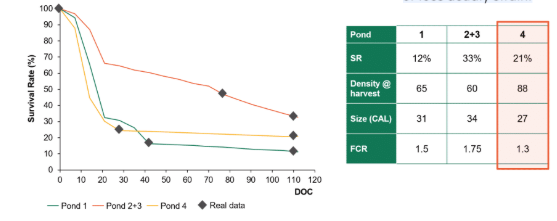
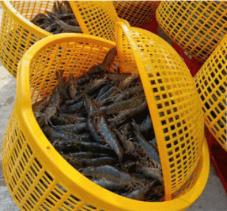
Dragoș explained, “This gave us the confidence to keep the crop. We continued as usual, distributing the shrimp among the available grow-out ponds. As a result, the density was lower than our typical practice—60–80/m3at harvest, instead of the usual 150+ PL/m3. We had three ponds with TPD shrimp, which we harvested at around DOC 110–115.The shrimp sold for a premium of USD 6-7/kg, partly because it was Chinese New Year (Tet in Vietnam) when prices were high, and because supply was low due to many farms facing TPD.”
Case two
A hatchery-linked outbreak with high TPD levels (confirmed by plating and PCR) caused ongoing mortality for 45 days. The post-larvae came from a different hatchery. The crop was terminated, as the same intervention from case 1 was in effective. Mortality decreased after 15 days but persisted until the crop was abandoned at DOC 45 with shrimp size~300/kg.
Case three
This was likely a waterborne outbreak in a single pond. The same batch of post-larvae was stocked in several ponds but only one pond had a TPD outbreak. “We believe that shrimp contracted TPD from poorly disinfected pond water. Economic performance was acceptable, as the shrimp recovered relatively fast in this instance. ”Early intervention, strong disinfection and biosecurity containment prevented the spread. Survival was 50-60%post challenge. The cycle finished with a survival rate of35%, size 40 CAL, in 95 days.
Lessons to manage TPDTPD is among the most severe diseases affecting shrimp farming. Drawing from his experience with TPD, Dragoș categorised key lessons into methods for prevention and containment:
- Preventing TPD requires sourcing post-larvae from reputable hatcheries and verifying their quality. This isthe most important step.
- It is prudent to always assume water sources may be contaminated with TPD and to implement effective water treatment protocols. For instance, high pH level scan reduce chlorine’s efficacy. In Vietnam, it is advisable to presume TPD is present in nearby canals and to apply the required dose of disinfectant before stocking.
- The use of nursery ponds will limit the spread of TPD within the farm. This will also minimise economic losses as smaller volumes of water will be compromised.
- Implementing biosecurity measures has proven effective in limiting the spread of TPD, as demonstrated in case 3
Dragoș added, “While this may not be the ideal solution, farmers who choose to retain TPD-infected shrimp may consider approaches aimed at strengthening shrimp health, reducing horizontal transmission, and optimising gut health.” These are outlined in the table below
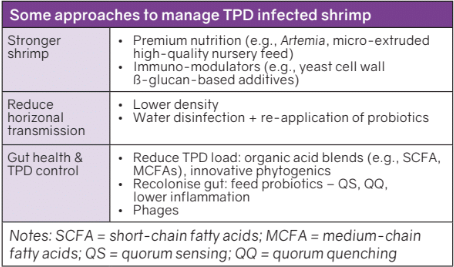
The message was “We noticed that the outcome was mixed, despite using the same protocols. It was an unpredictable disease and we suspected we were dealing with different strains of TPD.
”Post note by Dragoș. As an update on TPD since TARS2025 – outbreaks have decreased significantly, I have not heard of it much in the South of Vietnam this season. Probably hatcheries figured out a way to prevent it, and the consensus has always been that it came from them.
The diagnostics gap: Early detection of pathogens
“There is the financial toll of disease across board,” said Kit Yong, Founder of Forte Biotech, as he highlighted the harsh economic realities faced by aquaculture farmers across Southeast Asia in a presentation at TARS 2025on shrimp aquaculture, in August 2025. “When disease strikes, farmers lose their harvest and income while feedmills and dealers risk losing receivables tied up in ponds for one to three months. Furthermore, credit chains are disrupted, straining cash flow across the value chain.”
“Time is the most critical factor in disease management. Early detection, that is within the first 24 hours of infection, can significantly reduce financial losses. With timely diagnostics, farmers can conduct emergency harvesting, remove infected stocks early, save feed, labour and medication costs and prevent wider spread to neighbouring farms.
“The startup, Forte Biotech has been piloting on-site diagnostic tools with farmers across Southeast Asia and reports detecting white spot outbreaks up to seven days before visible symptoms appear. This early warning window allows farmers and their partners to take preventive action rather than reacting to catastrophic losses.
The company offers customisable, on-site diagnostic tools, white label partnerships, subscription models and AI driven advisory support to help farmers interpretresults and optimise treatment timing. Its TPD assay was ready for use recently. It runs on the RAPID devices with the same simple workflow: extract, load and get quantitative results in one hour on site. “We have since then, tested this with TPD isolates in Vietnam,” added Kit


