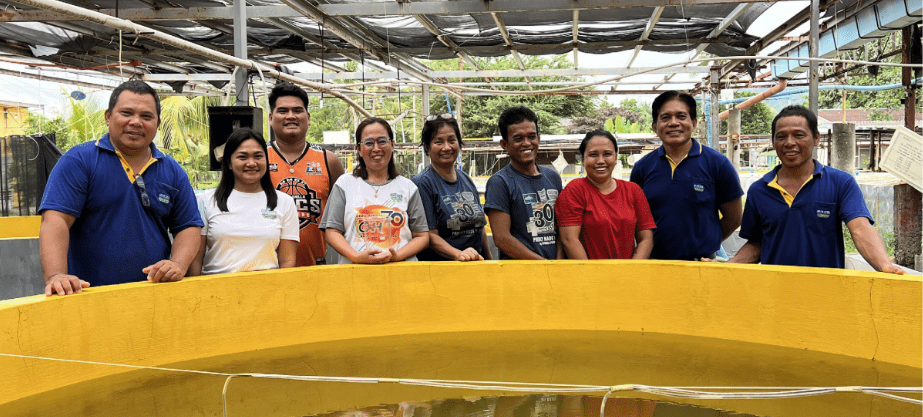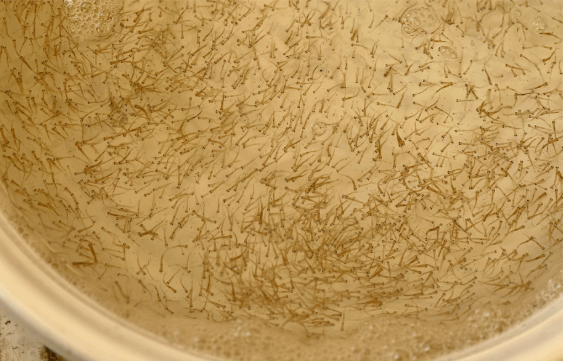
Cebu’s Oversea milkfish hatchery is scaling up production of size 3 fry to meet growing demand from farms across the Visayas and Mindanao. While the hatchery has maintained a steady output, consistency remains a challenge due to fluctuating weather patterns, particularly reduced sunlight and lower temperatures. Milkfish Chanos Chanos, commonly known as ‘bangus’ remains the Philippines’ most widely consumed marine fish. Farmed in brackish water ponds, pens and marine cages in almost all provinces in the Philippines, milkfish is the most accessible and affordable marine fish ata farmgate price of PHP180/kg (USD3.1). Production of farmed milkfish was 400,246 tonnes in 2025 (PSA,2025).
Industry challenge: Persistent national fry deficit
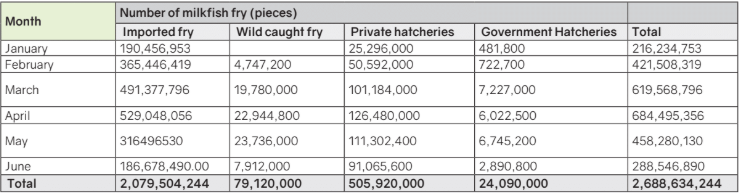
However, a shortfall in local fry production is creating along-standing supply gap affecting the entire industry. The national milkfish industry requires at least 4 billion fry annually. In the first half of 2025, collectively, local and government hatcheries produced 530 million fry and fry imports total led 2 billion (Table 1). In 2024, the total milkfish supply in the country was 3.04 billion.
Current production levels and structural constraints continue to keep the country dependent on imports. To reduce reliance on imports, since 2018, SEAFDEC-AQD (Southeast Asian Fisheries Development Center-Aquaculture Department) and Department of Agriculture– Bureau of Fisheries and Aquatic Resources (DA-BFAR)have been reviving and constructing several milkfish hatcheries nationwide under the Fry Sufficiency Program.
Broodstock management: High investment for large inventory
A recent trip to the Oversea milkfish hatchery in Cebu revealed that running such a facility is challenging. While it is not the largest hatchery in the Visayas, it has consistently produced size 3 fry (graded length 10-12mm) to supply local and regional farm.
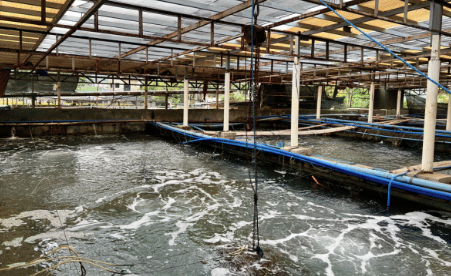
Gina Melendres, Manager of the 2ha hatchery complex, part of Oversea Feed Corporation aquaculture business which encompasses feed production for shrimp and fish (tilapia and milkfish), farming and milkfish and shrimp hatcheries said, “In the Philippines, milkfish hatcheries maintain their own broodstock. This is a big challenge as broodstock take sup most of the space here. Imagine, we have 600 spawners, each around 10-20kg. We maintain them over 7 years until they are ready for spawning. We also have some 30-year-old broodstock, donated by SEAFDEC-AQD which still provide good quality eggs.”
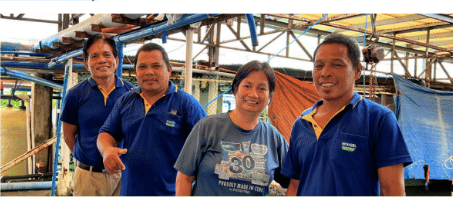
“We also get wild fry and grow-out in cages and at 5 years old, we then choose the shooters to transfer to tanks,” added Gina who started her aquaculture career in 1988 in this hatchery
Tank conditions and water management
“It is costly to maintain such a large number of broodstock,”added Ramir Dacullo, National Feed Sales Manager. “We keep them in large cement rectangular tanks in a covered area. These are 2.5m deep and each hold 250cm3of water. Both males and the larger females are kept together at a ratio of 1:1. Reflecting milkfish sensitivity to temperature and water quality, the daily water exchange for these broodstock tanks is 100%.” The current cold-season temperatures have prompted the hatchery to explore heating incoming water as well as partial water recirculation options.
Nutrition and conditioning
The Oversea Feed mill produces slow sinking extruded broodstock feeds for both the maintenance and spawning phases. Technicians monitor body condition or fatness to determine spawning readiness. “During spawning mode, feed rations increase to 9kg per 100 fish per day,” said Gina. Technicians spend a lot of time feeding the broodstock to satiation.
Spawning performance and environmental control
“Peak fecundity is between 6–10 years but it all depend son broodstock management, nutrition, and spawning environment,” explained Gina. Natural spawning is practised exclusively, with temperature control as the primary trigger. Successful spawning occurs at 27°C,while temperatures below 25°C inhibit egg release. Technicians observe fish activity. Overnight splashing of water indicates the start of the courting process. The next day they gently siphoned out the eggs from the spawning tanks. Peak spawning aligns with natural cycles, March, April, June and July. This is a pattern that Gina said matches the natural spawning cycle seen in the wild. There is only natural spawning at this hatchery, induced by controlling temperature at around 27°C. Although SEAFDEC has developed induced-spawning protocols, the hatchery avoids them so as not to stress the fish; furthermore, technicians must have the skill required to handle frequent handling.
Larval rearing: An 18 day cycle tosize 3 fry
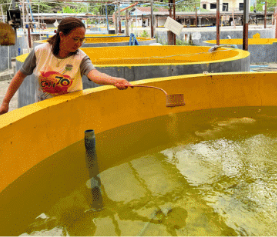
First feeding larvae starts with live feed at two days post hatch (DPH2). These are Brachionus plicatilis(L typerotifers) mass produced in outdoor tanks. This is then followed by rotifers plus powdered feed. “This 45% crude protein, 300μm micro diet is produced exclusively by our feedmill for internal use. Three days before harvest(DPH18), fry receive Artemia to improve energy reserves for transport,” said Gina. The live feed team indicated that rotifer production drops during rainy periods due to reduced sunlight. Gina noted, “We prefer to use powdered feeds rather than depend on the live feed. We enrich the rotifers with vitamin C.
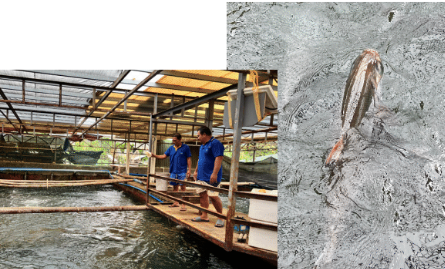
The production cycle from eggs to size 3 fry takes 18 days. Fry are supplied to local farmers for direct pond stocking for grow-out to marketable fish of 400-500g in 4 months or to produce juveniles over 2 months for stocking cages and pens. Distribution is focused on Cebu, Visayas, and Mindanao. While growing fry to juveniles could increase profitability, Gina said that space constraints limit the hatchery to fry only operations. Furthermore, it is difficult and costly to transport juveniles.
Survival rate: Incremental gains and higher targets
This determines the success of hatcheries. SEAFDEC-AQD benchmarks egg-to-fry survival at 20–30% for well-managed hatcheries. Ramir noted that over the years, the Oversea hatchery team has improved survival rates from egg hatching to DPH18. Years ago, survival was only 20% and this gradually increased to 25-30%.The team said that the most critical stage is from DPH2 toDPH9, when the larvae is very sensitive to environmental changes. At DPH9, fry is bigger and eat well. In 2025,the survival achieved up to DPH9 stage was 50% and consequently to the fry stage, it was 35%.
Scaling up: Infrastructure adjustments and production goals
The hatchery produced 24million size 3 fry in 2025. Its January 2026 output has already reached 2.3million fry, attributed to infrastructure improvements—specifically shifting from fully covered to partially covered live feed areas to optimise sunlight exposure. Poor performance in January 2025 at 800,000 fry was linked to frequent rains and insufficient sunlight. This year, management has set an ambitious 50% survival target which the team is confident of fulfilling.
Good market position
Local fry are priced at PHP480 (USD8.3) per 1,000 fry compared to PHP200 (USD3.4) per 1,000 fry imported from Indonesia. Despite the price gap, farmers prefer locally produced fry due to significantly higher survival. Most imported fry go to farms in Iloilo, according to Gina.
“Although our fry costs more, our customers are happy with a high survival rate of 70-80% compared to reported survival of less than 20% with imported fry from Indonesia. At one time, farmers complained on size variation which we addressed through improved grading,” said Ramir
Outlook
With strengthened broodstock management, refined larval protocols, and infrastructure upgrades, Oversea’s Cebu hatchery is positioned to contribute more significantly to regional fry sufficiency. Continued improvements in environmental control and survival rates will be critical to meeting the 2026 production target and supporting the broader national goal of reducing dependence on imported fry.