
John Williamson addressed the challenges in maintaining animal health and productivity through functional nutrition.
Central to these strategies is gut health, which is the foundation of shrimp performance. The assertion is that a healthy gut supports better digestion, stronger immunity and resilience to stress. Increasing concerns on antimicrobial resistance and consumer demand for residue free seafood are limiting the use of antibiotics. This has accelerated the development of non-antimicrobial and sustainable health solutions.
During TARS 2025, on shrimp aquaculture, John Williamson, Business Development Director, Auranta, Ireland, discussed functional nutrition strategies to mitigate major diseases and outlined results from laboratory and field trials. Auranta is an Irish biotech startup focused on natural, science‑backed solutions for animal health, especially gut health, immunity and antimicrobial reduction. It originated as a spin‑off from NovaUCD, the University College Dublin innovation hub. “It is important to understand the enemy and then develop solutions,” said John. “Understanding the value proposition is critical. Targeted use is important such as during a WSSV outbreak.”
Various pathogens such as Vibrio, white spot syndrome virus (WSSV) and Enterocytozoon hepatopenaei (EHP) are disrupting production cycles and constraining profitability. At Auranta, shrimp primary gut and hepatopancreas cells have been isolated to study infection mechanisms and cellular responses. Combined with in vivo infection studies, this work has been documented in seven peer reviewed papers covering Vibrio, translucent post larvae disease (TPD), EHP, WSSV and gregarines (Nematopsis), the latter prevalent in Ecuador.
On the use of functional feeds, John Williamson said, “I think what we should focus on is value and cost per kg shrimp produced as opposed to cost per kg of feed or of the functional additive itself.”

Managing Vibrio and TPD
TPD is caused by Vibrio parahaemolyticus strains carrying multiple plasmid-borne toxin genes. Key among these are VHVP-1 and VHVP-2, a two-component toxin system where VHVP-1 supports attachment to the shrimp epithelial cell whilst VHVP-2 executes toxic effects inside shrimp cells (Williamson, 2025).
TPD can cause more than 90% mortality within 24–48 hours in PL 2–4 shrimp if left unchecked. Research using shrimp cell models showed that a natural antimicrobial blend based on an organic acid/phytogenic blend can silence key virulence genes, including VHVP toxins and PirA. Downregulation of HCP1 and HCP2 reduces bacterial adhesion and cytotoxicity across different salinities and strains (Asian and Latin America). In a Vibrio TPD challenge trial, untreated shrimp showed mortality around 91%, while the inclusion of natural antimicrobial blend reduced mortality to below 6%.
Efficacy to overcome WSSV and EHP
John demonstrated how the organic acid/phytogenics blend modulated immune oxidative pathways exploited by the virus. Downregulation of genes such as beta-1,3-glucan binding protein reduced hyperinflammation and cell death. Increased mucin gene expression (Mucin 1 and Mucin 2) improved mucus production and antioxidant activity further reduced oxidative stress. In vivo trials demonstrated significant reductions in viral copy numbers and mortality (from 96% in controls to 7% in treated shrimp).
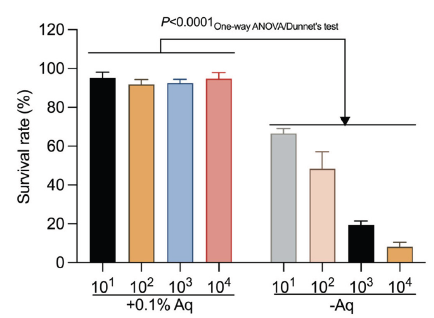
Field trials in Thailand and Ecuador showed reduced white faeces and WSSV prevalence. In a farm in Thailand, WSSV prevalence decreased from over 30% in 2021 to 3% in 2022, which remained between 3–10% throughout 2024. Growth performance and feed conversion ratio (FCR) were maintained in Ecuador. In the Thai farm with 200 ponds, the organic acid blend was added directly into feeds at 5kg/tonne by the feed mill and fed to shrimp all year round. This farm has been successful in overcoming WSSV whilst others in the area encountered disease.
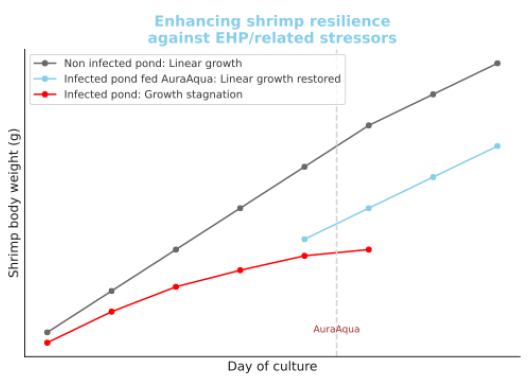
In a field trial in India, the blend was effective against EHP by attacking the parasite’s infection process and bolstering host cell defences. Inclusion of the product during an ongoing EHP infection restored linear growth performance (Figure 2). The effect was a significant reduction in EHP copy numbers.
John concluded that undoubtedly, functional nutrition is a critical pillar of health management. However, further research is needed to define nutritional thresholds and identify novel functional ingredients. Clear documentation of performance, cost and ROI is essential to drive adoption by producers. “Often, functional ingredients seem to be expensive. I think what we should focus on is value and cost per kg shrimp produced as opposed to cost per kg of feed or of the functional additive itself. The application strategy is also crucial, necessitating close collaboration between feed manufacturers and farmers.”
Reference
Williamson, J., 2025. Natural antimicrobials in shrimp aquaculture: Broad-Spectrum protection against WSSV, EHP and TPD. September/October 2025, pp 32-34. https://issues.aquaasiapac.com/view/879690187/34/
The rising concern of TPD regionally
A panel led Dr Kallaya Sritunyalucksana-Dangtip, BIOTEC/NSTDA, Thailand, with invited industry players noted that while some countries reported no official detection, anecdotal evidence from farmers suggested otherwise. Private laboratory testing in Vietnam confirmed TPD cases. Malaysia has already implemented stricter biosecurity measures, requiring imported broodstock to be certified free of TPD. Thailand has formed a task force for regular surveillance. Panellists stressed that cross-border movement of post larvae and broodstock presents significant risk making coordinated enforcement essential.
Members also cautioned against the misinformation on how to prevent or manage TPD. Practices such as indiscriminate antibiotic baths for post larvae may risk long term consequences, including antimicrobial resistance. The importance of infrastructure and regulation was highlighted. Proper farm design, water treatment systems and reservoir capacity can reduce disease pressure. Meanwhile, stricter oversight of cross-border livestock transfers is essential to prevent pathogen spread.
The promise and skepticism of functional feeds
One of the central themes of the discussion was functional nutrition. In Thailand, with increasing pressure to reduce antibiotic use and move toward antibiotic-free production, functional ingredients could serve as alternatives. Yet, cost remains a barrier. Without clear field data demonstrating consistent performance improvements and links to profitability, feed mills and farmers remain hesitant to fully embrace functional formulations.
John provided a useful benchmark with salmon farming, where functional nutrition is widely adopted during stress periods, such as seawater transfer and has been linked to measurable performance gains. The shrimp sector may learn from this model. In Ecuador, farmers use functional feeds throughout the production cycle as part of a broader strategy to manage the disease. In Asia, premium functional feeds priced significantly higher than standard diets have struggled to gain widespread adoption. Lower cost formulations with select additives like organic acids or beta glucans are more acceptable, but farmers remain cautious due to their high expectations.



