
Although Asian pangasius production in 2023 surpassed 3 million tonnes, the absence of comprehensive data regarding essential nutrient requirements is likely impeding improvements in farm efficiency and profitability

The 2023 farm production of several Pangasius catfish species (Pangasius hypophthalmus – ‘tra’, Pangasius bocourti – ‘basa’, Pangasius djambal, Pangasius pangasius, Pangasius gigas) across Southeast and South Asia was estimated by the Food and Agriculture Organisation (FAO) at 3.41 million tonnes, valued at nearly USD4.46 billion. The two largest producers, Vietnam produced 51% at 1.75 million tonnes, and Indonesia 10% at 0.35 million tonnes (FAO Fishstat J. 2025 dataset).
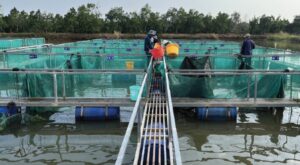
In most countries, pangasius are preferably farmed in ponds rather than in cages and pens, requiring different feeding practices. Feeding management and reducing waste feed are often easier in cages than in large ponds, usually, but not always, reflected in lower feed conversion ratios (FCR) and better water quality.
A live fish yield, of course, requires an even greater quantity of feed. Total feed used is dependent on type and intensity of farming, feeding practices and FCRs across the region. Increasingly, due to convenience and improved survival rates, nearly all farmers in Vietnam are using commercially made feeds.
Feed cost is challenged by reduced FCR
While the use of fresh farm-made feeds is declining in Vietnam, in India and Bangladesh, many small-scale farmers use a combination of both types of feed to keep production costs down to a manageable level (Alam, 2011; Mugaonkar et al., 2019). Farm-made feeds are often cheaper for the farmer, but with poorly balanced nutrients and poor water stability, they give FCRs often double that of commercial feeds. Additionally, there is a high chance of feed wastage resulting in deteriorating water quality.
Some recent estimates of FCR for pangasius farming using commercial feeds include:
• Bangladesh: 1.96 – 1.97 (Sarkar et al., 2005; Ali et al., 2013)
• India: In outdoor recirculating aquaculture system (RAS), 1.35 – 1.74 (Rehman, 2023), in cages – 1.63 and ponds – 1.47 (Kumar et al., 2017)
• Indonesia: 1.68 (WWF, Indonesia, 2015)
• Vietnam: 1.57 – 1.69 (Phan et al., 2009; Nhu, 2015; Nguyen and Jolly, 2020; Hai and Ton, 2023).
In a paper that relates to pond aquaculture, Stone et al. (2024) discussed factors affecting FCRs in the US catfish production ponds. These were environmental factors (temperature, salinity), genetics, chemical water quality (dissolved nitrogen), aeration and oxygenation, stocking density, fish age and size, feed quality, feeding strategy, skill of hand-feeders and survival to harvest (reduced by disease, predation).
Since feed cost is responsible for 60 – 85% of total production cost in pangasius farms across the region (Bosma et al., 2009; Griffiths et al., 2010; Nhu, 2015; Seshagiri et al., 2021; Sonvanee et al., 2021), the ability of a farm to consistently obtain a favourable reduced FCR is the single biggest factor ensuring profitability. From the feed perspective, Stone et al. (2024) stated: “It is generally accepted that if the feed is nutritionally balanced, meets all nutrient and energy requirements, and supports optimum fish growth, it will result in a favourable FCR.” Going forward, we will focus on the state of knowledge about the nutrition of Pangasius species to date.
Requirements for crude protein
In reality, fish do not have a protein “requirement”; they have a requirement for the digestible amino acids the protein provides. Any undamaged protein, coming from any plant or animal source, that can provide digestible amino acids can be used in feed to supply dietary amino acids.
Formulating a feed with an established protein ‘requirement’ for a species is a convenient way of approximating the quantity of protein from ingredients needed to provide the essential amino acids that the animal needs. Thus, a dietary protein requirement expressed as % protein in the diet without considering protein digestibility or protein quality has limited usefulness in predicting feed performance.
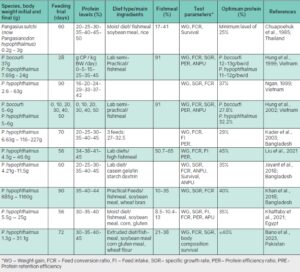
The earliest report on the protein requirement of Pangasius suchi fry was by Chuapoehuk et al. (1985); other authors in Vietnam, India and Bangladesh had analysed farm data in their countries, and estimated protein requirements. These studies are summarised in Table 1. It is worth noting that all of the studies except one used juvenile fish grown in aquariums or tanks, with a single study using cages in ponds. Typically, juveniles have a higher daily protein intake requirement on a body weight basis than larger fish.
Specific requirements for amino acids
Currently, there are no reliable published reports using purified research diets on the specific requirements for essential amino acids for the pangasius fish. Deficient intake of any of the key essential amino acids, lysine (LYS) and methionine (MET) in particular (which are the first limiting amino acids for fish in plant ingredients), has a profound effect on feed performance and growth. Therefore, knowing specific requirements is essential to allow fine tuning of amino acid content, leading to improved feed performance and lower FCRs.
In this absence, the best solution is to measure whole body amino acids of the pangasius fish (Men et al., 2005; Danuwat et al., 2016; Aristasari et al., 2020) and then use the Ideal Protein Concept to estimate an approximate amino acid profile for feed formulation.
Additionally, there are a few reports of experimental feeding of amino acids to pangasius.
Yuangsoi et al. (2016) prepared a series of experimental diets (34% CP) using base ingredients very similar to commercial feeds in Vietnam, with 4.76% fishmeal, 48 soybean meal, 23.65% corn meal and 4.59 to 5% rice bran, with 8% added fish and soya oil. Lower cost pangasius feeds would likely use a higher content of full-fat rice bran to reduce oil addition. The researchers then added DL-MET at 0, 0.1, 0.2, 0.3 and 0.4%. Juvenile P. bocourti (162g) were raised on these diets for 60 days. Growth performance was measured by % weight gain, FCR, SGR (specific growth rate) and PER (protein efficiency ratio). They concluded that MET at 0.63g/100g dry diet was best for maximum growth and feed utilisation.
In a recent paper, Liqat et al. (2024) fed P. hypophthalmus one of six fishmeal-free diets (main ingredients: 40% soybean meal, 29% corn meal, 12% rice polish, 7% wheat bran and 6% canola meal). Diets were supplemented with amino acids LYS, threonine (TRP), and MET at 1.56%, 0.37% and 0.16% respectively, and then together with TRP in several combinations. Their intention was to assess amino acid levels with growth, immune response and disease resistance of P. hypophthalmus. Fish (17.9g) were fed pelleted diets for 8 weeks, then challenged with Staphylococcus aureus and assessed for 15 days. In addition to assessing feed performance (SGR, FCR, HSI, survival), blood and muscle tissues were collected for additional testing, digestive enzymes were assayed and several tissues were histologically examined. The most favourable outcome was obtained with the basal diet supplemented with 5g/kg each of LYS, MET and TRP on top of the basal levels.
In the latest paper of Liqat et al. (2025), P. bocourti fingerlings (10g) were fed essentially the same diets as above for 10 weeks, then challenged with Streptococcus iniae and assessed for 14 days. In this experiment, their intention was to assess amino acid levels with growth, immune response and disease resistance. After the challenge, fish were assessed for growth and IGF-1, haematological profile, antioxidant enzyme status and immune response factors IGF-1 and IL-6. Here, the most favourable outcome was obtained with the basal diet supplemented with 6g/kg each of LYS, MET and TRP.
Dietary lipid and fatty acid requirements
There are no published studies on specific fatty acid requirements for the pangasius, but there are studies investigating the appropriate level of lipids to incorporate into feeds. Sivaramakrishnan et al. (2016) fed P. hypophthalmus juveniles (13.5-14g) a series of purified casein-gelatin 35% protein diets with oil (1:1 sunflower: fish oil) added at 3, 6, 9, 12 and 15%. They concluded that 10% added lipid was optimal for maximum growth of the fish.
Kabir et al. (2019) fed 3-year-old female P. hypophthalmus broodfish (3.3kg) one of three 30% CP diets with 6, 9 and
12% lipids coming from fish oil and palm oil. They were interested in the impact of these diets on spawning and
fecundity of the fish. A feed lipid content of 9% or higher gave a significantly better reproductive performance (ovary weight, fecundity, egg weight and fertilisation) than 6% lipid.
Related to feed lipid levels, several authors had assessed the best protein to energy balance for pangasius. This is an important factor in determining the amount of visceral fat deposited in farmed fish. Phumee et al. (2009) fed P. hypophthalmus fry (3.5-3.8g) 25, 30, 35 or 40% protein (Danish fishmeal) diets having either 6% or 12% lipids (fish oil, corn oil), and found that a 40% protein diet with 12% lipid gave the best results (SGR, FCR), but performance of a 30% protein diet with 12% lipid was not significantly different, suggesting that the lipid has a protein sparing effect. Similarly, Epasinghe et al. (2015) fed 1.1g Pangasius sutchi fry with diets (main ingredients: fishmeal, soybean meal and wheat flour) containing 25, 30 and 35% protein, with fat levels at 6% and 10%, and reported the best result with 35% protein and 10% lipid.
Recently, Prakash et al. (2025) fed P. hypophthalmus juveniles (168g) nine extruded practical diets (main ingredients: de-oiled rice bran, soybean meal, groundnut oil cake, mustard oil cake, wheat flour, fishmeal) with three protein levels (28, 30, 32%) and three lipid levels (4, 6, 8%), and reported that the best performance (weight gain, SGR, FCR, PER) was obtained with the 28% CP and 4% lipid diet which is somewhat puzzling. There is little to explain why the results are seemingly the opposite of the previous studies. Feed intake data were not provided, but practical experience suggests that there may have been a problem with their groundnut oil cake (perhaps due to palatability or mycotoxins), the only ingredient that increased substantially as protein levels increased.
Vitamin requirements
To date there is only one published study on the requirements for vitamins. Daniel et al. (2016) investigated the dietary ascorbic acid (vitamin C) requirement of P. hypophthalmus fry (3.2 – 3.4g) using purified caseingelatin- dextrin diets with dietary ascorbic acid levels 17.5, 35, 70, 175, 350 and 700mg vitamin C/kg diet (from L-ascorbyl-2 polyphosphate).
Analysis showed actual levels were 14.5, 32.5, 68.9, 163.5, 341.2 and 682.8mg/kg diet, respectively. The best growth, FCR, SGR, PER and survival was obtained at the 35mg/kg level. Ascorbic acid saturation level in the liver was obtained at about 76mg/kg diet.
In a later work Daniel et al. (2018, 2021) looked at the impact of dietary ascorbic acid on P. hypophthalmus haematology, immune and stress responses before and after challenge with Aeromonas hydrophila. In this instance, the authors concluded that supplementing ascorbic acid at 350 – 700mg/kg diet gave the highest immunostimulatory effect.
Mineral requirements
As with vitamins, there are few published requirements for any of the macro- or micro-mineral requirements. Several studies on the pangasius have been conducted with zinc (Jintasataporn et al., 2014; Kumar et al., 2017; Singh et al., 2017; Kaliky et al., 2019), and there is a single study with selenium (Thangarani et al., 2024). Singh et al. (2017) fed purified diets (casein, gelatin, dextrin, starch) containing 23, 26, 29, 32 and 35mg/kg Zn (ZnSO4) to P. hypophthalmus fingerlings (11.5g), and after measuring weight gain, SGR, FCR and PER, concluded that 32mg/kg was sufficient for maximum growth and nutrient utilisation. In an earlier report, Jintasataporn et al. (2014) fed practical diets, where the main ingredients were 32% soybean meal, 25% wheat flour, 10% rice bran, 10% soy protein concentrate (SPC), 5% fishmeal and 5% rapeseed meal to 209g P. hypophthalmus with added inorganic zinc sulphate and/or zinc amino acid complex (ZAAC) providing 0, 50, 100, 150, 200mg Zn/kg diet. Here, the authors concluded 50mg ZAAC as the sole source, or a mixture of 70% Zn sulphate/30% ZAAC gave the best growth performance.
Take home message
Considering that the Asian annual production of the pangasius is now in excess of 3 million tonnes, a near complete lack of data requirements foe essential nutrients is most likely holding farm efficiency back and profitability down. Detailed nutritional information is absolutely essential to develop feeds with the highest performance (precision nutrition), superior fish quality, and optimised health and survival.
Furthermore, considering that the largest quantity of feed is eaten by pre-harvest fish, the lack of studies using large fish prevents the optimisition of feeding management, FCR and maximising profitability where it counts most.
I believe that if the nutrient requirement knowledge gap is to be addressed, Asian product will have to step up, since there is no incentive for others to do it. The most sensible approach is to create a research environment managed by Asia researchers in international and national public institution and private enterprise, similar to the European aquaculture nutrition research model. Such an effort could be funded by Asian government themselves, as well as the pangasius industry (farmers, processors) checkoff funding based on tonnes of fish produced.


