
Somsak Hirunratanakorn and son, Arnan, use extensive pond data to guide tilapia production at their farm in Chachoengsao province, changing harvest sizes to consumer demand.
This Thai tilapia farming story spans 30 years, tracing the shift from traditional practices to semi-intensive and modern biosecure production, while moving into its third generation. Arnan Farm, located in Phanom Sarakham district, Chachoengsao province, is recognised as a model farm and serves as a Department of Fisheries learning centre for tilapia farming. The farm produces 300 tonnes of tilapia annually, with productivity of one tonne per rai of pond area; one rai equals 1,600m2.
Khun Somsak’s success was built through trial and error. Over the years, he has diligently recorded farm data
and used it to understand problems and events while continually refining farming practices. At a meeting in Cebu, Philippines, for next-generation shrimp and tilapia farmers, Arnan described the extensive data collected over 30 years and explained how he is now digitising it to develop predictive analysis (see page 48).
Moving to large fish
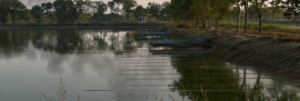
Established in 1991, Arnan Farm has a land area of 50 ha, with ponds of 10-50 rai in size, stocked with tilapia and white shrimp. Ponds are divided by function: one large reservoir pond for water treatment, four 4 rai nursery ponds and eight grow-out ponds. This is a long way from the early days, when Khun Somsak’s father first began farming tilapia. It started as a backyard activity at a chicken farm in Bangkok, where waste from the poultry farm fertilised green-water ponds for the fish.
In the beginning, when the business was small, the farm operated on an all-in, all-out system, harvesting fish at 300g.
“Back then, I was producing good-quality fish with a consistent supply, so I could tell the middleman my price. Nowadays, it is the reverse. The middleman sets the price based on size. Gradually, I migrated to producing larger fish, harvesting 600-700g, then 800g and subsequently 1kg. We stood out as we could produce these sizes, but today the market is saturated, as mostfarmers can easily produce 1 kg fish,”
said Khun Somsak.
From monosex tilapia to off-flavour control
The farm is recognised as the first in the province to farm monosex tilapia. About 30 years ago, the farm began using male monosex fry from Nam Sai soon after owner Warren Turner started production. Khun Somsak observed improved growth performance and has remained a loyal Nam Sai customer ever since.
He is also known for producing tilapia without off-flavour or muddy taste, making his fish highly sought after. Arnan recalled a recent visit when he, representing the farm’s third generation, and Jessica, Nam Sai’s second generation, reviewed off-flavour in a harvest. The farm had been testing brackish-water culture as a way to prevent off-flavour, and the results were encouraging.
Father and son attribute these qualities to three practices: using 25% crude protein (CP) pelleted feed without relying on natural food, maintaining water quality and avoiding intensive farming. Ponds are cleaned for two weeks after each crop.
“Our emphasis is on minimising the impact of overfeeding on water quality. We monitor feed consumption and reduce uneaten feed. Part of our SOP is the regular use of probiotics to manage soil condition.”
A few years ago, as part of his effort to eliminate offflavour, Khun Somsak raised tilapia in 8-20ppt saline water and then reducing water salinity to zero. The approach worked—the fish had no off-flavour—but growth was slow, taking one year to reach 600g. By comparison, pellet-fed fish in freshwater ponds reached 600g in five months. For the farm, shortening the farming cycle is essential to meet market demand.
Caution with pre-stocking tests
The farm stocks each 4-rai nursery pond with 100,000 fry of 0.2g, (25,000 fry/rai). The nursery phase lasts two months but may be extended if the grow-out ponds are not ready. Juveniles, usually weighing 20–30g, are then transferred to grow-out ponds, where stocking density is typically 1,000–1,200 fish/rai. Arnan explained,
“If nursery-stage mortality is high, we reduce grow-out density to 800–900 fish/rai. We may also keep fish longer in the nursery and transfer larger juveniles of about 35g.”
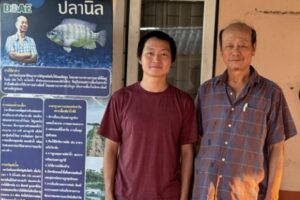
son, Arnan is recognised as a model farm and serves as a
Department of Fisheries learning centre for tilapia farming
The farm produces fish weighing 700g to 1.4kg, with an average size of 1kg. Each crop takes eight months, allowing 1.5 cycles per year. “If the market is unfavourable, we delay harvesting. Under current economic conditions, some fish have remained in the ponds for nine months,” said Arnan, adding that consumers are shifting towards barbeques with pork and eating less fish.
As part of the farm’s SOP, 1,000 fish are first stocked in a small cage in a nursery pond and monitored for five to seven days. The same procedure is used in growout ponds, where 1,000 fish are held in a larger cage. “This allows us to identify the cause of any mortality. High mortality in the nursery may indicate transportation stress, while high mortality in grow-out may point to pond water-quality problems. It is a better approach than releasing fry or juveniles directly into a large volume of water, where dead or moribund fish may not be seen, and the cause cannot be traced.”
Planning harvests, linking prices
Arnan linked tilapia prices to farming conditions, weather and demand. In March, low water levels force many farmers to harvest, pushing prices down. April is typically a recovery month, while disease outbreaks and flooding in early May further weaken prices. After a period of low prices, the market rebounds; by late May, prices rise and usually stay high through year-end. He added that festivals have little influence on prices.
“Although Streptococcus outbreaks affect all farms, their impact is less severe at our farm. Our response is to remove affected fish, reduce feeding and change the water quickly. Our large reservoir pond gives us an advantage.”
In Thailand, tilapia prices are linked to size: the price/ kg falls as fish size increases, with fish above 1.4kg receiving the lowest prices. In March 2026, prices opened at THB45/kg for mid-sized fish, THB30/kg for larger fish, and THB25/kg for jumbo fish.
“Today, a 1.4kg fish fetches the same price as a 600g fish,” Arnan said. “Customers still prefer whole fish, but we need to shift their focus to fillets. That would support farming larger fish of about 1.5kg. However, we still have a long way to go.”
Long-term pond records
Over 30 years, Khun Somsak has collected extensive farm and pond data, storing the records both digitally and in hard copy. His weather records show May as the hottest month, with morning water temperatures around 23°C and afternoon temperatures reaching 29°C. Oxygen levels were measured twice daily throughout each cycle. They were generally higher in the evening than in the morning, and higher early in the cycle when fish were smaller, before declining as the fish grew. This pattern is linked to increased phytoplankton levels associated with feeding practices.
Turning records into practical learning
Khun Somsak shares data trends with workers so they can better understand pond conditions, see the bigger picture and recognise the value of careful data collection.
“We want the workers to understand and stay motivated. Although the cost of collecting oxygen and pH data is high, being able to create graphs makes the expense worthwhile.”

Using feed data to guide decisions
Feed is the farm’s largest production input, accounting for 70% of total costs. The farm uses grow-out feed from a single supplier. Over the past two years, feed prices have risen following the Ukraine war and have remained high. Khun Somsak has analysed the average daily growth (ADG) of three grades of feed by the same feed mill; premium feed at 7g/day; medium-grade feed at 6g/ day and standard feed at 5–6g/day. His feed selection varies according to farming conditions and market demand.


