
This year, TARS focussed on the aquafeed industry, with the State of Industry (SOI) serving as the annual conference’s flagship session. Moderator Ronnie Tan of the U.S. Grains & BioProducts Council opened by outlining the challenge: “Prices for raw materials— including fishmeal, corn co-products, soybean meal and wheat flour—have soared. Feed millers need to raise prices, yet farmers are receiving low farmgate prices for fish and shrimp. So how can the aquafeed industry manage? It is not alone; it depends on the whole value chain. The program chair has scripted this session to cover this problem from 4 vantage points.”

The session opened with Caleb Floss of the U.S. Grains & BioProducts Council presenting the current situation and outlook for major grains—corn, soybean meal and wheat. Brett Glencross of IFFO, UK, then assessed the fishmeal market and considered whether fishmeal remains a strategic ingredient.
“Next, Piet Verstraete of 4SEA Investment & Technology Ltd, Thailand, will discuss how the industry can build resilience. Finally, as Indonesi is our host country, Haris Muhtadi of De Heus Indonesia will provide a local perspective.”
said Tan
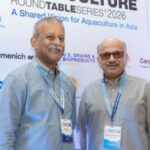
At the panel session, S Santhana Krishnan, Marine Technologies, India, the invited industry player explained the pain points in India.
“Shrimp farming industry is facing a growing cost squeeze, with feed now accounting for up to 75% of shrimp production costs in India. “Rising ingredient prices, limited fishmeal availability, disease outbreaks and climate driven changes in water temperatures are compounding the pressure. Indian feed millers are also constrained by limited access to alternative ingredients, while locally produced fishmeal is increasingly exported, creating shortages in the domestic market.”
On whether feed companies can increase the price of feed to the farmers, Santhana commented,
“They are finding it very difficult because whenever there is a logical price increase, the government intervenes, then prices are reduced. For farmers, feed conversion ratios (FCRs) are moving up to 1.6, so there has to be an efficiency improvement in terms of feeding also.”
In general, the panel agreed that better feed management, improved FCR, and stronger nutritional strategies for disease resilience and climate adaptation will be essential. For formulators, the panel recommended using more alternative proteins, improving coordination among purchasing, formulation and quality teams, and testing ingredients more proactively. Fishmeal inclusion can be reduced further, provided digestible nutrients and palatability are maintained, while hydrolysates and other palatability enhancers offer additional tools.
In Bangladesh, however, greater use of plant-based ingredients raises mycotoxin concerns, particularly in distillers dried grains with solubles (DDGS) and poorly stored soybean meal, underscoring the need for better post-harvest management. The panel also noted that rapidly processed marine by-products can remain highly palatable, while concerns about Indonesia’s feed market partly reflect inflated estimates of shrimp production and feed demand.

September/October 2026 AQUA Culture Asia Pacific


