
Grain and feed ingredient prices can seem unpredictable. However, there is rarely a single reason behind a price change. Supply, demand, weather, freight, energy prices, government policies and geopolitics can all influence what a feed mill ultimately pays.
For aquaculture producers, these changes matter because corn, soybean meal (SBM) and distillers dried grains with solubles (DDGS) are important feed ingredients, and changes in their prices can eventually affect production costs.
Caleb Floss, Deputy Regional Director of the Southeast Asia and Oceania Office of the U.S. Grains and Bio Products Council, outlined some of the forces currently shaping grain markets.
A formula for futures on grain prices
A simple way to understand grain prices is through supply and demand, but seasonal changes and wildcard events (weather, geopolitics, macroeconomic, sociodemographic, etc.) can disrupt the market. These factors are interconnected, making markets extremely difficult to predict. As Floss noted, anyone claiming to know exactly where prices are going should be treated cautiously.
For Asian buyers, the price of the commodity itself is only part of the equation. Freight and logistics costs can significantly affect the final price paid by a feed mill. Floss added that a disruption to major shipping routes can therefore make an ingredient more expensive even when its underlying international price has changed little.
More food does not always mean lower prices
Global food production has expanded significantly, with coarse grain production roughly doubling over the past 30 years, but this does not automatically mean lower prices. Grain may be plentiful in one region while demand is high elsewhere. The challenge is getting that supply to where it is needed at an acceptable cost.
“However, modelling just corn and SBM prices can’t perfectly predict DDGS prices,” – Caleb Floss
Corn: Stronger demand is tightening the market
The latest U.S. outlook indicated that global export demand is reducing the amount of corn remaining in the U.S., while weather concerns, including a hotter than normal July, have raised questions about yields. Since the U.S. is a major supplier to global feed markets, developments there matter to Asian feed manufacturers.
Soybeans: Fuel demand is changing the equation
Soybeans are used for food and feed, but they are also processed to produce soyoil for renewable fuels. When more soybeans are crushed for oil, more SBM is produced as a by-product. In the U.S., the required volume for diesel related renewable fuel increased from 3.35 billion gallons in 2025 to 5.42 billion gallons in 2026, an increase of more than 60%. This has been an important driver of soybean demand.
“Soybean meal is major protein ingredient in aquaculture feeds, so renewable fuel policies can indirectly affect its supply,”
said Floss.
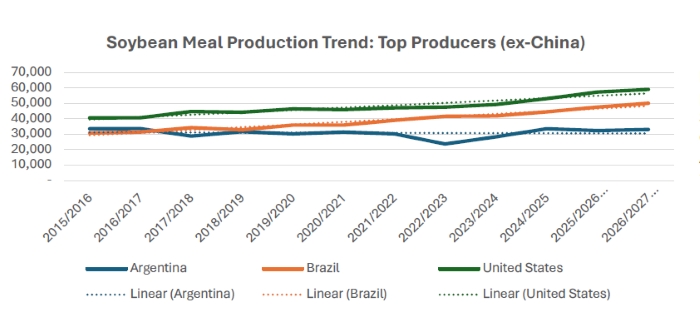
Around 7 million tonnes of additional global soybean meal production are primarily from Brazil (Figure 1)

Wheat and geopolotics
Wheat demonstrate how several factors can be affect a market simultaneously. The Russia-Ukraine was has disrupted international wheat trade, while hot and dry conditions in Europe have raised concerns about its yield.
DDGS could become increasingly important
DDGS is another ingredient to watch. U.S ethanol and DDGS production have been relatively stable for abut a decade. However, policies encouraging low carbon fuels could increase ethanol production and therefor DDG, which is a co-product of ethanol manufacturing.
About 70% of U.S DDGS is consumed domestically and 30% exported, making the U.S domestic market an important influence on international availability.
“However, modelling just corn and SBM prices can’t perfectly predicts DDGS prices.”
added floss
Brazil could also become a larger DDGS source, The country is increasingly using corn rather than sugarcane as
an ethanol feedstock. Continued expansion could provide Asian feed buyers with another source of DDGS and reduce dependence on a single origin.
Geopolitics can become a feed cost issue
Events far from an aquaculture farm can eventually affect feed prices. The conflict involving Iran and disruption around the Strait of Hormuz have affected oils markets and marine bunker fuel. Higher shipping fuel costs can increase freight rates, raising the cost of transporting corn, SBM, DDGD and other ingredients into Asian markets.
What does this mean for aquacultue?
The key takeaway from Floss’ presentation is that feed ingredient prices are influenced by much more than the size of a harvest. Geopolitical conflicts can lead to higher oil prices, higher shipping costs and ultimately higher feed costs. Renewable fuel policies can increase ethanol production, creating more DDGS. Higher demand for soybean oil can increase soybean crushing and potentially increase SBM availability.


